

On This Day in Science: May 20, 1990
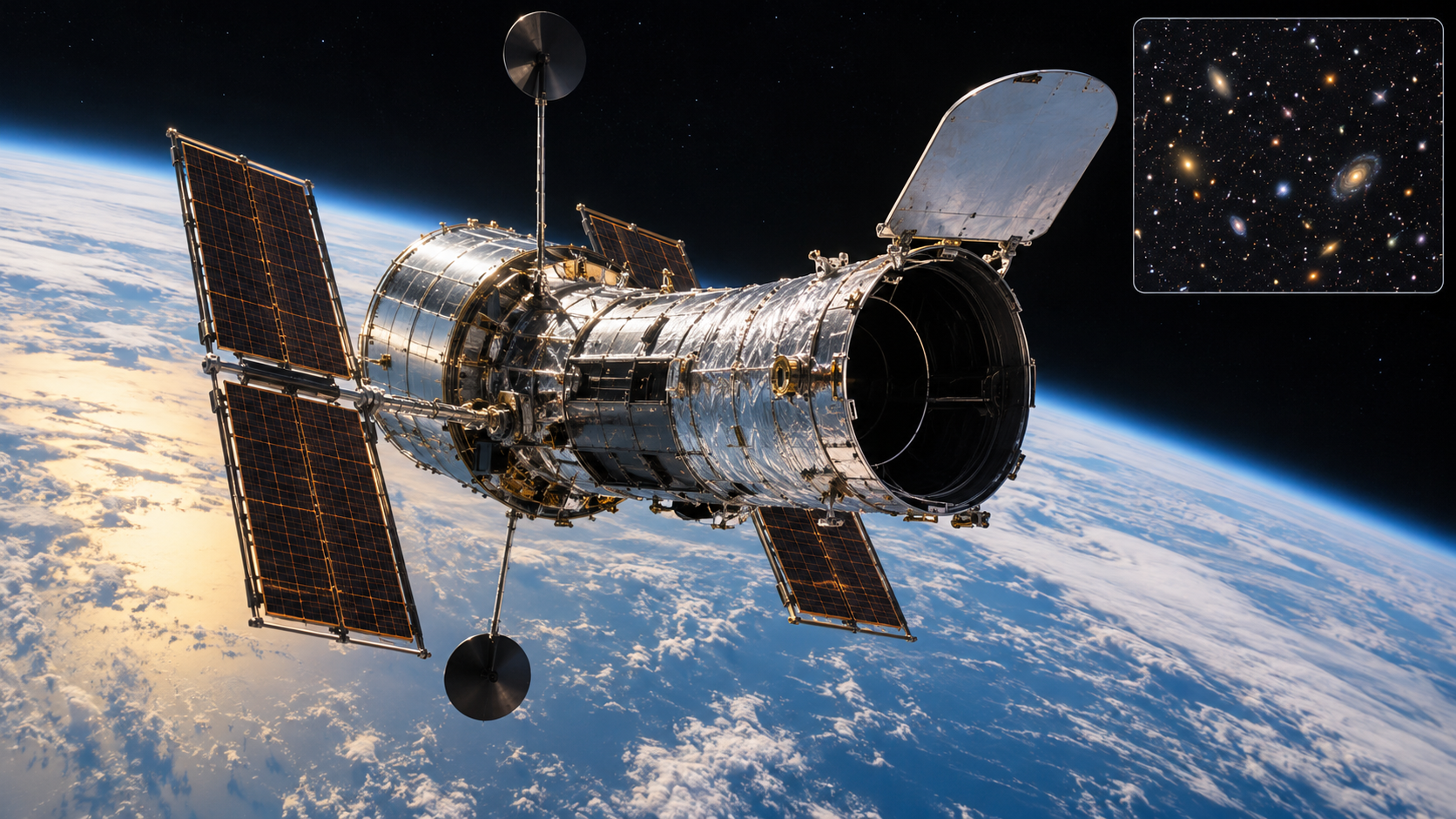
On May 20, 1990, the newly deployed Hubble Space Telescope recorded its first image, an event astronomers call first light. Engineers pointed the observatory toward a star field and used the Wide Field/Planetary Camera to verify that light traveled through the telescope, reached the detector, and produced recognizable data. A comparison with a ground-based image showed the promise of observing above atmospheric turbulence.
First light is a systems test rather than a finished scientific result. Hubble’s mirrors, pointing controls, electronics, camera, data handling, communications, and ground processing all had to work together. Teams used early observations to focus instruments, calibrate detectors, map geometric distortions, and refine procedures before the observatory entered routine research.
The commissioning period soon revealed that Hubble’s primary mirror had been polished to the wrong shape by a tiny amount. The spherical aberration blurred images, although computers could recover some information and several instruments remained useful. Astronauts installed corrective optics and a compensated camera during the first servicing mission in 1993.
The first image therefore belongs to both Hubble’s achievement and its early engineering crisis. It marked the start of an observatory whose long scientific life would depend on calibration, diagnosis, repair, and successive generations of instruments. Its calendar date is an entry point, not an endpoint. The people involved worked with the instruments, assumptions, and social conditions of their time, and later research has both extended and corrected their conclusions. Separating what was known that day from what became clear afterward protects the history from myth and shows how cumulative evidence turns an episode into lasting scientific knowledge. For science history, the event also shows how evidence moves from an observation or engineered test into a durable body of knowledge. Instruments supplied measurements, specialists debated interpretation, and later work refined what the first result could mean. Archives preserve the early record while new methods let researchers ask different questions of it. That continuing revision is the process through which a dated milestone remains scientifically useful. Seen across a longer timeline, scientific milestones are junctions rather than isolated beginnings. Earlier experiments, tools, and institutions made the work possible, while later teams tested limits and carried the result into new settings. What survives is a traceable chain of evidence, correction, and application that allows one moment to remain relevant as knowledge and technology continue to change. The anniversary highlights the difference between a first result and a finished understanding. A successful observation can settle one question while opening several harder ones, and even a failed objective can reshape later designs. Preserved data, specimens, photographs, and hardware allow new generations to revisit the work with better tools. Science advances through that continuity rather than stopping on a memorable date.
The first image verified the optical path, camera, pointing system, and data return.
It was a commissioning milestone rather than a polished showcase observation.
Later tests showed that the primary mirror introduced spherical aberration.
Image processing helped, but full performance required corrective hardware.
Astronaut servicing corrected the optics and replaced instruments over time.
Hubble's longevity came from maintenance as much as from its original launch.
Explore more of "On This Day ..."
Discover more events from the same date across news, politics, technology, sports, and other fields. Each link highlights significant moments that shaped history on different fronts.