

On This Day in Science: May 19, 1910
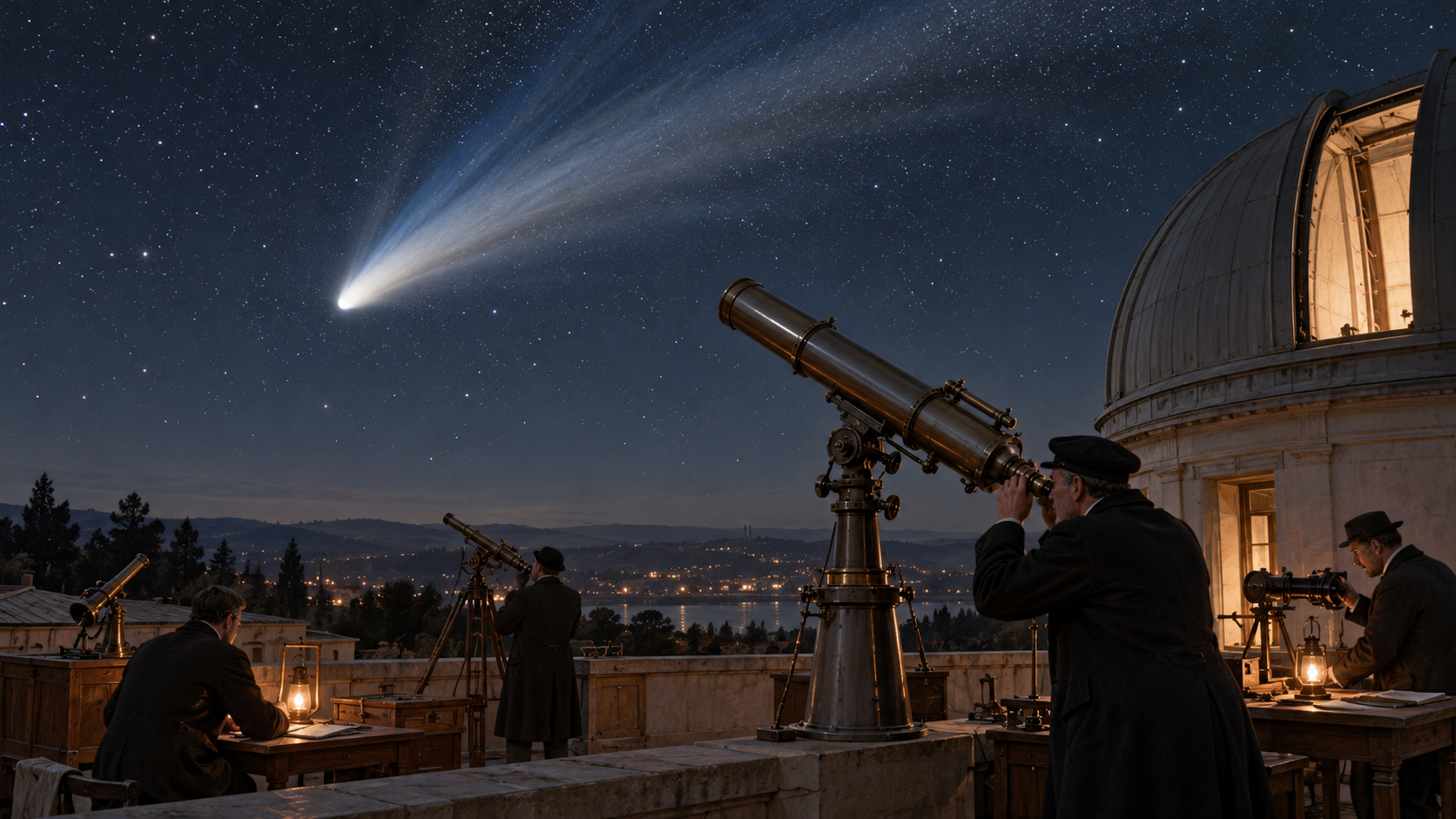
On May 19, 1910, Earth passed through the outer portion of Halley’s Comet’s tail as the comet crossed between Earth and the Sun. Astronomers had calculated the geometry in advance, making the passage a global test of prediction, observation, and public communication. Observatories searched for changes in sky brightness, atmospheric chemistry, electrical conditions, and the appearance of the comet.
Spectroscopy had detected cyanogen gas in cometary material, and newspapers amplified fears that a poisonous cloud might reach the ground. Comet tails, however, are extraordinarily diffuse. The amount of material encountered by Earth was far too small to threaten life, and the atmosphere provided additional protection. Vendors nevertheless sold supposed comet pills, masks, and bottled air.
Observers disagreed about the exact visual evidence for the tail crossing because weather, moonlight, the Milky Way, and rapid changes in the comet complicated interpretation. No harmful effect occurred and no dramatic physical boundary swept across the surface. The event instead illustrated how a precisely predicted astronomical alignment can be real while its local consequences remain subtle.
Halley’s return joined modern spectroscopy and orbital calculation with old cultural anxiety about comets. The date remains useful for examining how uncertainty becomes public risk and why trace detection does not automatically imply dangerous exposure. The anniversary highlights the difference between a first result and a finished understanding. A successful observation can settle one question while opening several harder ones, and even a failed objective can reshape later designs. Preserved data, specimens, photographs, and hardware allow new generations to revisit the work with better tools. Science advances through that continuity rather than stopping on a memorable date. Its calendar date is an entry point, not an endpoint. The people involved worked with the instruments, assumptions, and social conditions of their time, and later research has both extended and corrected their conclusions. Separating what was known that day from what became clear afterward protects the history from myth and shows how cumulative evidence turns an episode into lasting scientific knowledge. For science history, the event also shows how evidence moves from an observation or engineered test into a durable body of knowledge. Instruments supplied measurements, specialists debated interpretation, and later work refined what the first result could mean. Archives preserve the early record while new methods let researchers ask different questions of it. That continuing revision is the process through which a dated milestone remains scientifically useful. Seen across a longer timeline, scientific milestones are junctions rather than isolated beginnings. Earlier experiments, tools, and institutions made the work possible, while later teams tested limits and carried the result into new settings. What survives is a traceable chain of evidence, correction, and application that allows one moment to remain relevant as knowledge and technology continue to change.
Orbital calculations showed Earth moving through the region recently occupied by the comet's tail.
Observatories prepared measurements of light, atmosphere, and electrical conditions.
Spectra identified a toxic compound in cometary gas.
The tail's extremely low density meant the concentration near Earth posed no realistic threat.
Headlines and commercial remedies often outran the scientific evidence.
The harmless passage became an early lesson in communicating low-concentration risk.
Explore more of "On This Day ..."
Discover more events from the same date across news, politics, technology, sports, and other fields. Each link highlights significant moments that shaped history on different fronts.