

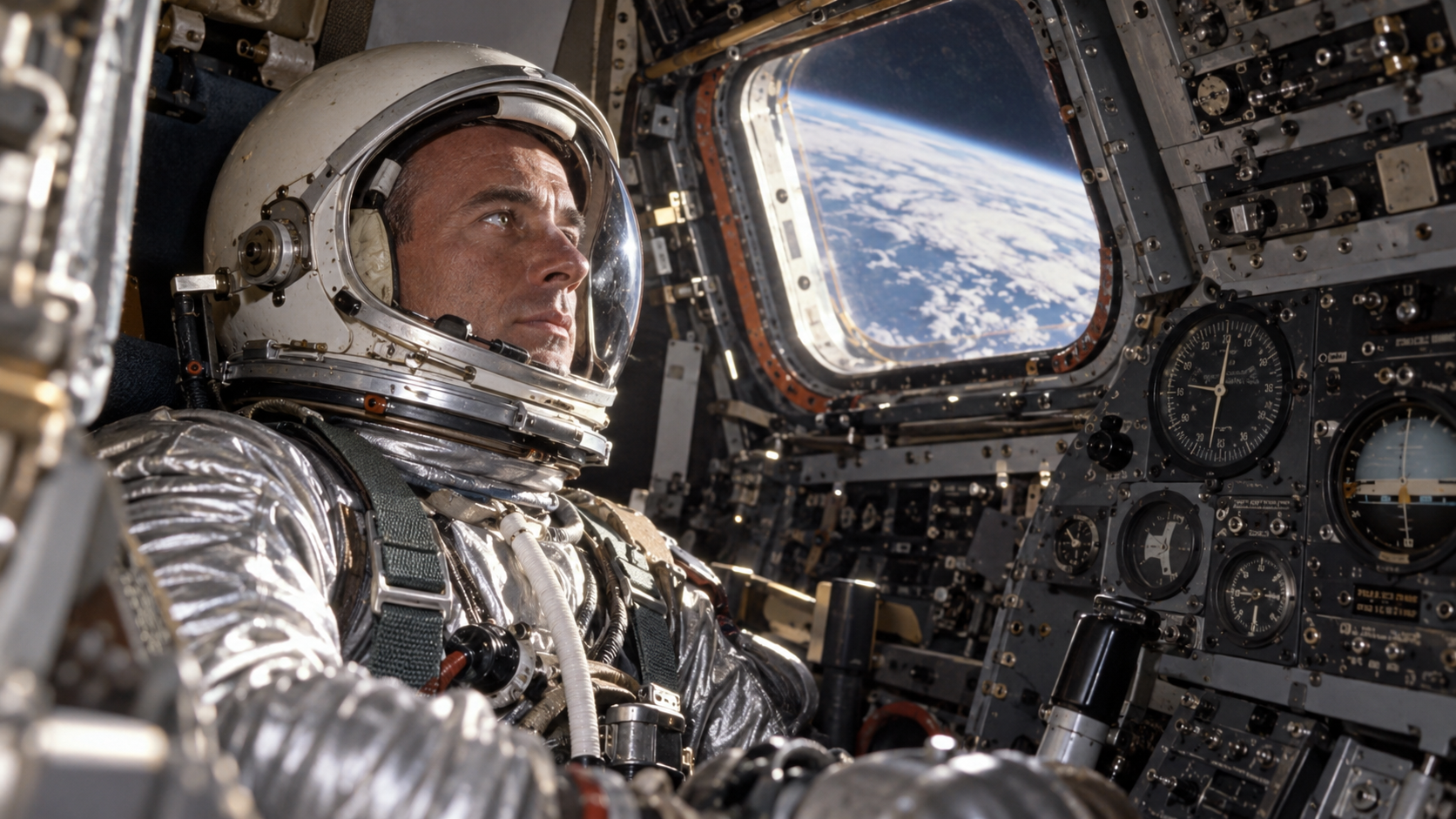
On This Day in Science: May 24, 1962
On May 24, 1962, NASA astronaut Scott Carpenter launched from Cape Canaveral aboard the Mercury capsule Aurora 7. He became the fourth American in space and the second to orbit Earth, completing three circuits in just under five hours. The mission emphasized scientific observation more strongly than the earlier Mercury flights while continuing tests of human performance and spacecraft control.
Carpenter photographed weather systems, observed the horizon and airglow, deployed a balloon experiment, and investigated the luminous particles that John Glenn had called fireflies. He also exercised manual and automatic attitude-control modes. A combination of equipment behavior, operational choices, and high fuel use left limited propellant for the final reentry sequence.
The capsule’s attitude and the timing of the retrorocket firing contributed to a landing far beyond the planned recovery area. Aurora 7 splashed down safely in the Atlantic, but aircraft needed time to locate Carpenter, who waited in a life raft before helicopter pickup. The mission prompted close review of cockpit displays, fuel management, procedures, and the balance between experiments and spacecraft operation.
Aurora 7 showed that orbital science and piloting tasks compete for attention inside a small vehicle. Its successes and overshoot both improved later Mercury planning by making workload, interface design, and navigation part of the engineering evidence. Its calendar date is an entry point, not an endpoint. The people involved worked with the instruments, assumptions, and social conditions of their time, and later research has both extended and corrected their conclusions. Separating what was known that day from what became clear afterward protects the history from myth and shows how cumulative evidence turns an episode into lasting scientific knowledge. For science history, the event also shows how evidence moves from an observation or engineered test into a durable body of knowledge. Instruments supplied measurements, specialists debated interpretation, and later work refined what the first result could mean. Archives preserve the early record while new methods let researchers ask different questions of it. That continuing revision is the process through which a dated milestone remains scientifically useful. Seen across a longer timeline, scientific milestones are junctions rather than isolated beginnings. Earlier experiments, tools, and institutions made the work possible, while later teams tested limits and carried the result into new settings. What survives is a traceable chain of evidence, correction, and application that allows one moment to remain relevant as knowledge and technology continue to change. The anniversary highlights the difference between a first result and a finished understanding. A successful observation can settle one question while opening several harder ones, and even a failed objective can reshape later designs. Preserved data, specimens, photographs, and hardware allow new generations to revisit the work with better tools. Science advances through that continuity rather than stopping on a memorable date.
Carpenter photographed Earth, studied the horizon, and investigated particles around the capsule.
The flight expanded Mercury's scientific agenda beyond basic survival.
Attitude-control activity consumed more propellant than planned.
Experiments and piloting tasks competed for the attention of one astronaut.
Reentry conditions carried Aurora 7 well beyond the intended recovery point.
The delayed pickup drove changes in procedures, displays, and mission planning.
Explore more of "On This Day ..."
Discover more events from the same date across news, politics, technology, sports, and other fields. Each link highlights significant moments that shaped history on different fronts.