

How Entropy Gives Time a Direction Explainer
Many basic equations of mechanics work almost as well if time is mathematically reversed, yet everyday events have a clear direction. Hot coffee cools, perfume spreads, and a shattered glass does not spontaneously reassemble. Thermodynamics connects that direction with entropy. For an isolated system, the second law says total entropy does not decrease in ordinary macroscopic processes, giving a practical arrow from a lower-entropy past toward a higher-entropy future.
Entropy can be understood statistically. A macrostate such as a gas evenly filling a room can be produced by vastly more microscopic arrangements of molecules than a macrostate with every molecule crowded into one corner. Random molecular motion can in principle create unusual fluctuations, but the number of evenly spread arrangements is so much larger that a large system almost always evolves toward them.
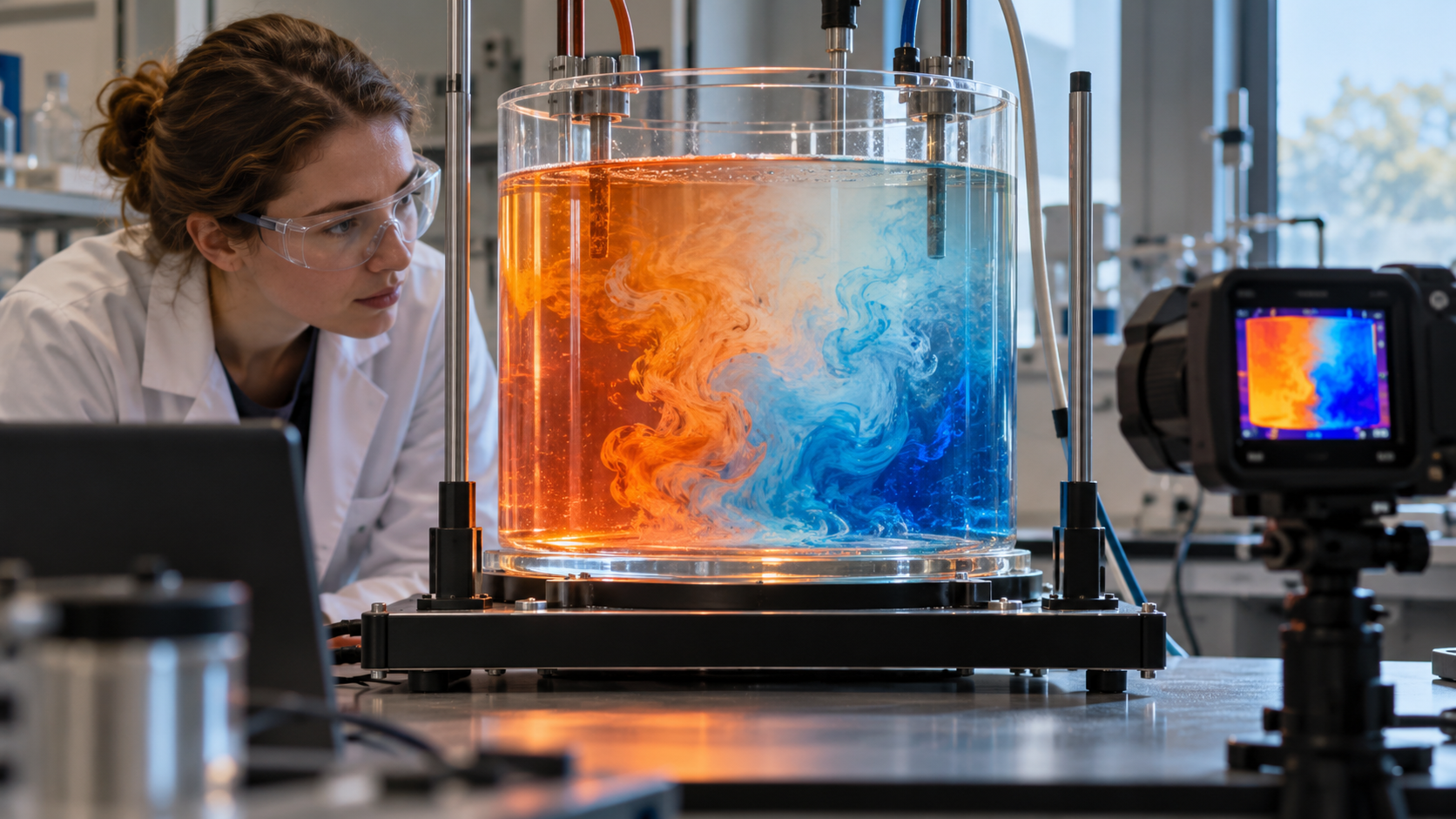
Energy dispersal provides another view. When a hot object touches a cold one, energy flows until their temperatures approach equilibrium. Energy is conserved, but the combined energy becomes distributed among more possible microscopic arrangements and is less available to produce directed work. The entropy increase describes this change in multiplicity and energy distribution; it does not mean that matter simply becomes visually messy.
Local entropy can decrease. A refrigerator cools its interior, a plant builds organized tissue, and a crystal forms from a liquid. Each process exports heat or other entropy to its surroundings. When the complete system is counted, including electricity generation, metabolism, or released heat, the total entropy does not fall. The second law concerns the full balance rather than the appearance of one selected region.
The law is statistical, not a claim that every molecule always moves toward disorder. Microscopic fluctuations occur, especially in tiny systems, and entropy can briefly decrease locally by chance. For everyday numbers of particles, however, a large reversal is fantastically improbable. Memories, fossils, photographs, and heat generated while records are created all belong to the same time direction in which entropy production leaves traces of the past.
Why the universe began in a very low-entropy state remains a deep question. Thermodynamics explains how a low-entropy condition evolves and why irreversible processes appear, but it does not by itself explain that initial condition. The arrow of time therefore emerges from both probabilistic physics and the special state from which cosmic history started.
Macroscopic changes usually proceed in the direction of increasing total entropy in an isolated system.
High-entropy macrostates correspond to vastly more microscopic arrangements than low-entropy ones.
Heat flow toward equilibrium disperses energy while conserving the total amount of energy.
Local organization is allowed when a process exports enough entropy to its surroundings.
Microscopic fluctuations can reverse briefly, but large everyday reversals are overwhelmingly improbable.
The thermodynamic arrow also depends on the universe having begun in an unusually low-entropy condition.
Explore more "Explainers"
Discover additional explainers across politics, science, business, technology, and other fields. Each explainer breaks down a complex idea into clear, everyday language—helping you better understand how major concepts, systems, and debates shape the world around us.