

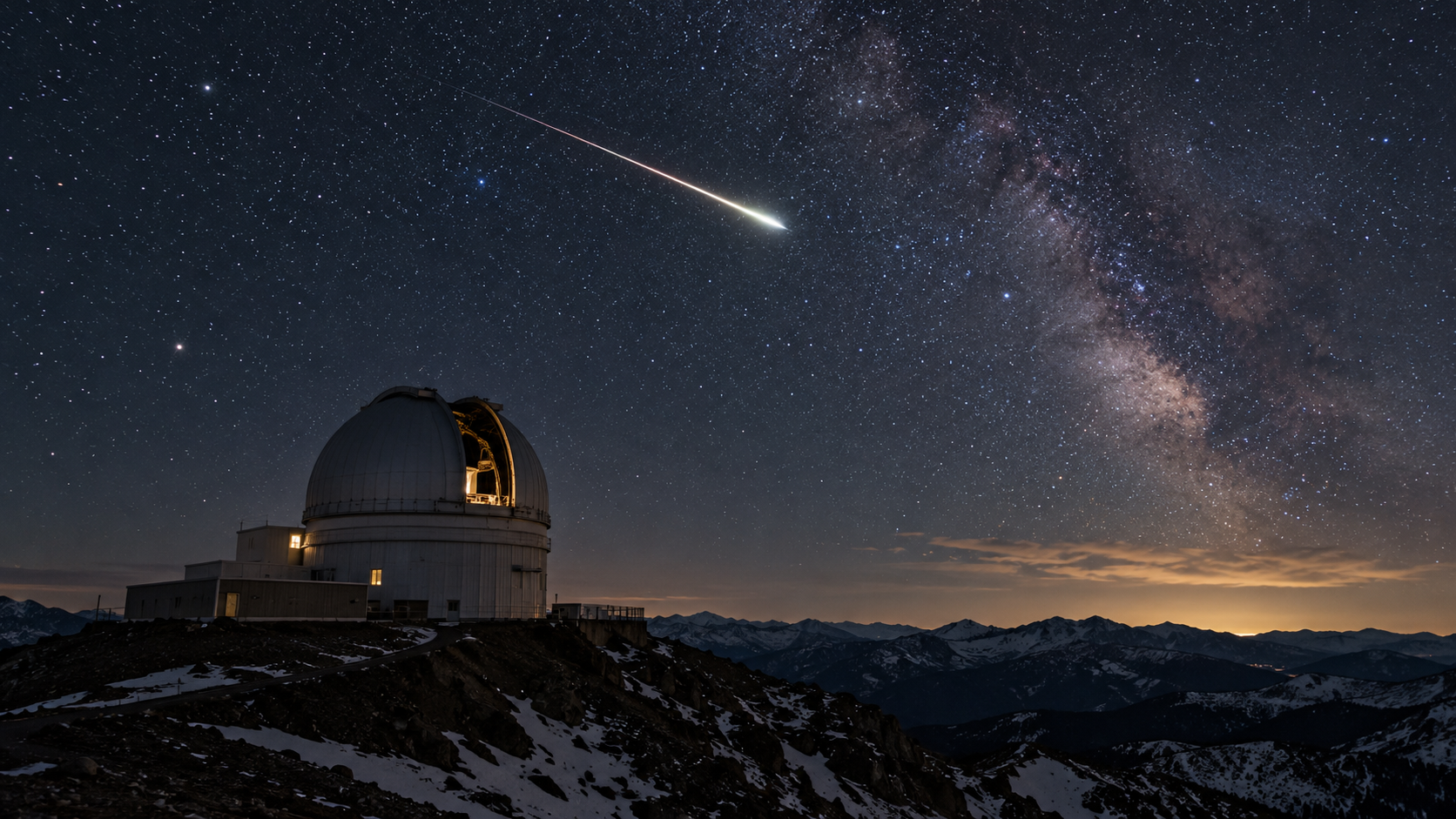
How Meteors Glow in the Atmosphere Explainer
A meteoroid is a natural piece of rock or metal moving through space. When it enters an atmosphere and produces a visible streak, the phenomenon is called a meteor. If part survives to the ground, that remnant is a meteorite. Most visible meteors begin as small particles traveling at tens of kilometers per second, so even a grain can release substantial energy during atmospheric entry.
The glow is not simply the rock becoming red-hot from rubbing against air. The object moves so fast that air in front of it is strongly compressed and heated. Collisions ionize and excite atmospheric gases and vaporized meteoroid material. As atoms and molecules return to lower-energy states, they emit light. The meteoroid’s surface also melts and vaporizes through ablation.
Brightness depends on speed, mass, composition, entry angle, and fragmentation. Different atoms can contribute characteristic colors, but cameras, atmospheric conditions, and human vision affect what is observed. A very bright meteor is often called a fireball. A large object may fragment explosively in an airburst, while many smaller meteoroids disappear completely high in the atmosphere.
Some meteors leave persistent trails after the bright object has gone. Ionized gas, vaporized metals, and atmospheric chemistry can produce a glowing or reflective path that winds reveal over seconds or minutes. Radar detects ionized trails even when clouds or daylight block a visible meteor, allowing researchers to count smaller particles and study upper-atmosphere winds.
Meteor showers occur when Earth passes through streams of debris shed by a comet or, in some cases, an asteroid. Parallel particle paths appear to radiate from one point in the sky because of perspective. Shower names refer to the nearby constellation, not the debris source itself. Sporadic meteors come from particles not associated with a recognized stream.
Whether a meteorite survives depends on size, strength, composition, speed, and the details of breakup. The interior of a recovered meteorite may remain relatively cool because intense heating is brief and much of the hot exterior is stripped away. Observations of light, radar, sound, and recovered fragments together reveal the object’s path and physical history.
A meteoroid in space becomes a meteor when atmospheric entry produces visible light.
Compression heats air, while ablation, ionization, and atomic emission create the luminous path.
Speed, mass, composition, angle, and fragmentation control brightness and survival.
Persistent trails contain ionized gas and vapor that upper-atmosphere winds can distort.
Meteor showers occur when Earth crosses concentrated streams of comet or asteroid debris.
Meteorites are surviving fragments whose flight is reconstructed from several kinds of evidence.
Explore more "Explainers"
Discover additional explainers across politics, science, business, technology, and other fields. Each explainer breaks down a complex idea into clear, everyday language—helping you better understand how major concepts, systems, and debates shape the world around us.