

On This Day in Science: June 14, 1967
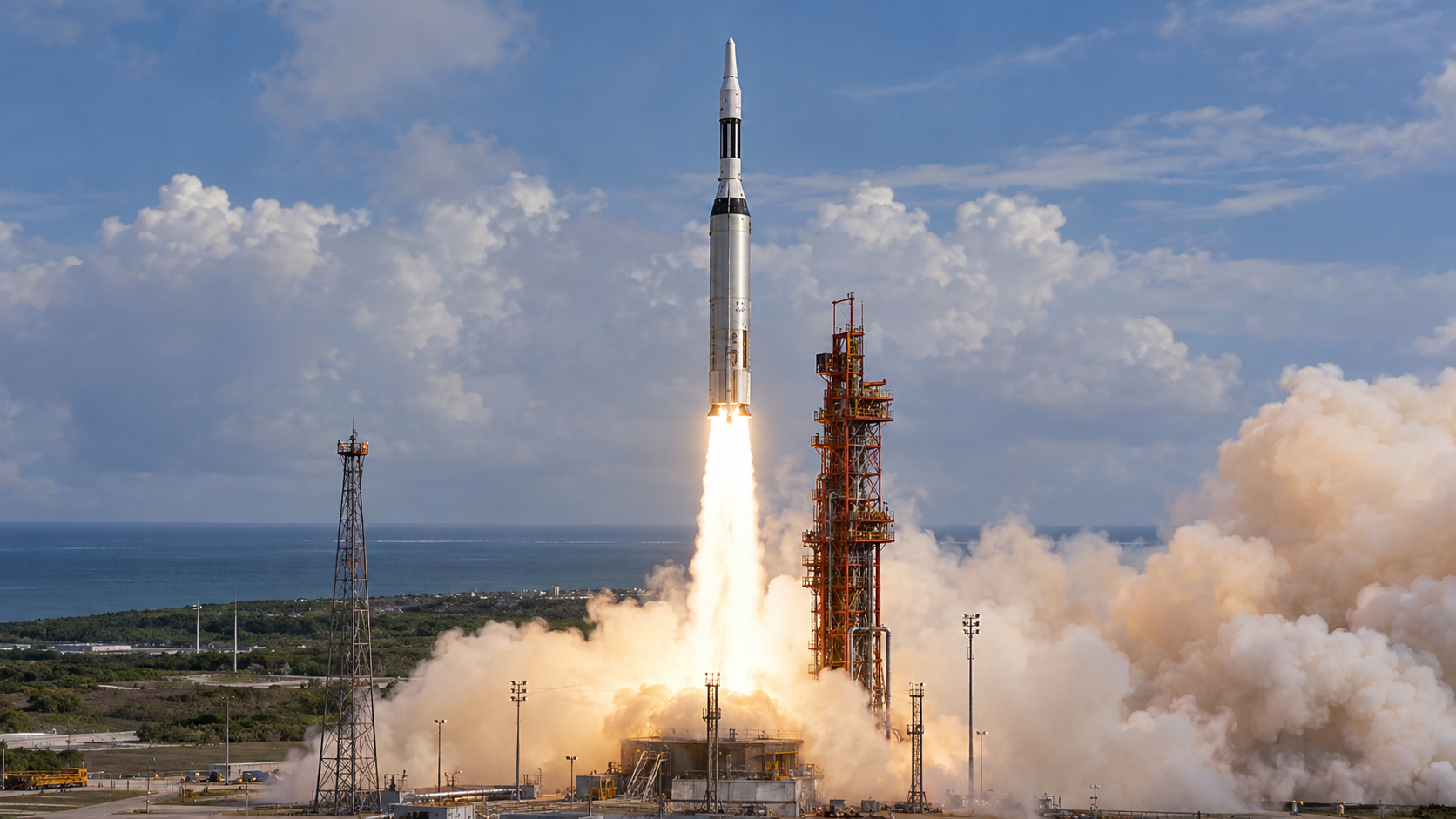
On June 14, 1967, NASA launched Mariner 5 from Cape Kennedy on an Atlas-Agena rocket. The spacecraft had originally been built as a backup for Mariner 4 at Mars, then modified for a much closer solar environment and a flyby of Venus. Engineers reversed and reduced its solar panels, added thermal protection, and adapted instruments for the new target.
Mariner 5 passed Venus in October at a distance of about four thousand kilometers. It carried no camera. Instead, it measured charged particles, magnetic fields, ultraviolet emissions, and radio signals. During occultation, the spacecraft’s radio beam passed through layers of the atmosphere before disappearing behind the planet, allowing scientists to infer pressure and temperature profiles.
The observations showed a very dense, hot atmosphere and an ionosphere shaped by interaction with the solar wind. Measurements made during the same period by the Soviet Venera 4 descent probe complemented the flyby data. Differences between early interpretations prompted scientists to refine atmospheric models rather than treat either mission as complete by itself.
Mariner 5 demonstrated the value of repurposing tested hardware and of using a spacecraft’s communication link as a scientific instrument. Its launch began a mission in which geometry, radio physics, and international measurements combined to reveal an atmosphere hidden beneath clouds. Seen across a longer timeline, scientific milestones are junctions rather than isolated beginnings. Earlier experiments, tools, and institutions made the work possible, while later teams tested limits and carried the result into new settings. What survives is a traceable chain of evidence, correction, and application that allows one moment to remain relevant as knowledge and technology continue to change. The anniversary highlights the difference between a first result and a finished understanding. A successful observation can settle one question while opening several harder ones, and even a failed objective can reshape later designs. Preserved data, specimens, photographs, and hardware allow new generations to revisit the work with better tools. Science advances through that continuity rather than stopping on a memorable date. Its calendar date is an entry point, not an endpoint. The people involved worked with the instruments, assumptions, and social conditions of their time, and later research has both extended and corrected their conclusions. Separating what was known that day from what became clear afterward protects the history from myth and shows how cumulative evidence turns an episode into lasting scientific knowledge. For science history, the event also shows how evidence moves from an observation or engineered test into a durable body of knowledge. Instruments supplied measurements, specialists debated interpretation, and later work refined what the first result could mean. Archives preserve the early record while new methods let researchers ask different questions of it. That continuing revision is the process through which a dated milestone remains scientifically useful.
Mariner 5 used spare Mariner 4 hardware adapted for stronger sunlight near Venus.
Changes to the solar arrays and thermal design protected the spacecraft from extra heat.
Fields and particles instruments sampled the environment around the planet.
Radio occultation converted changes in the communication signal into an atmospheric profile.
Mariner 5 observed from a flyby while Venera 4 descended through the air.
Combining their measurements improved estimates of Venusian pressure, temperature, and composition.
Explore more of "On This Day ..."
Discover more events from the same date across news, politics, technology, sports, and other fields. Each link highlights significant moments that shaped history on different fronts.