

On This Day in Science: June 13, 1983
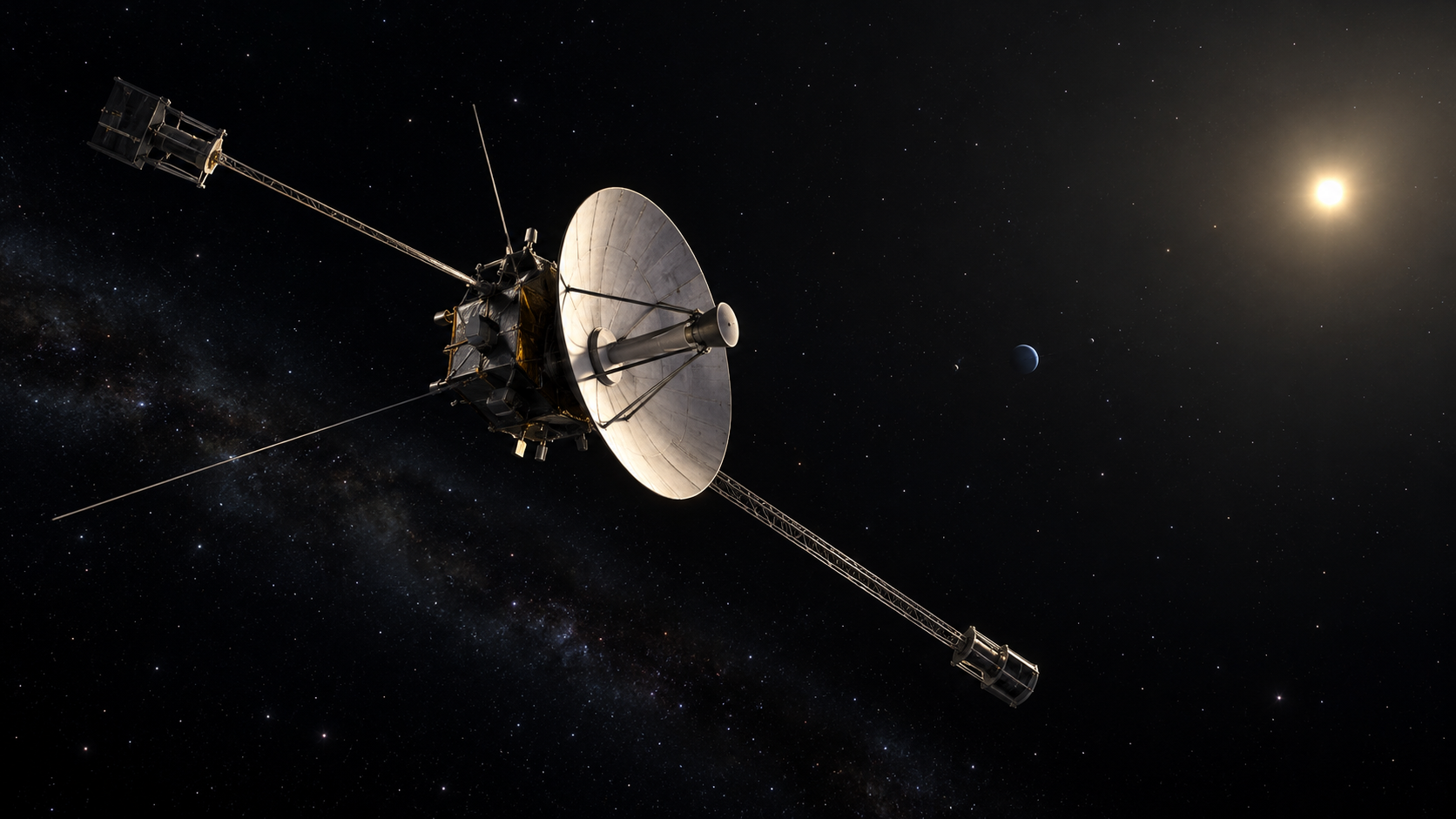
On June 13, 1983, NASA’s Pioneer 10 crossed the distance from the Sun associated with Neptune’s orbit. Because Pluto was then closer to the Sun than Neptune, the milestone made Pioneer 10 the first human-made object to travel beyond the orbital range of all the planets as they were positioned at that time. The spacecraft did not pass near Neptune itself.
Pioneer 10 had launched in 1972 and became the first probe to cross the asteroid belt and make close observations of Jupiter. Jupiter’s gravity bent its path onto an escape trajectory from the solar system. Long after the encounter, the craft continued measuring cosmic rays, charged particles, magnetic fields, and the interplanetary environment.
Its great distance made communication progressively harder. Radio signals weakened according to the inverse-square law, commands took hours for a round trip, and declining electrical power forced instruments to shut down. NASA received the last useful telemetry in 2002 and the final faint signal in 2003.
The June crossing is best understood as an orbital-distance benchmark, not a planetary encounter or arrival at the edge of the solar system. Pioneer 10 remains within the Sun’s extended domain while traveling toward interstellar space, carrying a plaque intended to identify its origin if ever found. For science history, the event also shows how evidence moves from an observation or engineered test into a durable body of knowledge. Instruments supplied measurements, specialists debated interpretation, and later work refined what the first result could mean. Archives preserve the early record while new methods let researchers ask different questions of it. That continuing revision is the process through which a dated milestone remains scientifically useful. Seen across a longer timeline, scientific milestones are junctions rather than isolated beginnings. Earlier experiments, tools, and institutions made the work possible, while later teams tested limits and carried the result into new settings. What survives is a traceable chain of evidence, correction, and application that allows one moment to remain relevant as knowledge and technology continue to change. The anniversary highlights the difference between a first result and a finished understanding. A successful observation can settle one question while opening several harder ones, and even a failed objective can reshape later designs. Preserved data, specimens, photographs, and hardware allow new generations to revisit the work with better tools. Science advances through that continuity rather than stopping on a memorable date. Its calendar date is an entry point, not an endpoint. The people involved worked with the instruments, assumptions, and social conditions of their time, and later research has both extended and corrected their conclusions. Separating what was known that day from what became clear afterward protects the history from myth and shows how cumulative evidence turns an episode into lasting scientific knowledge.
Pioneer 10 crossed Neptune's orbital radius without approaching the planet.
Pluto's eccentric orbit placed it closer to the Sun than Neptune at the time.
The 1973 encounter returned close observations and changed the probe's path.
Jupiter's gravity sent Pioneer 10 onto a trajectory that escapes the solar system.
Increasing distance weakened signals and lengthened communication delays.
Radioisotope power also declined until the spacecraft could no longer operate its instruments and transmitter reliably.
Explore more of "On This Day ..."
Discover more events from the same date across news, politics, technology, sports, and other fields. Each link highlights significant moments that shaped history on different fronts.