

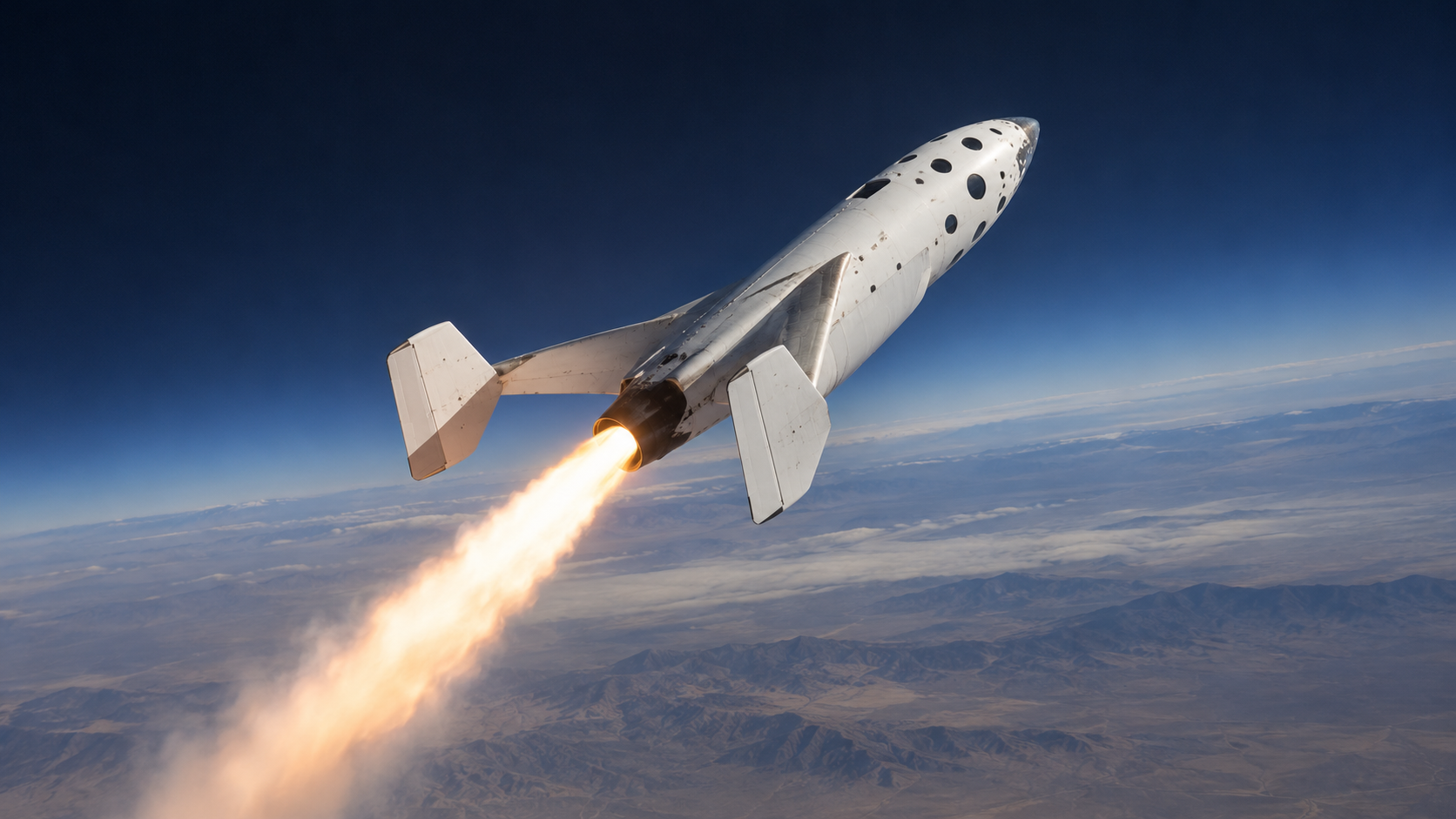
On This Day in Science: June 21, 2004
On June 21, 2004, pilot Mike Melvill flew SpaceShipOne above one hundred kilometers, the commonly used Kármán line, and completed the first privately funded human spaceflight. The small rocket plane was carried to altitude beneath the twin-boom White Knight aircraft, released, and then ignited its hybrid rocket motor for a steep climb.
SpaceShipOne used a pressure-fed motor burning nitrous oxide and a rubber-based solid fuel. Near the top of its trajectory, the vehicle entered a low-speed coast and Melvill experienced weightlessness. For reentry, the tail booms rotated upward into a feathered configuration that increased drag and passively aligned the craft before returning to a conventional gliding shape.
The flight suffered control problems during ascent and landed with damage to a movable surface, but it reached the required altitude. It was a demonstration flight, not one of the two later attempts that won the Ansari X Prize by repeating crewed spaceflight within two weeks.
The achievement showed that a small non-government team could integrate carrier aircraft, rocket propulsion, life support, flight controls, reentry stability, and range operations. It also opened continuing debates about how experimental commercial spacecraft should be certified, regulated, and made safe for people beyond professional test pilots. For science history, the event also shows how evidence moves from an observation or engineered test into a durable body of knowledge. Instruments supplied measurements, specialists debated interpretation, and later work refined what the first result could mean. Archives preserve the early record while new methods let researchers ask different questions of it. That continuing revision is the process through which a dated milestone remains scientifically useful. Seen across a longer timeline, scientific milestones are junctions rather than isolated beginnings. Earlier experiments, tools, and institutions made the work possible, while later teams tested limits and carried the result into new settings. What survives is a traceable chain of evidence, correction, and application that allows one moment to remain relevant as knowledge and technology continue to change. The anniversary highlights the difference between a first result and a finished understanding. A successful observation can settle one question while opening several harder ones, and even a failed objective can reshape later designs. Preserved data, specimens, photographs, and hardware allow new generations to revisit the work with better tools. Science advances through that continuity rather than stopping on a memorable date. Its calendar date is an entry point, not an endpoint. The people involved worked with the instruments, assumptions, and social conditions of their time, and later research has both extended and corrected their conclusions. Separating what was known that day from what became clear afterward protects the history from myth and shows how cumulative evidence turns an episode into lasting scientific knowledge.
White Knight carried SpaceShipOne above much of the dense lower atmosphere.
Release at altitude reduced drag and let the rocket plane begin with forward speed.
The tail booms hinged upward to create a high-drag, self-stabilizing shape.
After deceleration, they returned to the glide position for runway landing.
The June flight first crossed one hundred kilometers with private funding.
Separate flights later that year satisfied the repetition rules for the Ansari X Prize.
Explore more of "On This Day ..."
Discover more events from the same date across news, politics, technology, sports, and other fields. Each link highlights significant moments that shaped history on different fronts.