

On This Day in Science: June 25, 1997
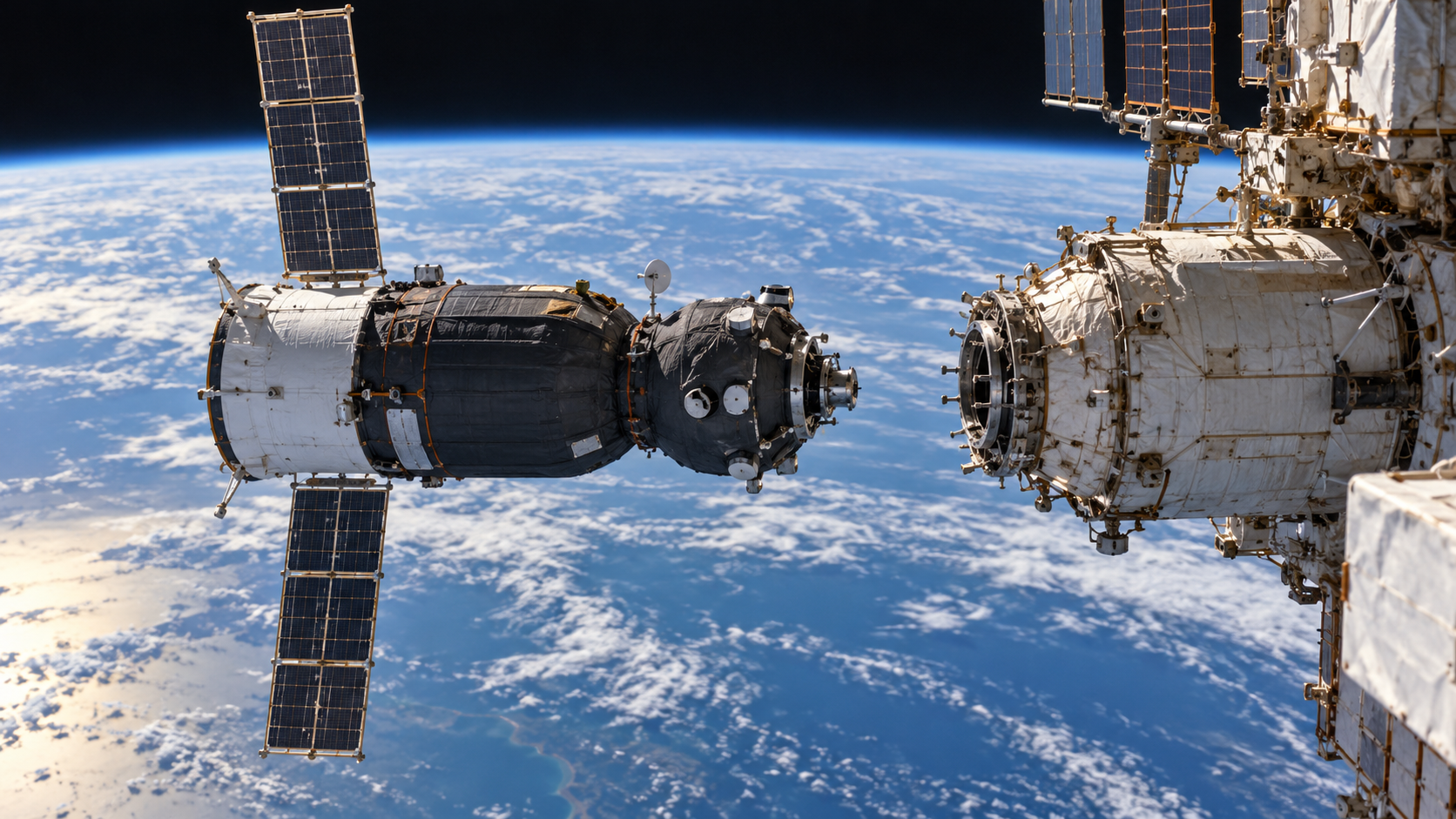
On June 25, 1997, the uncrewed Progress M-34 cargo spacecraft collided with the Mir space station during a manual docking test. Cosmonaut Vasily Tsibliyev was controlling Progress from inside Mir using a television view intended to evaluate whether future dockings could avoid relying on the automatic Kurs radar system. The closing rate and alignment were misjudged.
Progress struck a solar array and the Spektr research module, puncturing its pressure hull. Air began escaping from the station. The crew disconnected cables crossing Spektr’s hatch and sealed the module, a difficult emergency action because the cables carried electrical power from its solar arrays into the rest of Mir.
The impact sent the station rotating and reduced available power. Tsibliyev, Aleksandr Lazutkin, and NASA astronaut Michael Foale stabilized Mir using thrusters and eventually restored attitude control. Later spacewalks and an internal excursion attempted to reconnect wiring and assess the damage, but Spektr remained depressurized.
The collision exposed the interaction of cost pressure, training limits, degraded hardware, human workload, and experimental operations on an aging station. The crew’s survival also demonstrated the value of compartment hatches, emergency procedures, and the ability to improvise when multiple systems fail together. For science history, the event also shows how evidence moves from an observation or engineered test into a durable body of knowledge. Instruments supplied measurements, specialists debated interpretation, and later work refined what the first result could mean. Archives preserve the early record while new methods let researchers ask different questions of it. That continuing revision is the process through which a dated milestone remains scientifically useful. Seen across a longer timeline, scientific milestones are junctions rather than isolated beginnings. Earlier experiments, tools, and institutions made the work possible, while later teams tested limits and carried the result into new settings. What survives is a traceable chain of evidence, correction, and application that allows one moment to remain relevant as knowledge and technology continue to change. The anniversary highlights the difference between a first result and a finished understanding. A successful observation can settle one question while opening several harder ones, and even a failed objective can reshape later designs. Preserved data, specimens, photographs, and hardware allow new generations to revisit the work with better tools. Science advances through that continuity rather than stopping on a memorable date. Its calendar date is an entry point, not an endpoint. The people involved worked with the instruments, assumptions, and social conditions of their time, and later research has both extended and corrected their conclusions. Separating what was known that day from what became clear afterward protects the history from myth and shows how cumulative evidence turns an episode into lasting scientific knowledge.
The crew guided Progress from a remote station using camera images rather than the normal automatic radar.
Limited depth cues and an excessive closing rate left too little time to avoid Mir.
The impact opened Spektr to space and the crew heard cabin pressure falling.
They cut and disconnected cables through the hatch so it could be closed.
Spektr's solar arrays could no longer feed the station normally.
The collision also started a rotation that complicated communications and energy generation.
Explore more of "On This Day ..."
Discover more events from the same date across news, politics, technology, sports, and other fields. Each link highlights significant moments that shaped history on different fronts.