

On This Day in Science: June 27, 1997
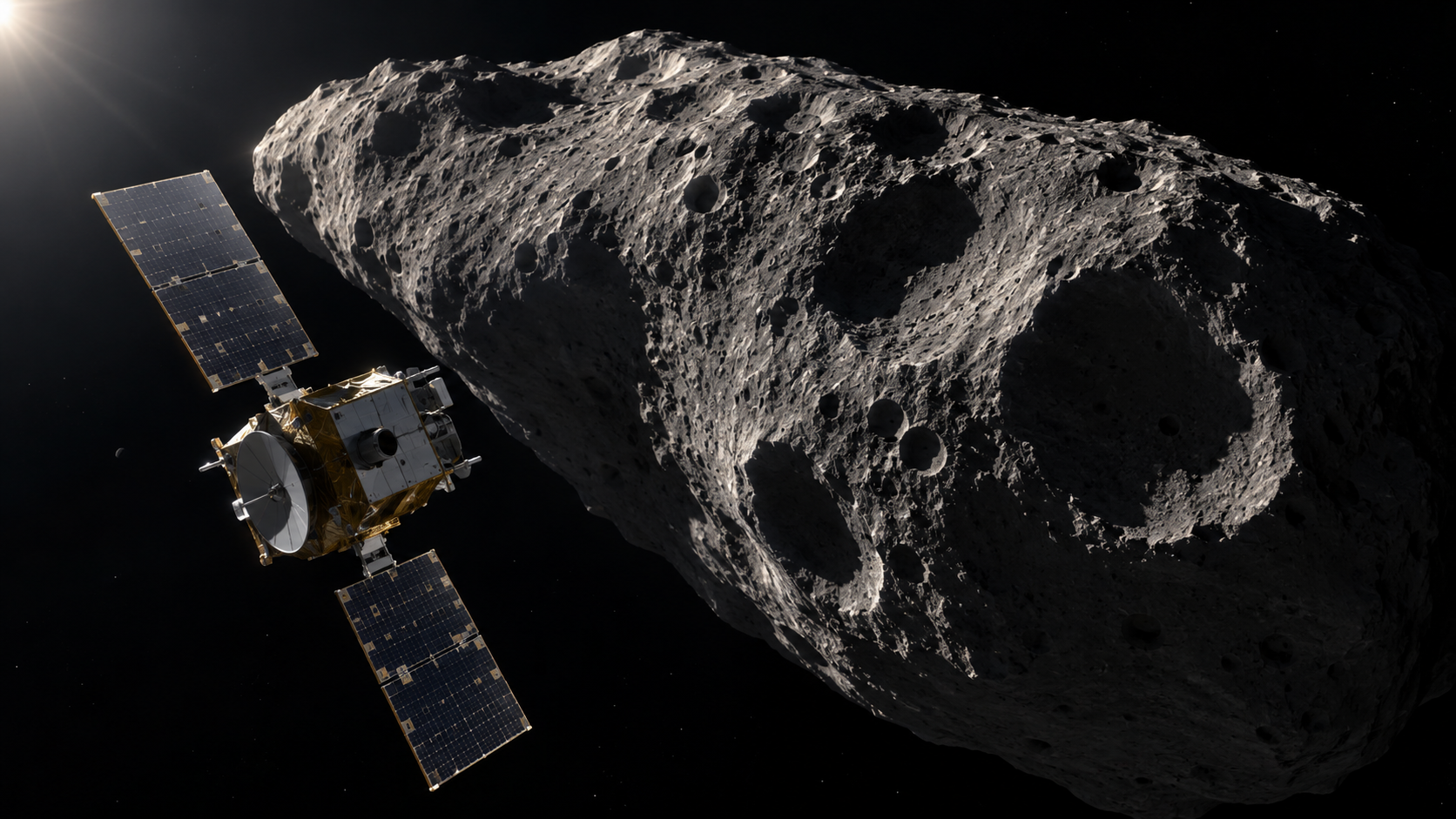
On June 27, 1997, NASA’s Near Earth Asteroid Rendezvous spacecraft passed within about 1,200 kilometers of asteroid 253 Mathilde. NEAR was traveling toward its primary target, Eros, but careful planning turned the crossing of Mathilde’s orbit into the first close encounter with a carbon-rich C-type asteroid.
The spacecraft photographed a dark, irregular body about fifty kilometers across. Several impact craters were enormous relative to the asteroid, yet Mathilde had not shattered. Its very low density suggested a porous interior, possibly a loosely bound collection of fragments with empty space between them rather than a solid monolith.
NEAR measured the asteroid’s mass through the slight gravitational deflection of the spacecraft’s trajectory. Combining that mass with image-based size estimates produced density. The encounter was brief and high-speed, so controllers had to sequence imaging and instrument operations in advance while keeping the antenna and solar arrays within safe limits.
Mathilde demonstrated how much can be learned from a short flyby when pictures, navigation, and physics are combined. The observations prepared scientists for the diversity of small bodies that later missions would orbit, touch, sample, and deliberately deflect. The anniversary highlights the difference between a first result and a finished understanding. A successful observation can settle one question while opening several harder ones, and even a failed objective can reshape later designs. Preserved data, specimens, photographs, and hardware allow new generations to revisit the work with better tools. Science advances through that continuity rather than stopping on a memorable date. Its calendar date is an entry point, not an endpoint. The people involved worked with the instruments, assumptions, and social conditions of their time, and later research has both extended and corrected their conclusions. Separating what was known that day from what became clear afterward protects the history from myth and shows how cumulative evidence turns an episode into lasting scientific knowledge. For science history, the event also shows how evidence moves from an observation or engineered test into a durable body of knowledge. Instruments supplied measurements, specialists debated interpretation, and later work refined what the first result could mean. Archives preserve the early record while new methods let researchers ask different questions of it. That continuing revision is the process through which a dated milestone remains scientifically useful. Seen across a longer timeline, scientific milestones are junctions rather than isolated beginnings. Earlier experiments, tools, and institutions made the work possible, while later teams tested limits and carried the result into new settings. What survives is a traceable chain of evidence, correction, and application that allows one moment to remain relevant as knowledge and technology continue to change.
Mathilde was not NEAR's final destination, but its path could be adjusted for a useful flyby.
The opportunity added major science without replacing the mission to Eros.
Some craters are comparable in scale to the asteroid's radius.
A porous rubble-like structure may absorb impact energy differently from solid rock.
Mathilde's pull produced a tiny, measurable change in the spacecraft's motion.
Mass from navigation and volume from images yielded an unexpectedly low density.
Explore more of "On This Day ..."
Discover more events from the same date across news, politics, technology, sports, and other fields. Each link highlights significant moments that shaped history on different fronts.