

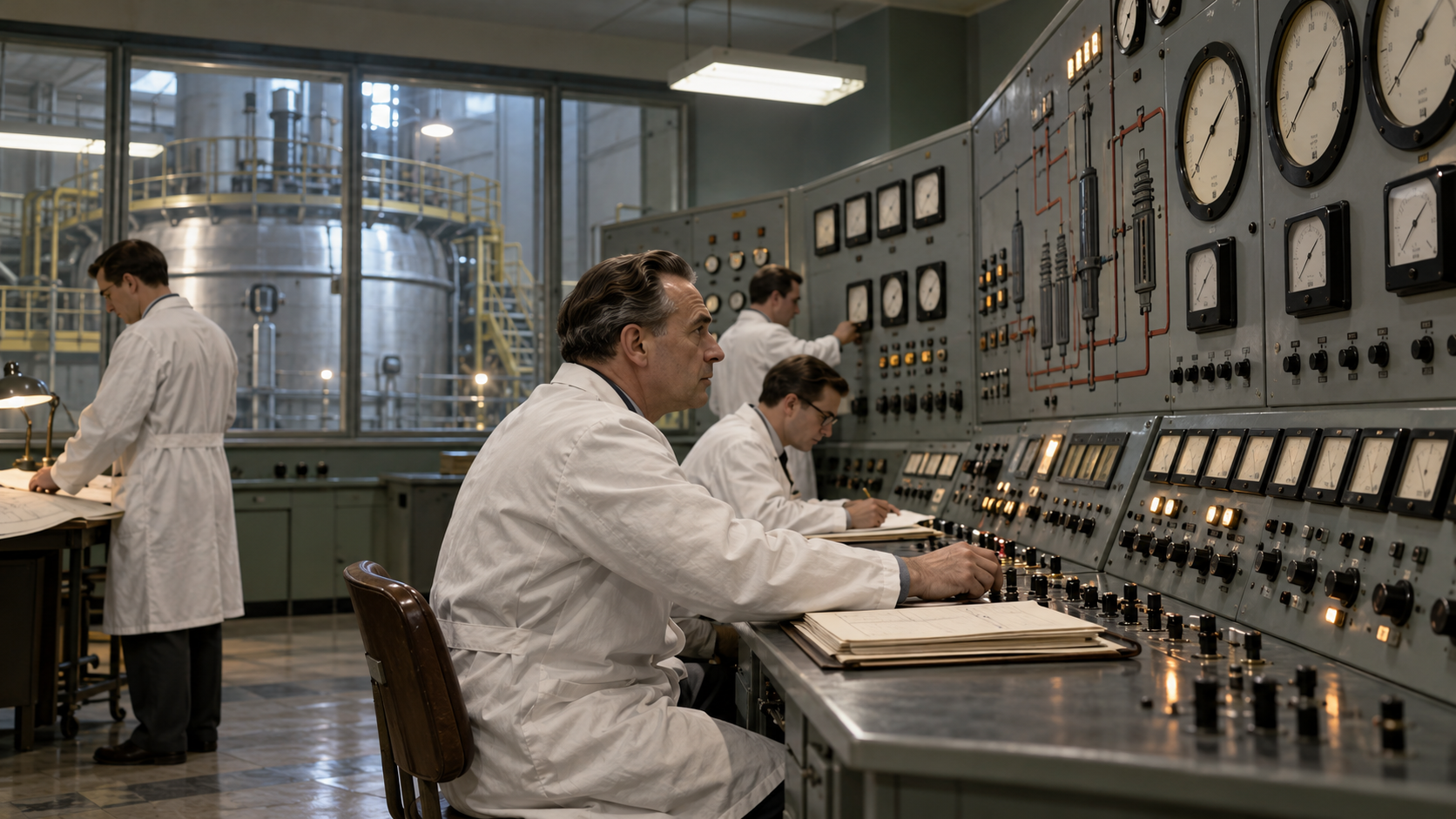
On This Day in Science: June 26, 1954
On June 26, 1954, the nuclear power station at Obninsk near Moscow began supplying electricity to the Soviet grid. Its AM-1 reactor produced about five megawatts of electrical power, tiny by later commercial standards, but it was the first nuclear power plant built to deliver electricity for civilian use on a continuing basis.
The reactor used graphite to slow neutrons and ordinary water to cool fuel channels. Heat from fission produced steam for a turbine-generator, translating a chain reaction into the same rotating machinery used in fossil-fueled stations. Operators and researchers could study reactor physics, materials, chemistry, and maintenance while producing useful electricity.
Obninsk was also connected to military and research institutions, so the phrase civilian power does not erase its Cold War setting. Other experimental reactors had generated electricity earlier, and larger commercial stations soon followed in several countries. Its distinction rests on operation as a grid-connected nuclear power station.
The plant operated for nearly forty-eight years before shutdown in 2002. Its commissioning marked the beginning of a technology that promised abundant low-carbon electricity while creating enduring questions about accidents, waste, weapons connections, economics, and public oversight. Seen across a longer timeline, scientific milestones are junctions rather than isolated beginnings. Earlier experiments, tools, and institutions made the work possible, while later teams tested limits and carried the result into new settings. What survives is a traceable chain of evidence, correction, and application that allows one moment to remain relevant as knowledge and technology continue to change. The anniversary highlights the difference between a first result and a finished understanding. A successful observation can settle one question while opening several harder ones, and even a failed objective can reshape later designs. Preserved data, specimens, photographs, and hardware allow new generations to revisit the work with better tools. Science advances through that continuity rather than stopping on a memorable date. Its calendar date is an entry point, not an endpoint. The people involved worked with the instruments, assumptions, and social conditions of their time, and later research has both extended and corrected their conclusions. Separating what was known that day from what became clear afterward protects the history from myth and shows how cumulative evidence turns an episode into lasting scientific knowledge. For science history, the event also shows how evidence moves from an observation or engineered test into a durable body of knowledge. Instruments supplied measurements, specialists debated interpretation, and later work refined what the first result could mean. Archives preserve the early record while new methods let researchers ask different questions of it. That continuing revision is the process through which a dated milestone remains scientifically useful.
Controlled splitting of uranium nuclei released heat into the reactor coolant.
Steam carried that energy to a turbine and generator connected to the electrical grid.
Five megawatts was modest compared with later reactors.
Continuous grid supply made Obninsk an operational power station rather than only a physics experiment.
Nuclear plants produce electricity with low direct carbon emissions.
Safety, radioactive waste, proliferation, and cost remain inseparable from the technology's history.
Explore more of "On This Day ..."
Discover more events from the same date across news, politics, technology, sports, and other fields. Each link highlights significant moments that shaped history on different fronts.