

On This Day in Science: June 28, 1911
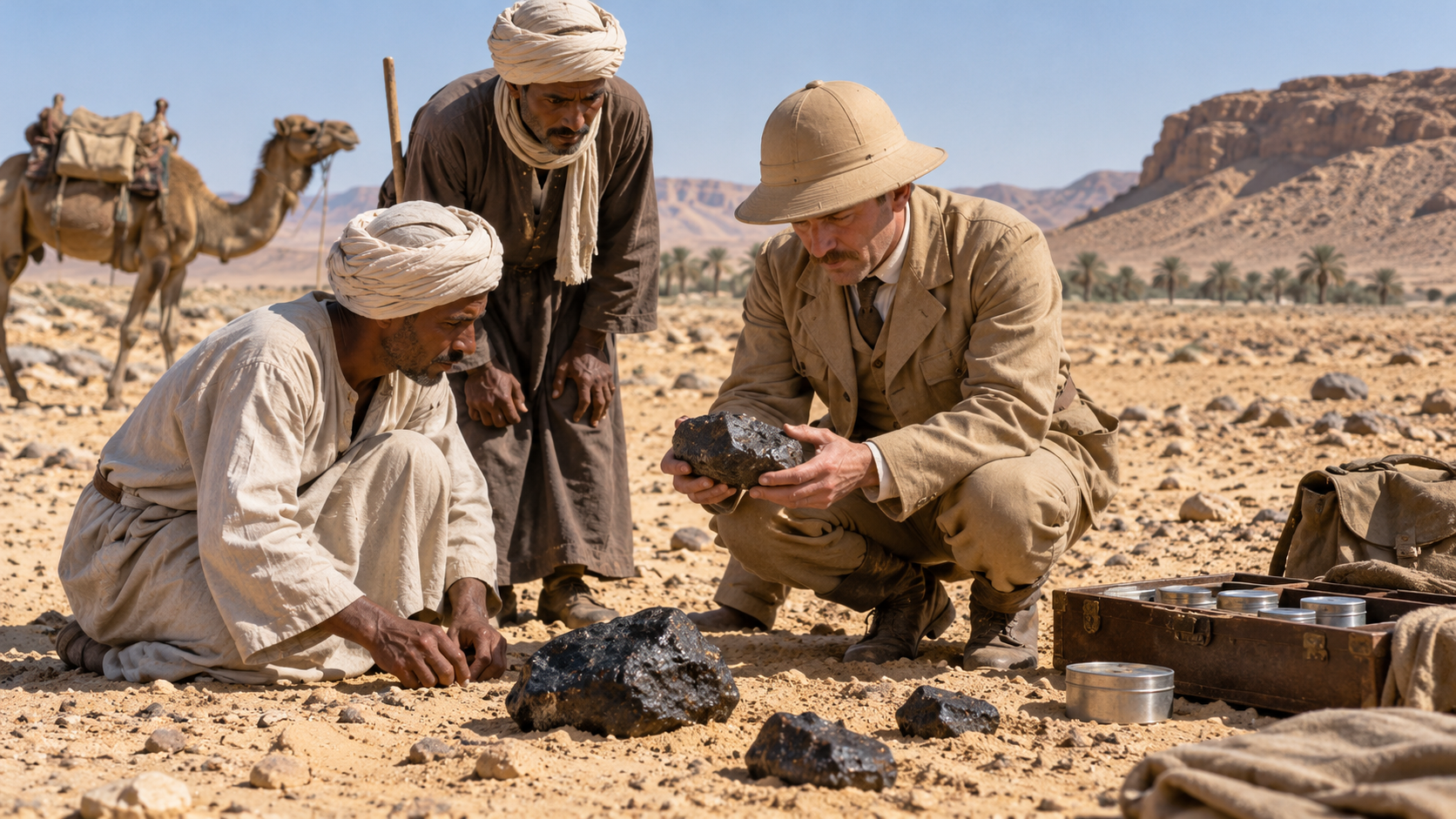
On June 28, 1911, witnesses near Nakhla in Egypt saw a bright object and heard explosions before stones fell across the area. People collected dozens of fragments totaling roughly ten kilograms. The specimens became the type example of nakhlites, a group of igneous meteorites with mineral textures unlike most common space rocks.
For decades, the parent body was uncertain. Laboratory measurements eventually showed that nakhlites crystallized from magma relatively recently in solar-system history and contained trapped gases whose composition closely matched the atmosphere measured on Mars by the Viking landers. Those clues identified Mars as the source.
A large impact on Mars blasted rock fast enough to escape the planet’s gravity. The fragments then orbited the Sun, experienced collisions and cosmic radiation, and eventually intersected Earth. Isotopic clocks help reconstruct stages of crystallization, ejection, space exposure, and terrestrial arrival.
Nakhla also contains minerals formed or altered in the presence of water, preserving evidence about fluids in the Martian crust. Because its fall was witnessed and material was collected quickly, the meteorite links a precise day on Earth with a much longer geological journey between planets. Its calendar date is an entry point, not an endpoint. The people involved worked with the instruments, assumptions, and social conditions of their time, and later research has both extended and corrected their conclusions. Separating what was known that day from what became clear afterward protects the history from myth and shows how cumulative evidence turns an episode into lasting scientific knowledge. For science history, the event also shows how evidence moves from an observation or engineered test into a durable body of knowledge. Instruments supplied measurements, specialists debated interpretation, and later work refined what the first result could mean. Archives preserve the early record while new methods let researchers ask different questions of it. That continuing revision is the process through which a dated milestone remains scientifically useful. Seen across a longer timeline, scientific milestones are junctions rather than isolated beginnings. Earlier experiments, tools, and institutions made the work possible, while later teams tested limits and carried the result into new settings. What survives is a traceable chain of evidence, correction, and application that allows one moment to remain relevant as knowledge and technology continue to change. The anniversary highlights the difference between a first result and a finished understanding. A successful observation can settle one question while opening several harder ones, and even a failed objective can reshape later designs. Preserved data, specimens, photographs, and hardware allow new generations to revisit the work with better tools. Science advances through that continuity rather than stopping on a memorable date.
Multiple fragments fell over the Nakhla region after sound and light were reported.
Prompt collection preserved a well-documented meteorite fall rather than an undated surface find.
Trapped noble gases closely match measurements of the Martian atmosphere.
Young volcanic ages and mineral chemistry support the same planetary origin.
A powerful collision accelerated Martian crustal rock beyond escape velocity.
Cosmic-ray exposure records part of the time the fragments spent traveling through space.
Explore more of "On This Day ..."
Discover more events from the same date across news, politics, technology, sports, and other fields. Each link highlights significant moments that shaped history on different fronts.