

On This Day in Science: June 24, 1983
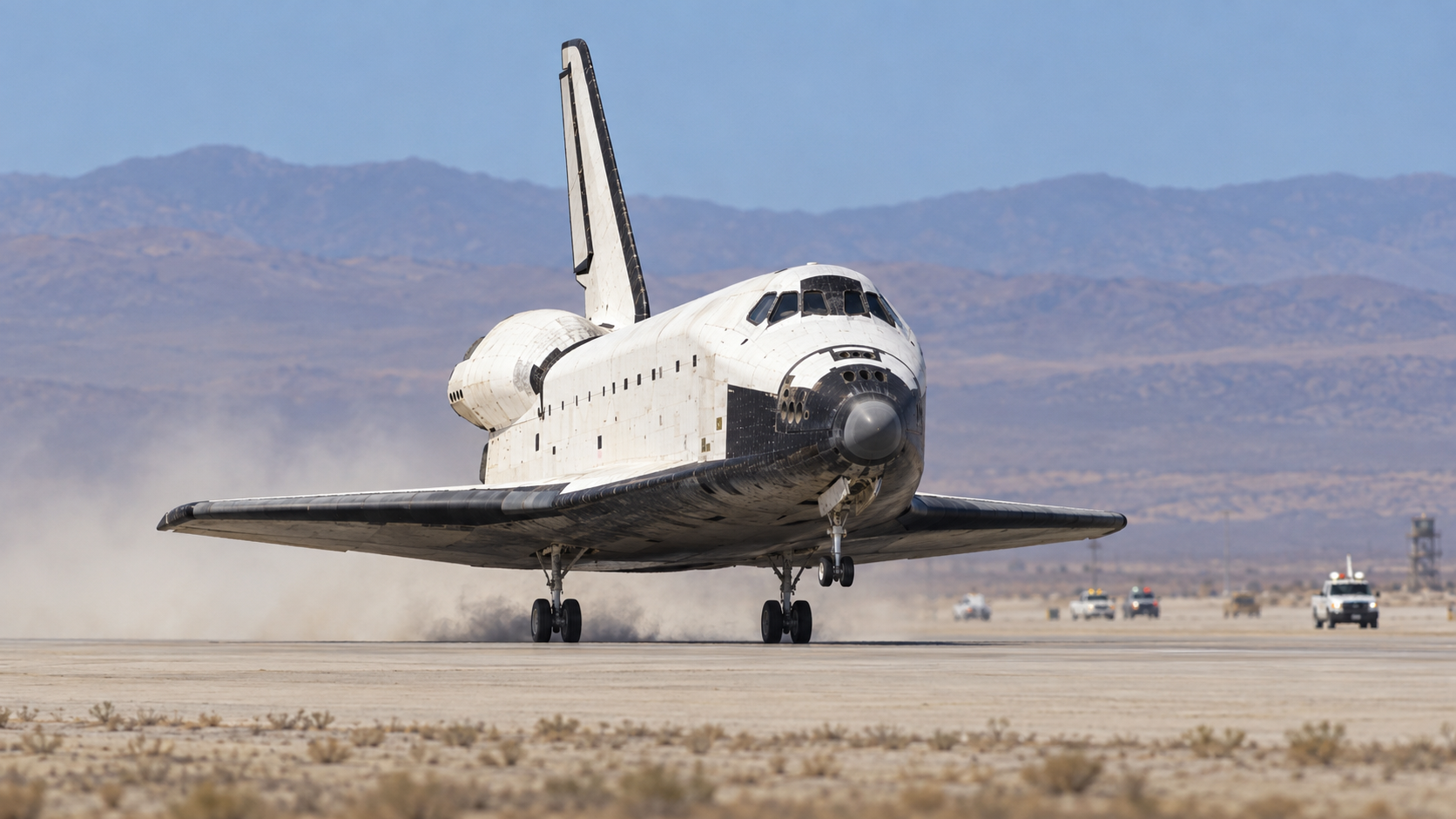
On June 24, 1983, Space Shuttle Challenger landed at Edwards Air Force Base, completing the six-day STS-7 mission. The crew included Sally Ride, the first American woman to travel in space, along with Robert Crippen, Frederick Hauck, John Fabian, and Norman Thagard. Weather in Florida diverted the planned landing to California.
During the mission, the crew deployed communications satellites for Canada and Indonesia. Ride and Fabian operated the Canadian-built robotic arm to release and retrieve the Shuttle Pallet Satellite, a free-flying platform carrying experiments. The work tested how the arm and orbiter could approach and handle a large object in space.
Experiments examined materials, biology, lightning, and Earth’s atmosphere. The crew also observed a small impact on a window and dealt with an attitude-control issue affecting one of the deployed satellites. A planned first shuttle landing at Kennedy Space Center was abandoned when cloud cover and rain made the runway unsuitable.
Ride’s flight broke a highly visible barrier, but its technical significance was inseparable from ordinary crew responsibilities. She served as a mission specialist trained in robotics, payloads, and flight-deck operations, establishing a model in which participation was measured by demanding work rather than ceremonial presence. Its calendar date is an entry point, not an endpoint. The people involved worked with the instruments, assumptions, and social conditions of their time, and later research has both extended and corrected their conclusions. Separating what was known that day from what became clear afterward protects the history from myth and shows how cumulative evidence turns an episode into lasting scientific knowledge. For science history, the event also shows how evidence moves from an observation or engineered test into a durable body of knowledge. Instruments supplied measurements, specialists debated interpretation, and later work refined what the first result could mean. Archives preserve the early record while new methods let researchers ask different questions of it. That continuing revision is the process through which a dated milestone remains scientifically useful. Seen across a longer timeline, scientific milestones are junctions rather than isolated beginnings. Earlier experiments, tools, and institutions made the work possible, while later teams tested limits and carried the result into new settings. What survives is a traceable chain of evidence, correction, and application that allows one moment to remain relevant as knowledge and technology continue to change. The anniversary highlights the difference between a first result and a finished understanding. A successful observation can settle one question while opening several harder ones, and even a failed objective can reshape later designs. Preserved data, specimens, photographs, and hardware allow new generations to revisit the work with better tools. Science advances through that continuity rather than stopping on a memorable date.
Ride and Fabian used the remote manipulator arm to deploy and retrieve a free-flying payload.
The operation rehearsed techniques later central to satellite servicing and station assembly.
Challenger released communications spacecraft and carried scientific investigations.
The mission combined operational deployment with research inside and outside the cabin.
Poor conditions prevented the planned first shuttle landing in Florida.
Challenger diverted safely to the long dry-lakebed runway at Edwards.
Explore more of "On This Day ..."
Discover more events from the same date across news, politics, technology, sports, and other fields. Each link highlights significant moments that shaped history on different fronts.