

How Pulsars Produce Regular Pulses Explainer
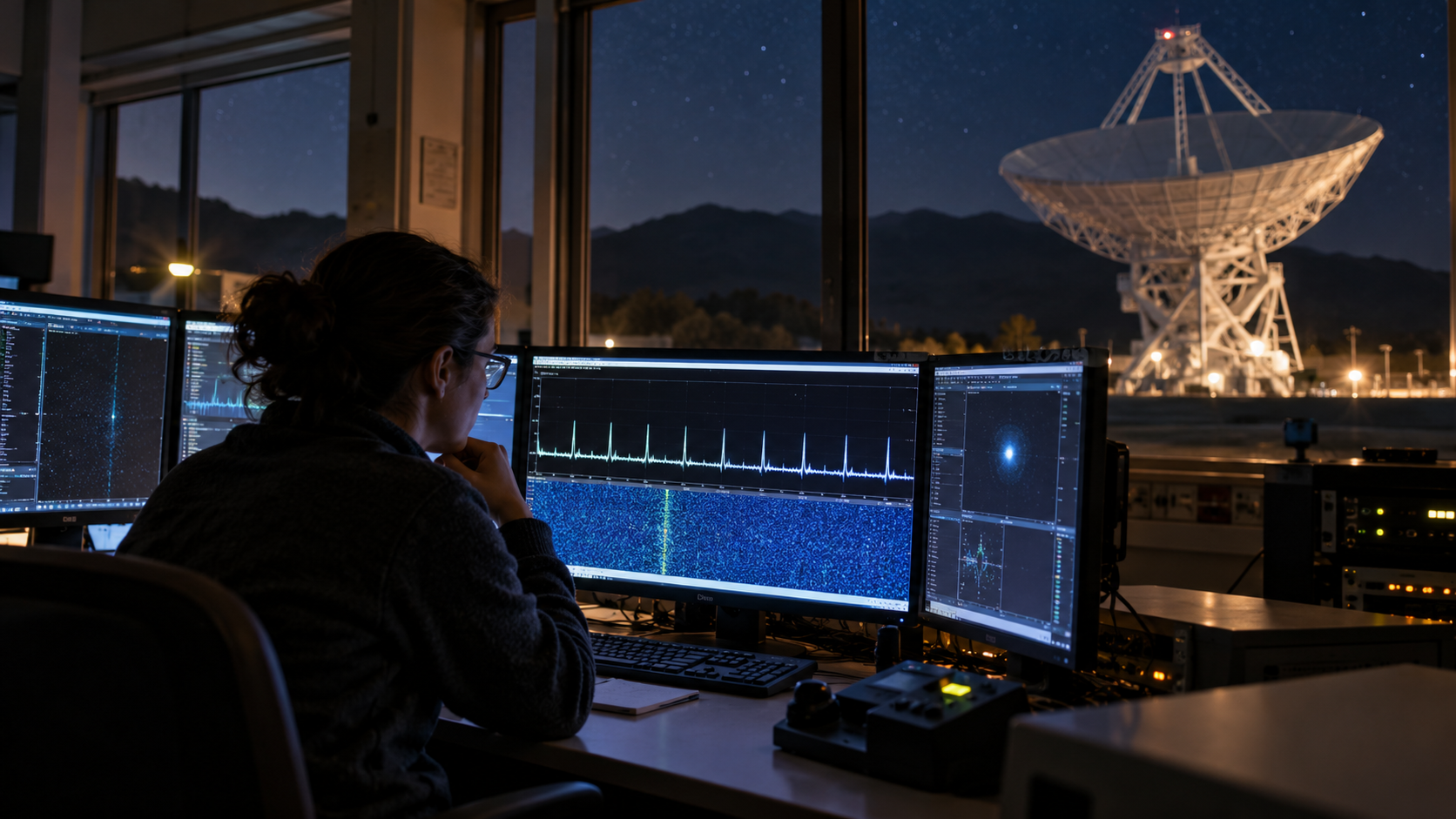
A pulsar is a rapidly rotating neutron star detected as a repeating source of radio waves, X-rays, gamma rays, or visible light. The star does not usually switch its entire emission on and off. Instead, radiation is concentrated into beams associated with its magnetic poles. If a beam sweeps across Earth during each rotation, a telescope records a pulse, much as an observer sees periodic flashes from a lighthouse.
Neutron stars form when the cores of massive stars collapse. Compressing the core preserves angular momentum and magnetic flux, producing an object only about city-sized that can spin quickly and carry an intense magnetic field. The magnetic axis is often tilted relative to the rotation axis. That misalignment makes the emitting regions trace cones through space as the star turns.
The rotating magnetic field generates enormous electric fields that pull charged particles from the surface or create particle cascades above the poles. Accelerated particles emit radiation along magnetic-field structures. The detailed radio-emission mechanism remains an active research topic, and different wavelengths may originate in different regions of the magnetosphere, but rotation sets the basic clock.
Pulsars gradually lose rotational energy through radiation, particle winds, and electromagnetic torque, so their periods increase extremely slowly. Millisecond pulsars have been spun up by accreting matter and angular momentum from a companion star. Their remarkable stability makes some useful as cosmic clocks, although no pulsar is perfectly regular and long observations are needed to model its motion and environment.
A glitch is a sudden small increase in rotation rate, probably involving interactions between the solid crust and superfluid material inside. Pulses can also arrive early or late because of orbital motion, interstellar plasma, or gravitational effects. Timing these deviations can reveal companion planets, measure binary systems, test gravity, and search for long-wavelength gravitational waves across a network of pulsars.
A pulsar beam may miss Earth, so the absence of pulses does not mean no neutron star is present. Pulses also weaken or scatter as radio waves travel through ionized gas. The regularity is rotational rather than a message or artificial beacon. Pulsars matter because each compact star turns extreme gravity, dense matter, and magnetized plasma into a clock readable across the galaxy.
A pulsar is a rotating neutron star seen when a focused radiation beam sweeps across Earth.
Collapse produces a compact object with rapid rotation and a powerful magnetic field.
Tilt between magnetic and rotation axes creates a lighthouse-like sweep.
Particle acceleration in the magnetosphere generates emission across several wavelengths.
Spin-down, binary motion, plasma, and glitches create measurable timing changes.
Many neutron stars are invisible as pulsars because their beams never cross Earth.
Explore more "Explainers"
Discover additional explainers across politics, science, business, technology, and other fields. Each explainer breaks down a complex idea into clear, everyday language—helping you better understand how major concepts, systems, and debates shape the world around us.