

How Black Holes Form and Grow Explainer
A black hole forms when enough mass is compressed inside a region from which the escape speed exceeds the speed of light. The boundary is the event horizon, not a solid surface. The best-understood formation route produces stellar-mass black holes: a massive star exhausts usable nuclear fuel, loses pressure support in its core, and collapses. Whether it leaves a neutron star or black hole depends on the core and the surrounding explosion and fallback.
Some collapsing stars produce a bright supernova, while others may collapse more quietly or have material fall back after an explosion. Binary neutron stars can also merge into a black hole if the remnant is massive enough. The resulting stellar black holes commonly contain several to tens of solar masses, although mergers measured through gravitational waves have revealed a broad population.
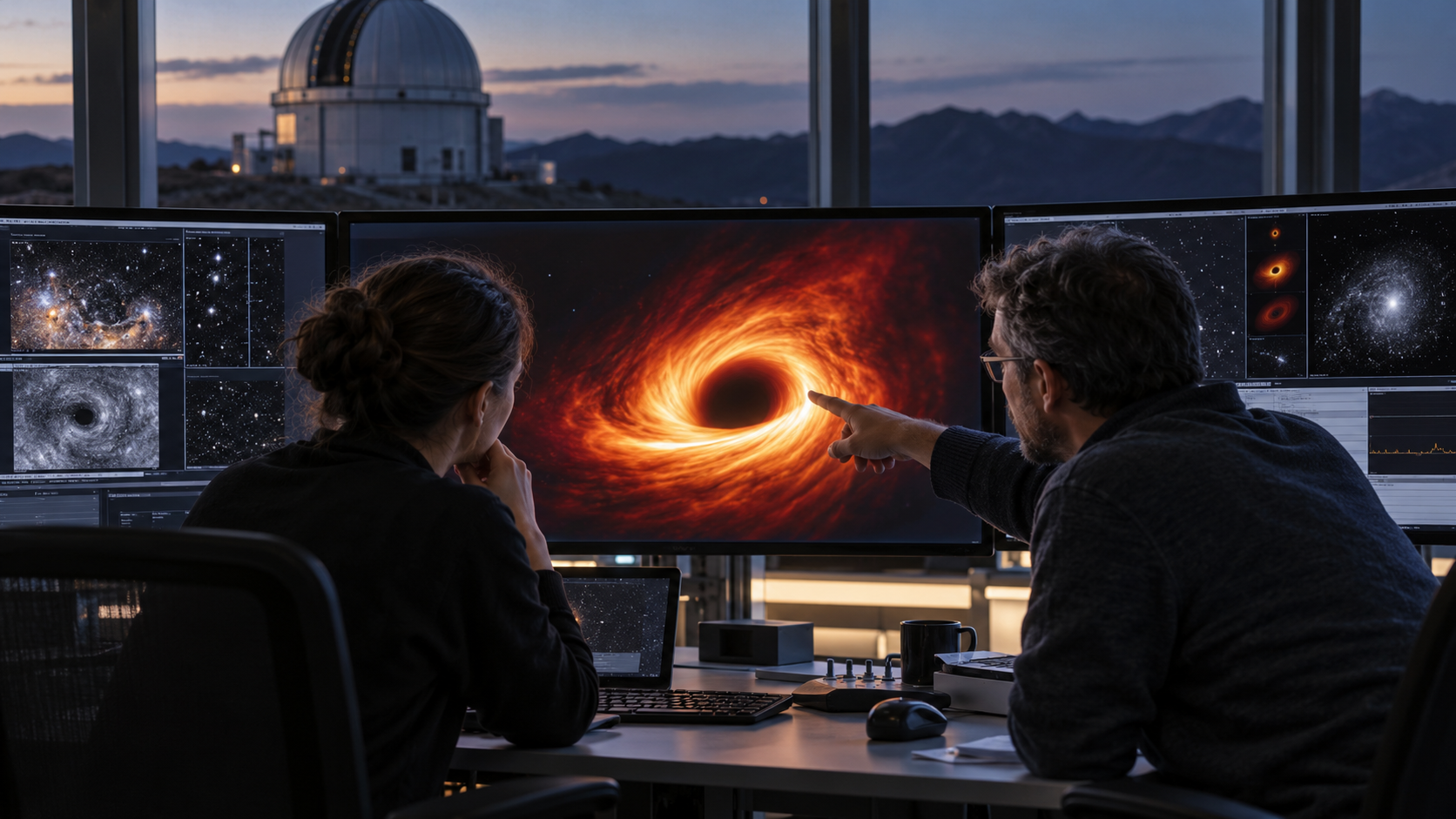
After birth, a black hole grows by accretion. Gas with angular momentum usually forms a rotating disk rather than falling straight inward. Friction-like magnetic turbulence moves angular momentum outward and lets matter spiral in, heating the disk so it can shine in visible, ultraviolet, or X-ray light. Magnetic fields can also launch jets. The observed light comes from matter outside the horizon, not from the black hole itself.
Black holes grow through mergers as well. When two orbiting black holes lose energy to gravitational waves, they spiral together and form a larger remnant, radiating part of their combined mass-energy as waves. A merged black hole can receive a recoil kick if the emission is uneven. Repeated accretion and mergers help build larger objects in dense stellar systems and galactic centers.
Most large galaxies host supermassive black holes containing millions to billions of solar masses. Their initial seeds remain an active research question. Candidates include remnants of the first massive stars, direct collapse of large gas clouds, and runaway stellar collisions. The existence of very massive black holes early in cosmic history challenges models to grow seeds quickly enough without exceeding realistic fuel supplies.
Black holes are not cosmic vacuum cleaners. Far away, their gravity behaves like that of any object with the same mass, and material needs a path that carries it close enough to be captured. Astronomers infer growth from disks, jets, stellar orbits, gravitational waves, and galaxy history. Formation and growth are well-supported physical processes, but the origin of the earliest supermassive seeds remains uncertain.
Sufficiently massive stellar cores can collapse past neutron-star support and form event horizons.
Supernova explosions, fallback, or quieter collapse produce different stellar-remnant outcomes.
Accretion disks convert gravitational energy into heat and radiation before matter crosses the horizon.
Merging black holes create a larger remnant and release gravitational waves.
Supermassive black holes may grow from light stellar seeds, heavy direct-collapse seeds, or both.
A black hole attracts distant objects like any other mass and captures only matter on suitable trajectories.
Explore more "Explainers"
Discover additional explainers across politics, science, business, technology, and other fields. Each explainer breaks down a complex idea into clear, everyday language—helping you better understand how major concepts, systems, and debates shape the world around us.