

How Particle Accelerators Steer and Collide Beams Explainer
A particle accelerator raises the energy of charged particles such as electrons, protons, or ions and guides them toward a target or another beam. The particles travel inside metal beam pipes kept at ultrahigh vacuum so collisions with gas molecules are rare. A source supplies particles, and a sequence of machines or accelerating sections shapes them into tightly timed bunches.
Electric fields do the accelerating. Radiofrequency cavities are metal structures containing oscillating electromagnetic fields. Particle bunches arrive when the electric field points in the direction that increases their energy. In a linear accelerator, they pass through a sequence once. In a circular accelerator, magnets return the beam repeatedly through the same cavities, adding energy on many turns.
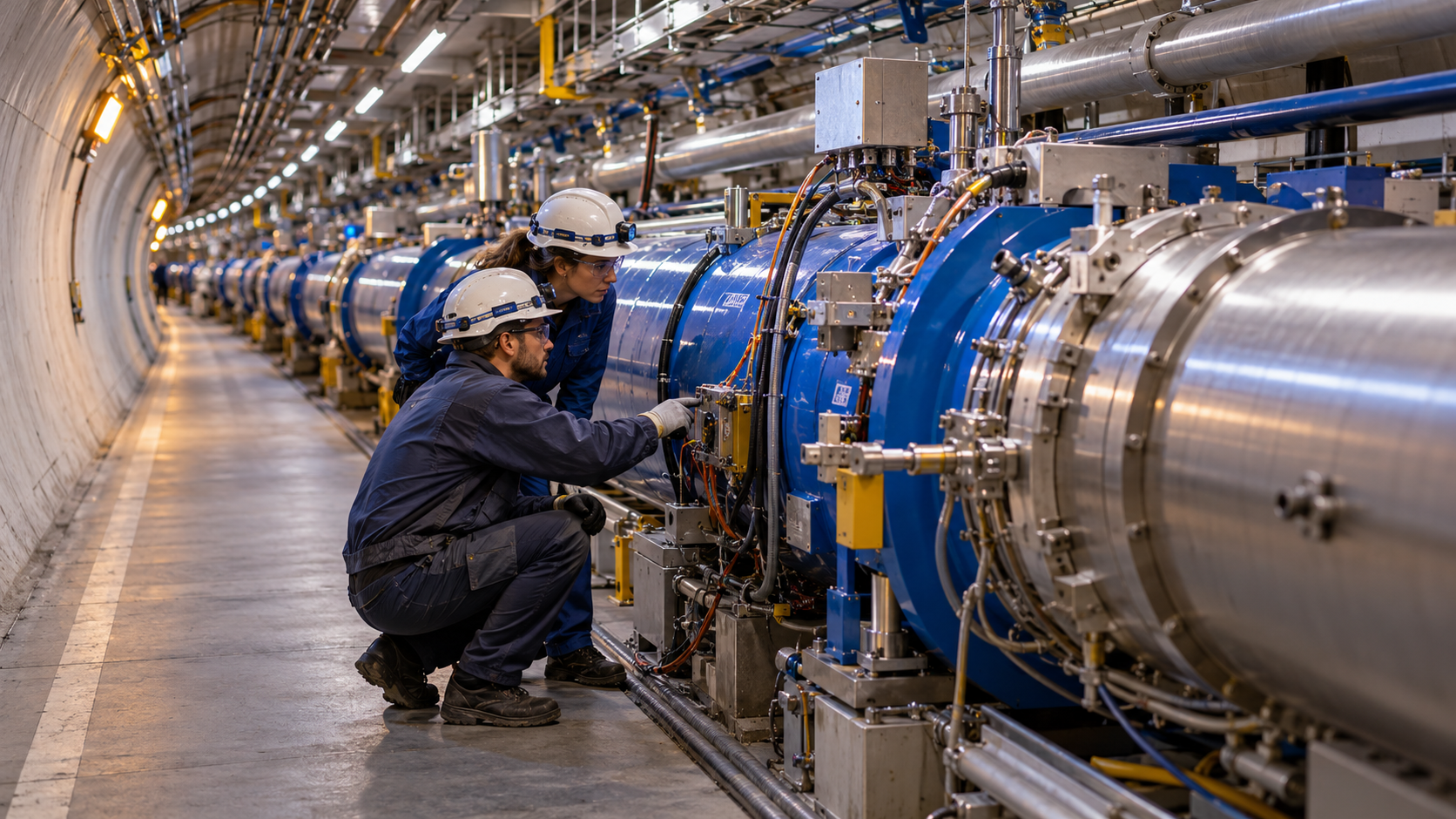
Magnetic fields steer and focus charged particles once they are moving. Dipole magnets bend the beam around curves, while quadrupole magnets focus it in one plane and defocus it in the perpendicular plane. Alternating quadrupoles can focus the beam overall, much like a series of lenses. Corrector magnets compensate for tiny alignment and field errors that would otherwise accumulate.
As energy rises, the beam becomes harder to bend, requiring stronger magnets or a larger ring. Operators synchronize fields, cavity frequency, beam position, and bunch spacing with extraordinary precision. Beam diagnostics measure current, profile, losses, energy, and orbit without unnecessarily disturbing the particles. Collimators absorb stray particles before they damage equipment or create excessive background.
A collider stores two beams moving in opposite directions and brings selected bunches into head-on overlap at detector sites. Focusing magnets squeeze the beams to increase the chance of interaction. Most particles pass through without colliding, so bunches circulate repeatedly. Layered detectors around the interaction point measure tracks, energy, timing, and particle decay products rather than photographing the short-lived collision directly.
Accelerators are not only giant particle-physics rings. Smaller systems produce medical imaging isotopes, treat cancer, sterilize materials, modify semiconductors, and probe structures with synchrotron light. Each machine balances energy, intensity, beam quality, radiation safety, cost, and purpose. The essential principle is coordinated electromagnetic control: fields add energy, magnets shape trajectories, vacuum preserves the beam, and detectors interpret the outcome.
Particle sources create charged particles that are grouped into timed bunches inside vacuum pipes.
Radiofrequency cavities transfer energy through oscillating electric fields synchronized to bunch arrival.
Dipole magnets bend trajectories and quadrupoles focus beam size and shape.
Diagnostics and correctors keep high-energy bunches aligned while collimators manage losses.
Colliders overlap counter-rotating bunches, and surrounding detectors reconstruct the debris.
Medical, industrial, and materials accelerators apply the same control principles at smaller scales.
Explore more "Explainers"
Discover additional explainers across politics, science, business, technology, and other fields. Each explainer breaks down a complex idea into clear, everyday language—helping you better understand how major concepts, systems, and debates shape the world around us.