

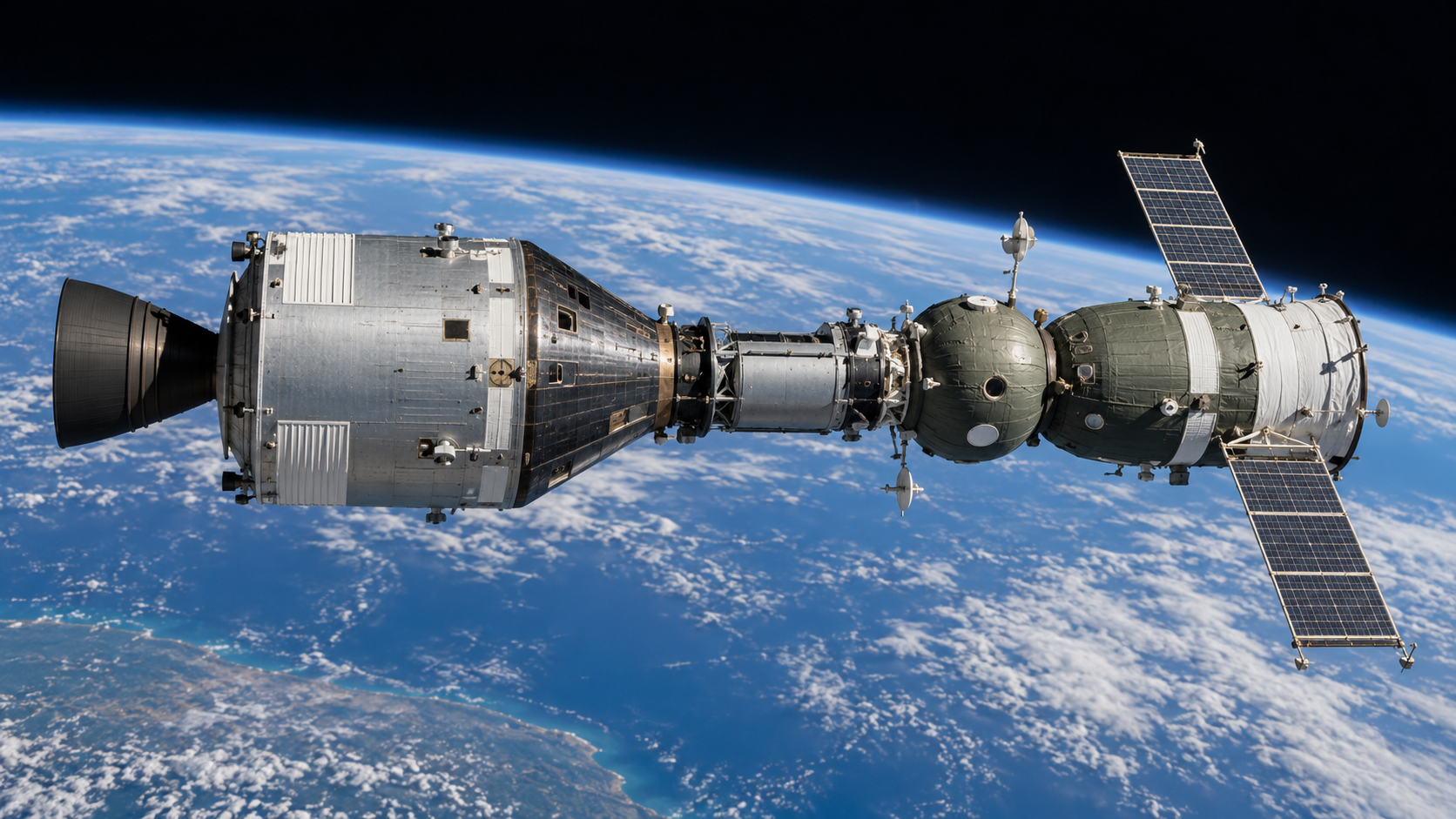
On This Day in Science: July 17, 1975
On July 17, 1975, American Apollo and Soviet Soyuz spacecraft docked in Earth orbit, two days after their separate launches. Apollo commander Thomas Stafford and Soyuz commander Alexei Leonov opened the hatches and met in the docking module, completing the first crewed linkup between spacecraft built by different nations.
The crews used a jointly designed androgynous docking system, in which either side could play the active or passive role. The docking module also worked as an airlock between Apollo’s low-pressure pure-oxygen atmosphere and Soyuz’s higher-pressure oxygen-nitrogen cabin. Crew members changed pressure gradually while moving between vehicles.
During nearly two days joined together, the five astronauts and cosmonauts exchanged visits, conducted experiments, shared meals, and participated in broadcasts. They also rehearsed undocking and redocking. Communication involved learned phrases, interpreters, common checklists, and years of joint training.
The docking was politically symbolic, but its most durable achievement was operational. It proved that competing programs could agree on interfaces that permitted rescue and cooperation in orbit. Decades later, multinational crews on the International Space Station would rely on compatible hardware and shared procedures as everyday necessities rather than one-time demonstrations. For science history, the event also shows how evidence moves from an observation or engineered test into a durable body of knowledge. Instruments supplied measurements, specialists debated interpretation, and later work refined what the first result could mean. Archives preserve the early record while new methods let researchers ask different questions of it. That continuing revision is the process through which a dated milestone remains scientifically useful. Seen across a longer timeline, scientific milestones are junctions rather than isolated beginnings. Earlier experiments, tools, and institutions made the work possible, while later teams tested limits and carried the result into new settings. What survives is a traceable chain of evidence, correction, and application that allows one moment to remain relevant as knowledge and technology continue to change. The anniversary highlights the difference between a first result and a finished understanding. A successful observation can settle one question while opening several harder ones, and even a failed objective can reshape later designs. Preserved data, specimens, photographs, and hardware allow new generations to revisit the work with better tools. Science advances through that continuity rather than stopping on a memorable date. Its calendar date is an entry point, not an endpoint. The people involved worked with the instruments, assumptions, and social conditions of their time, and later research has both extended and corrected their conclusions. Separating what was known that day from what became clear afterward protects the history from myth and shows how cumulative evidence turns an episode into lasting scientific knowledge.
Stafford and Leonov met after pressure checks and hatch opening.
Their greeting became the public symbol of the Apollo-Soyuz mission.
The common mechanism did not assign a permanently male or female side.
Either compatible spacecraft could perform the active capture role.
The crews performed experiments and tested repeated docking operations.
Shared standards became a precedent for later international stations.
Explore more of "On This Day ..."
Discover more events from the same date across news, politics, technology, sports, and other fields. Each link highlights significant moments that shaped history on different fronts.