

On This Day in Science: July 23, 1999
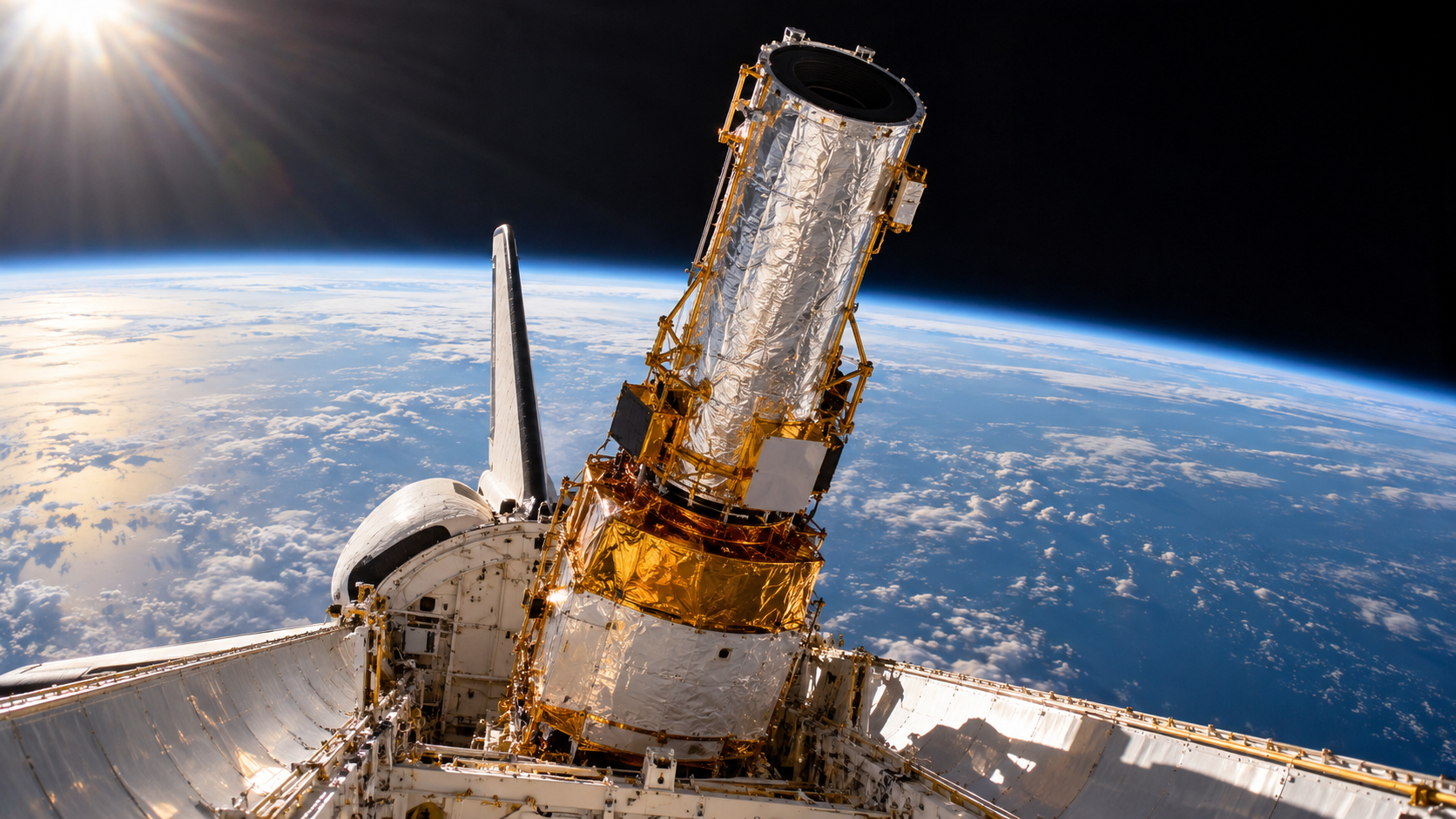
On July 23, 1999, Space Shuttle Columbia launched on mission STS-93 carrying the Chandra X-ray Observatory. After deployment from the payload bay, an Inertial Upper Stage and Chandra’s own propulsion placed the telescope in a highly elliptical orbit extending far beyond the radiation belts for long observing periods.
Earth’s atmosphere absorbs cosmic X-rays, protecting life but requiring X-ray observatories to operate in space. Chandra’s nested grazing-incidence mirrors guide energetic photons at shallow angles toward sensitive detectors. The system provides exceptionally sharp X-ray images and spectroscopy of extremely hot, violent, and compact objects.
The observatory has studied supernova remnants, neutron stars, black holes, galaxy clusters, stellar coronae, and hot gas across the universe. Its images are often assigned colors representing energy bands rather than ordinary visible appearance. Combining Chandra data with optical, infrared, and radio observations reveals structures that no single wavelength can show.
Named for physicist Subrahmanyan Chandrasekhar, the mission joined NASA’s family of Great Observatories. Its launch marked a major advance in resolving fine X-ray detail, allowing astronomers to trace shock waves, map hot matter, and examine how high-energy processes shape galaxies and cosmic environments. The anniversary highlights the difference between a first result and a finished understanding. A successful observation can settle one question while opening several harder ones, and even a failed objective can reshape later designs. Preserved data, specimens, photographs, and hardware allow new generations to revisit the work with better tools. Science advances through that continuity rather than stopping on a memorable date. Its calendar date is an entry point, not an endpoint. The people involved worked with the instruments, assumptions, and social conditions of their time, and later research has both extended and corrected their conclusions. Separating what was known that day from what became clear afterward protects the history from myth and shows how cumulative evidence turns an episode into lasting scientific knowledge. For science history, the event also shows how evidence moves from an observation or engineered test into a durable body of knowledge. Instruments supplied measurements, specialists debated interpretation, and later work refined what the first result could mean. Archives preserve the early record while new methods let researchers ask different questions of it. That continuing revision is the process through which a dated milestone remains scientifically useful. Seen across a longer timeline, scientific milestones are junctions rather than isolated beginnings. Earlier experiments, tools, and institutions made the work possible, while later teams tested limits and carried the result into new settings. What survives is a traceable chain of evidence, correction, and application that allows one moment to remain relevant as knowledge and technology continue to change.
The atmosphere blocks most astronomical X-rays before they reach the ground.
Chandra observes above that barrier in a high orbit.
X-rays would pass through or damage conventional telescope mirrors.
Nested shells reflect them gently toward detectors using grazing incidence.
Chandra maps gas at millions of degrees and matter near compact objects.
Its data complement visible, infrared, and radio astronomy.
Explore more of "On This Day ..."
Discover more events from the same date across news, politics, technology, sports, and other fields. Each link highlights significant moments that shaped history on different fronts.