

On This Day in Science: July 26, 1971
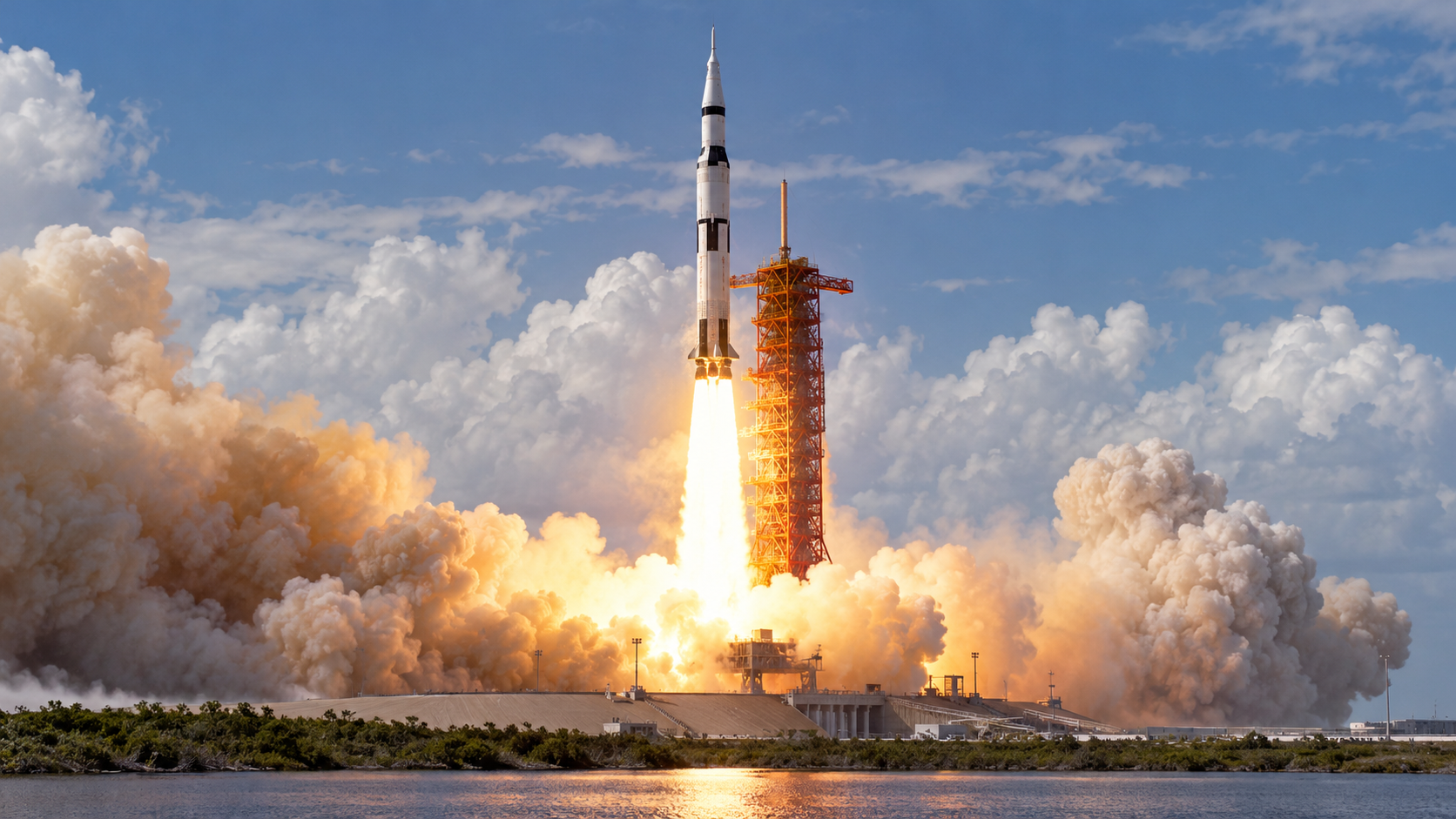
On July 26, 1971, Apollo 15 lifted from Kennedy Space Center aboard a Saturn V. Commander David Scott, lunar module pilot James Irwin, and command module pilot Alfred Worden began the first of Apollo’s extended J missions, designed to carry more equipment, stay longer, and emphasize scientific fieldwork.
The mission targeted the Hadley-Apennine region, where mountains, a deep sinuous rille, and exposed rocks promised clues to lunar history. The lunar module Falcon carried the first Lunar Roving Vehicle, a folded electric car that would greatly extend Scott and Irwin’s travel from the landing site.
Apollo 15 also carried an instrument bay in the service module for orbital mapping and remote sensing. While the surface crew explored, Worden operated cameras and instruments from lunar orbit. On the return trip he performed a deep-space spacewalk to retrieve film cassettes from the bay.
The launch began a mission that treated astronaut crews increasingly as field scientists. Training in geology, improved tools, longer stays, and mobile transport produced a richer sample collection, including the ancient rock later nicknamed the Genesis Rock. Apollo 15 demonstrated how an established transportation system could be adapted for more ambitious science. Seen across a longer timeline, scientific milestones are junctions rather than isolated beginnings. Earlier experiments, tools, and institutions made the work possible, while later teams tested limits and carried the result into new settings. What survives is a traceable chain of evidence, correction, and application that allows one moment to remain relevant as knowledge and technology continue to change. The anniversary highlights the difference between a first result and a finished understanding. A successful observation can settle one question while opening several harder ones, and even a failed objective can reshape later designs. Preserved data, specimens, photographs, and hardware allow new generations to revisit the work with better tools. Science advances through that continuity rather than stopping on a memorable date. Its calendar date is an entry point, not an endpoint. The people involved worked with the instruments, assumptions, and social conditions of their time, and later research has both extended and corrected their conclusions. Separating what was known that day from what became clear afterward protects the history from myth and shows how cumulative evidence turns an episode into lasting scientific knowledge. For science history, the event also shows how evidence moves from an observation or engineered test into a durable body of knowledge. Instruments supplied measurements, specialists debated interpretation, and later work refined what the first result could mean. Archives preserve the early record while new methods let researchers ask different questions of it. That continuing revision is the process through which a dated milestone remains scientifically useful.
Apollo 15 carried additional consumables, instruments, and surface equipment.
The extended design supported longer exploration than earlier landings.
The electric vehicle was packed against the lunar module descent stage.
Once deployed, it allowed the astronauts to reach distant geological targets.
Scott and Irwin practiced field geology around Hadley Rille.
Worden mapped the Moon and operated remote-sensing instruments from orbit.
Explore more of "On This Day ..."
Discover more events from the same date across news, politics, technology, sports, and other fields. Each link highlights significant moments that shaped history on different fronts.