

On This Day in Science: July 29, 1958
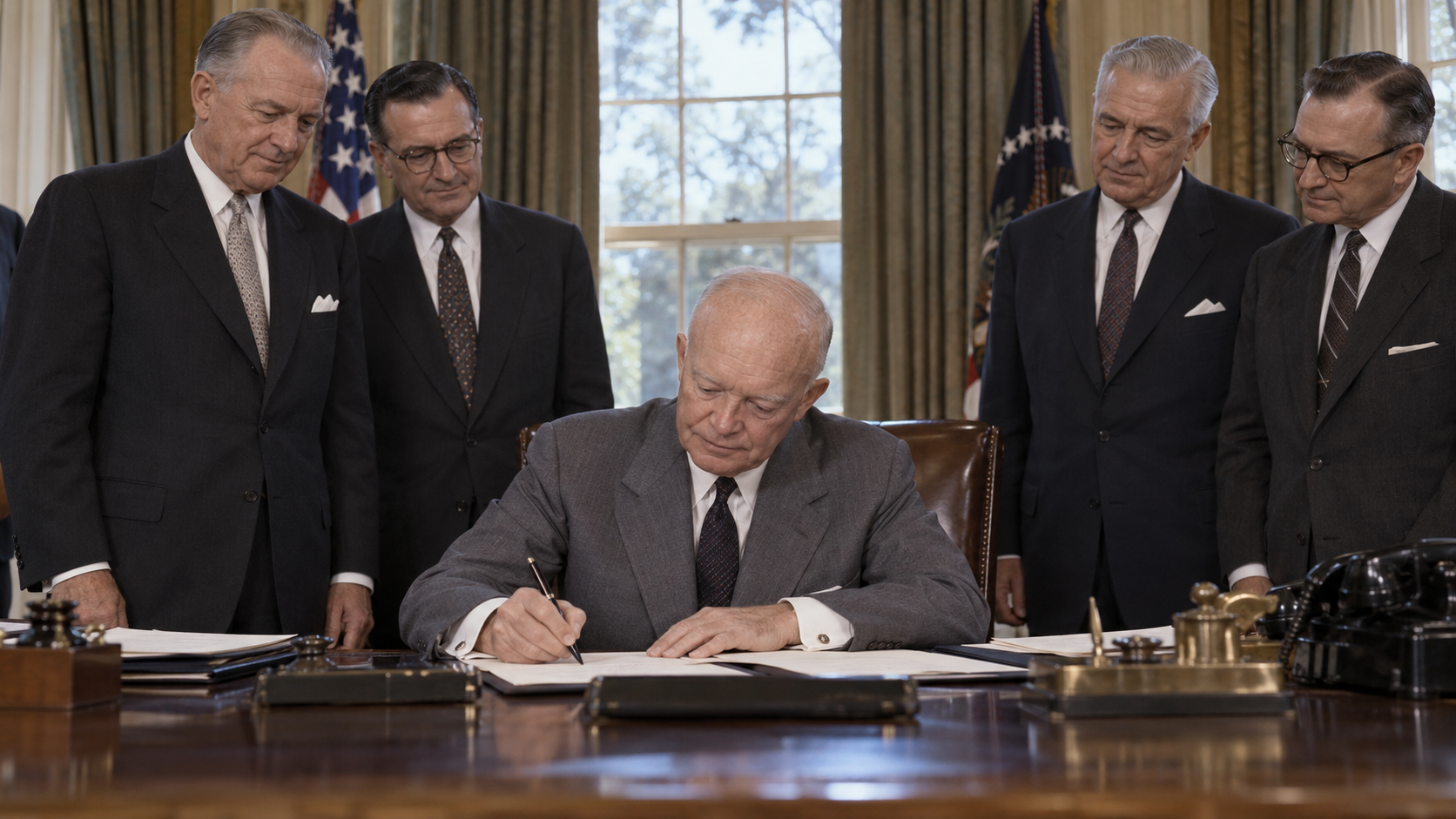
On July 29, 1958, President Dwight D. Eisenhower signed the National Aeronautics and Space Act into law. The legislation created the National Aeronautics and Space Administration, a civilian agency charged with research and exploration in flight and space, while recognizing separate military responsibilities. NASA began operations on October 1.
The act followed the Soviet Union’s launch of Sputnik in 1957 and an intense American debate over how to organize national space activity. Rather than building entirely from scratch, NASA absorbed the National Advisory Committee for Aeronautics, its laboratories, employees, research traditions, and experimental facilities. Other programs and centers were added as the agency grew.
The law called for expanding knowledge, improving aircraft and spacecraft, developing vehicles, preserving the United States’ role, and cooperating with other nations. It also required dissemination of information about activities and results, an important basis for the public scientific and technical record associated with civilian missions.
NASA later conducted human spaceflight, planetary exploration, Earth observation, astrophysics, aeronautics, and technology development. The signing did not produce those capabilities overnight, but it established the institutional framework through which engineers and scientists could plan long programs, operate spacecraft, share data, and pursue goals extending beyond a single military project. For science history, the event also shows how evidence moves from an observation or engineered test into a durable body of knowledge. Instruments supplied measurements, specialists debated interpretation, and later work refined what the first result could mean. Archives preserve the early record while new methods let researchers ask different questions of it. That continuing revision is the process through which a dated milestone remains scientifically useful. Seen across a longer timeline, scientific milestones are junctions rather than isolated beginnings. Earlier experiments, tools, and institutions made the work possible, while later teams tested limits and carried the result into new settings. What survives is a traceable chain of evidence, correction, and application that allows one moment to remain relevant as knowledge and technology continue to change. The anniversary highlights the difference between a first result and a finished understanding. A successful observation can settle one question while opening several harder ones, and even a failed objective can reshape later designs. Preserved data, specimens, photographs, and hardware allow new generations to revisit the work with better tools. Science advances through that continuity rather than stopping on a memorable date. Its calendar date is an entry point, not an endpoint. The people involved worked with the instruments, assumptions, and social conditions of their time, and later research has both extended and corrected their conclusions. Separating what was known that day from what became clear afterward protects the history from myth and shows how cumulative evidence turns an episode into lasting scientific knowledge.
The act placed peaceful national space research in a public civilian organization.
Military space responsibilities remained with defense agencies.
NASA inherited laboratories, personnel, aircraft research, and management experience.
The older aeronautics organization supplied an operating base for rapid expansion.
The law covered aeronautics, vehicles, knowledge, cooperation, and information.
Its broad language supported programs from Earth science to deep-space exploration.
Explore more of "On This Day ..."
Discover more events from the same date across news, politics, technology, sports, and other fields. Each link highlights significant moments that shaped history on different fronts.