

On This Day in Science: August 2, 1932
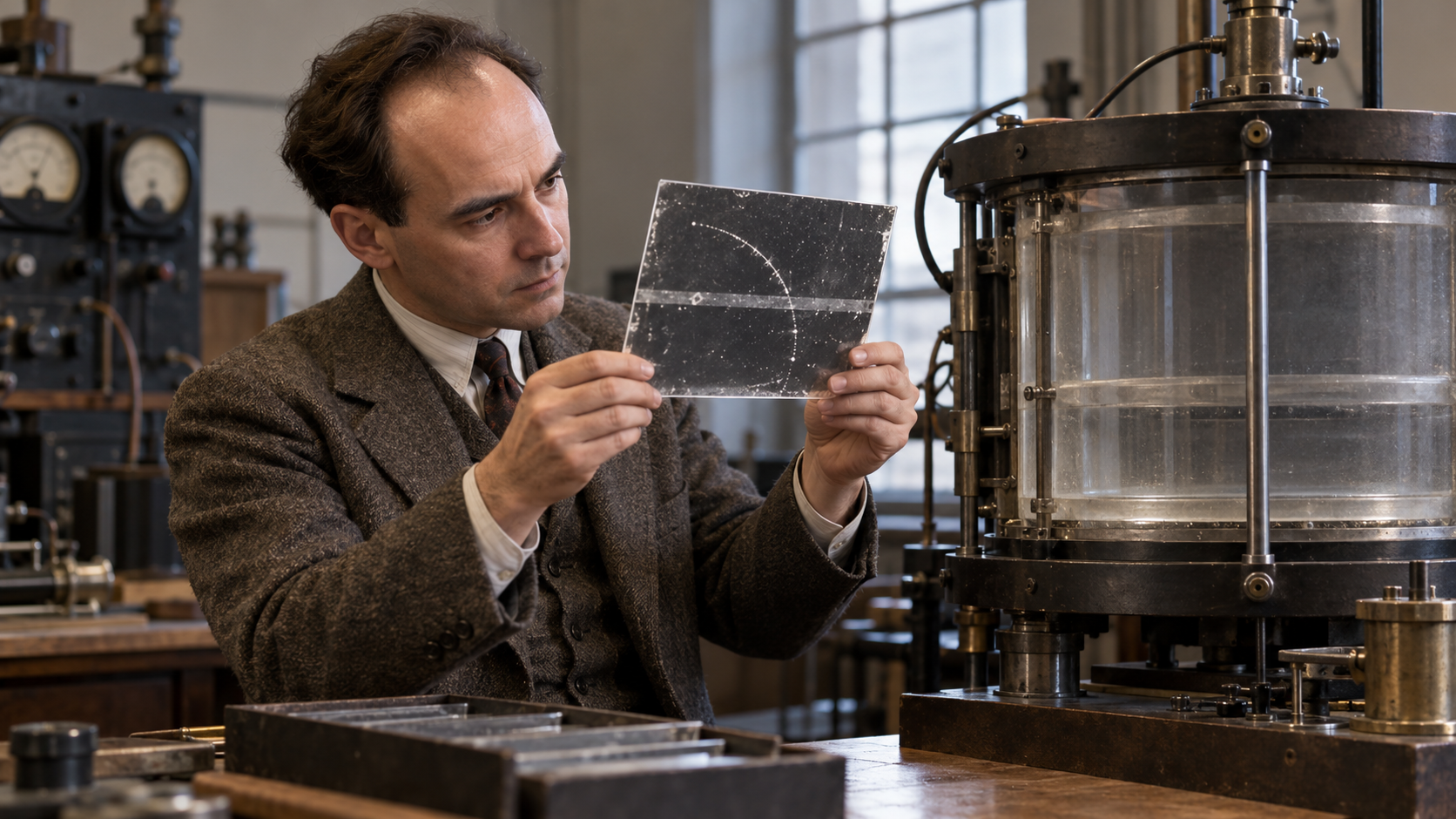
On August 2, 1932, Caltech physicist Carl Anderson recorded a cosmic-ray particle passing through a cloud chamber and a lead plate. Its track curved in a magnetic field like that of a positively charged particle, yet its energy loss and path showed that it could not be a proton. The evidence pointed to a particle with the electron’s small mass and the opposite charge.
Anderson’s apparatus filled a chamber with supersaturated vapor so a charged particle left a visible trail of droplets. A strong magnet bent the trail, revealing charge and momentum. The lead plate slowed the particle and made its direction of travel distinguishable, resolving an ambiguity that otherwise could make a positive particle look like an electron traveling the other way.
Paul Dirac’s relativistic quantum theory had implied an electron counterpart, but a theoretical possibility still required experimental evidence. Anderson published the result and called the particle the positive electron; the name positron followed. Other experiments soon confirmed pair production, in which energy can create an electron and positron together.
The photograph became the first clear observation of an antiparticle and earned Anderson a share of the 1936 Nobel Prize in Physics. Positrons are now used in particle research and positron-emission tomography, while antimatter remains a central tool for testing the symmetry of physical laws. Seen across a longer timeline, scientific milestones are junctions rather than isolated beginnings. Earlier experiments, tools, and institutions made the work possible, while later teams tested limits and carried the result into new settings. What survives is a traceable chain of evidence, correction, and application that allows one moment to remain relevant as knowledge and technology continue to change. The anniversary highlights the difference between a first result and a finished understanding. A successful observation can settle one question while opening several harder ones, and even a failed objective can reshape later designs. Preserved data, specimens, photographs, and hardware allow new generations to revisit the work with better tools. Science advances through that continuity rather than stopping on a memorable date. Its calendar date is an entry point, not an endpoint. The people involved worked with the instruments, assumptions, and social conditions of their time, and later research has both extended and corrected their conclusions. Separating what was known that day from what became clear afterward protects the history from myth and shows how cumulative evidence turns an episode into lasting scientific knowledge. For science history, the event also shows how evidence moves from an observation or engineered test into a durable body of knowledge. Instruments supplied measurements, specialists debated interpretation, and later work refined what the first result could mean. Archives preserve the early record while new methods let researchers ask different questions of it. That continuing revision is the process through which a dated milestone remains scientifically useful.
Ionization seeded a thin line of droplets inside Anderson’s cloud chamber.
A magnetic field curved the path according to the particle’s charge and momentum.
The particle lost energy as it crossed the plate.
Its tighter curvature after slowing showed which way it had traveled.
The positron matched the electron’s mass but carried positive charge.
Its discovery linked quantum theory to a new experimental world of antimatter.
Explore more of "On This Day ..."
Discover more events from the same date across news, politics, technology, sports, and other fields. Each link highlights significant moments that shaped history on different fronts.