

On This Day in Science: August 7, 1959
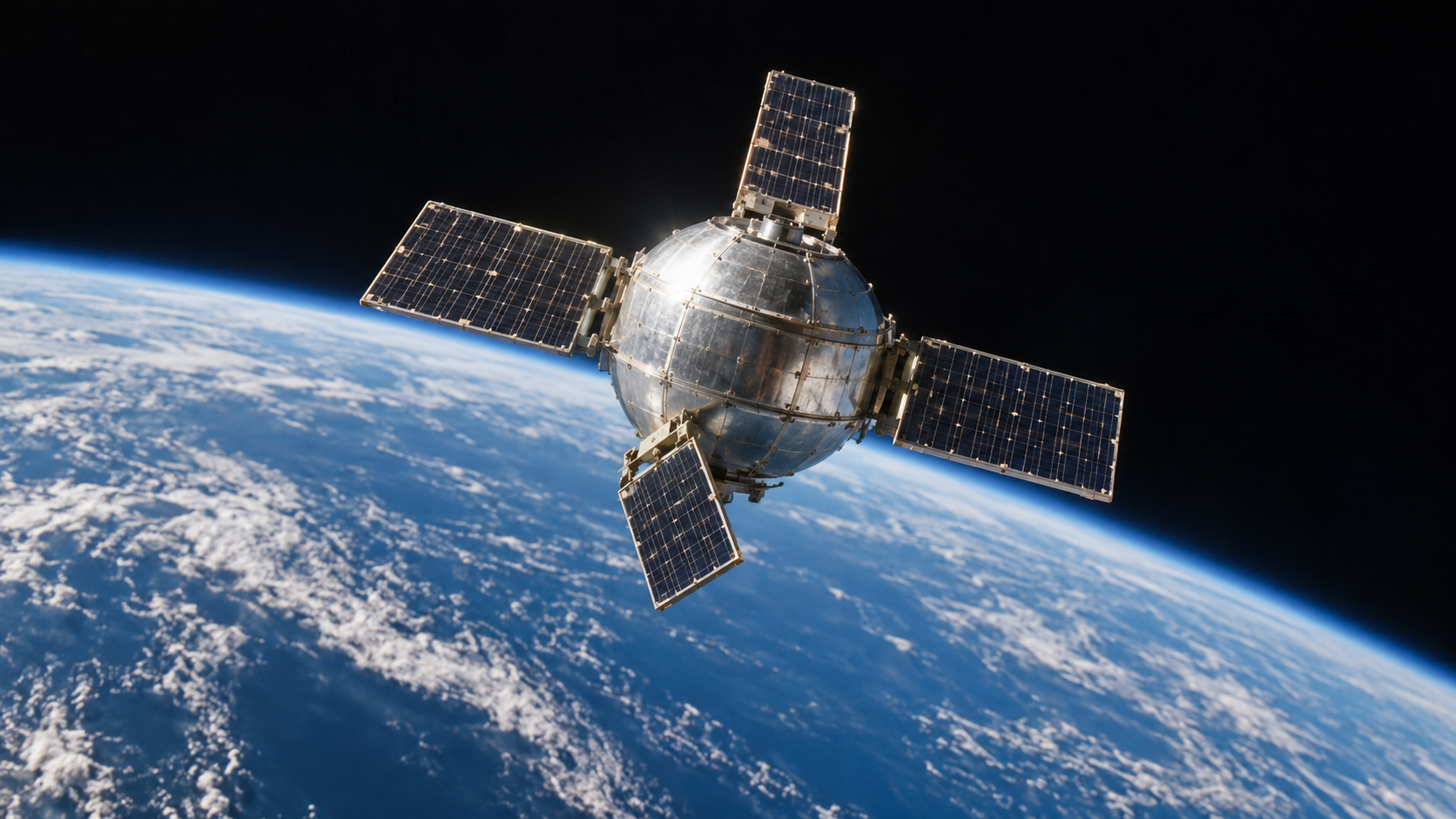
On August 7, 1959, the United States launched Explorer 6 on a Thor-Able rocket from Cape Canaveral. The small “paddlewheel” satellite carried four solar panels that unfolded around a rounded central body. Its instruments examined trapped radiation, cosmic rays, magnetic fields, micrometeoroids, and radio propagation in a highly elliptical orbit.
Explorer 6 also carried a simple scanning device intended to sense cloud cover. On August 14 it transmitted a crude image of the sunlit Pacific and cloud patterns from roughly 17,000 miles away. The picture was low in detail and required ground processing, but it became the first photograph of Earth sent from an orbiting satellite.
The spacecraft’s power system did not perform as planned because only three solar panels deployed fully. Engineers nevertheless received useful data for nearly two months. The mission added measurements to the rapidly growing picture of the Van Allen radiation belts and demonstrated communications over great distances.
The launch belongs to an era when Earth observation, space physics, power systems, and telemetry were tested together in compact experimental satellites. Explorer 6’s blurred crescent image was modest by modern standards, yet it helped shift planetary viewing from rare rocket snapshots toward routine observation from orbit. The anniversary highlights the difference between a first result and a finished understanding. A successful observation can settle one question while opening several harder ones, and even a failed objective can reshape later designs. Preserved data, specimens, photographs, and hardware allow new generations to revisit the work with better tools. Science advances through that continuity rather than stopping on a memorable date. Its calendar date is an entry point, not an endpoint. The people involved worked with the instruments, assumptions, and social conditions of their time, and later research has both extended and corrected their conclusions. Separating what was known that day from what became clear afterward protects the history from myth and shows how cumulative evidence turns an episode into lasting scientific knowledge. For science history, the event also shows how evidence moves from an observation or engineered test into a durable body of knowledge. Instruments supplied measurements, specialists debated interpretation, and later work refined what the first result could mean. Archives preserve the early record while new methods let researchers ask different questions of it. That continuing revision is the process through which a dated milestone remains scientifically useful. Seen across a longer timeline, scientific milestones are junctions rather than isolated beginnings. Earlier experiments, tools, and institutions made the work possible, while later teams tested limits and carried the result into new settings. What survives is a traceable chain of evidence, correction, and application that allows one moment to remain relevant as knowledge and technology continue to change.
Four solar panels were meant to unfold around the spacecraft’s central body.
One panel failed to open fully, reducing available power.
Most instruments measured particles, fields, and the space environment.
A photocell scanner added an experimental view of cloud cover.
The image transmitted a week after launch was crude and crescent-shaped.
It was the first photograph of Earth returned by an orbiting satellite.
Explore more of "On This Day ..."
Discover more events from the same date across news, politics, technology, sports, and other fields. Each link highlights significant moments that shaped history on different fronts.