

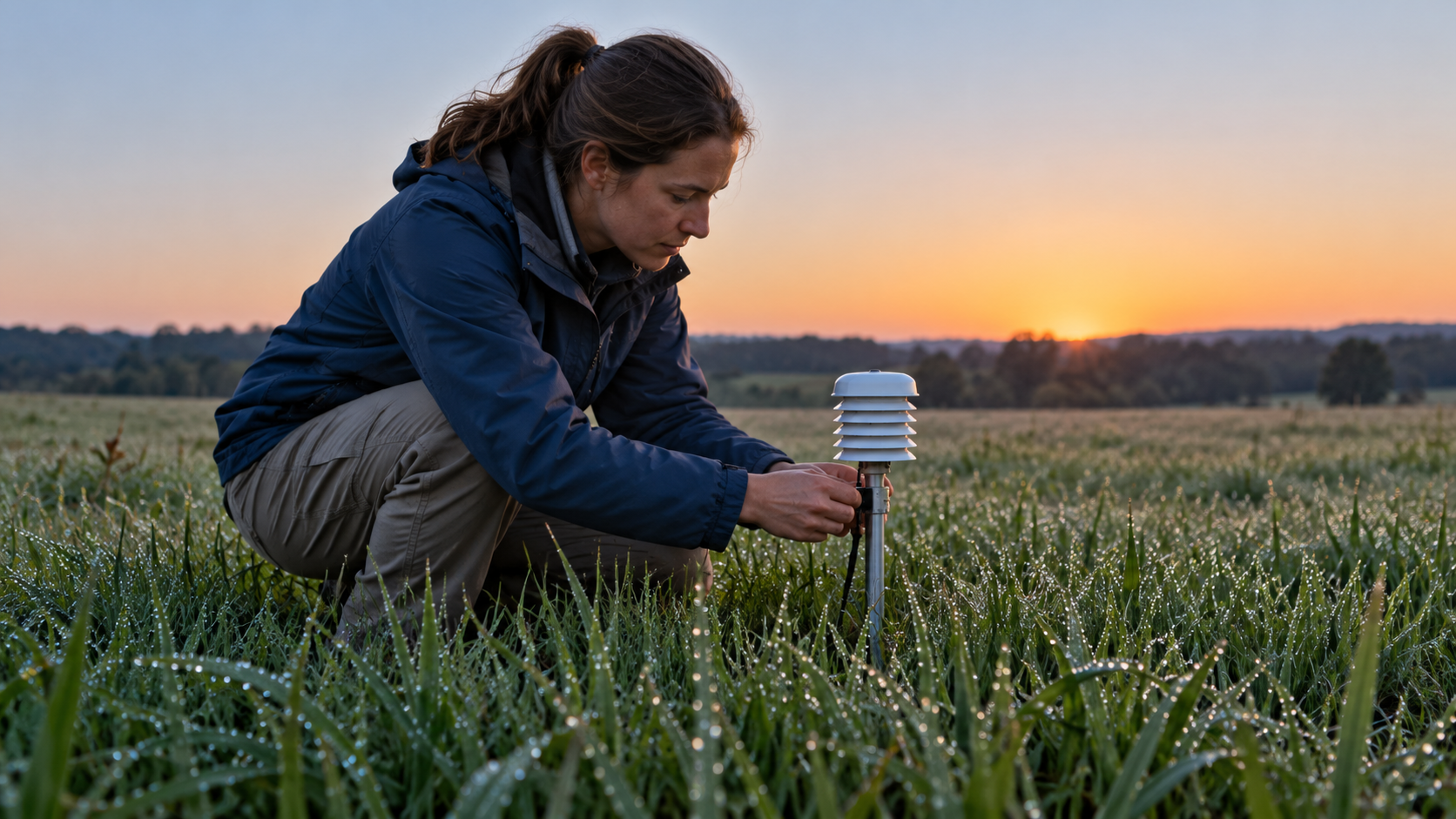
How Dew Forms Explainer
Dew is liquid water that condenses directly on surfaces near the ground. It is not rain left behind and does not ordinarily rise from inside a cold object. Air contains invisible water vapor, and for a given pressure there is a temperature at which that vapor reaches saturation. That threshold is the dew point, which depends mainly on the amount of moisture in the air.
After sunset, the ground and exposed objects emit infrared radiation and may cool faster than the air above them. On a clear night, less downward infrared radiation from clouds offsets that loss. If a leaf, car roof, or instrument surface falls below the dew point of adjacent air, water molecules condense there and release latent heat as droplets form.
Condensation continues while moisture reaches the surface faster than it evaporates. A humid air mass supplies more vapor, while gentle air movement can replenish moisture without mixing in too much warmer air. Strong wind often keeps surfaces and air temperatures closer together and can reduce radiative cooling. Cloud cover likewise tends to limit the temperature drop that favors heavy dew.
Surface properties change the pattern. Good infrared emitters and thermally isolated leaves may cool below nearby air, while thick or conductive materials exchange heat differently. Microscopic texture, cleanliness, and wettability control whether water spreads into a film or beads into droplets. Dew can therefore vary sharply across objects only centimeters apart even though they share the same weather.
If the surface is below freezing, water vapor may deposit as ice or supercooled droplets may freeze, producing frost rather than ordinary dew. Dew point and frost point are related but not interchangeable under all conditions. Fog uses the same saturation principle within an air layer, whereas dew is defined by condensation onto a surface that has cooled the neighboring air.
Meteorologists measure dew point as an indicator of atmospheric moisture, but predicting visible dew also requires surface temperature, radiation, wind, and local exposure. Dew can supply water to plants and small organisms, wet crops and equipment, and influence fungal disease. It is a compact example of how energy exchange and phase change connect the atmosphere with materials at the ground.
Dew point is the temperature at which air of a given moisture content reaches saturation.
Surfaces can cool below nearby air by emitting infrared radiation after sunset.
Water vapor condenses when contact with a cold surface cools the adjacent air sufficiently.
Clouds, wind, humidity, exposure, and thermal properties affect how much dew appears.
Texture and wettability determine whether condensate beads or spreads.
Below-freezing surfaces can produce frost, which is distinct from ordinary liquid dew.
Explore more "Explainers"
Discover additional explainers across politics, science, business, technology, and other fields. Each explainer breaks down a complex idea into clear, everyday language—helping you better understand how major concepts, systems, and debates shape the world around us.