

On This Day in Science: August 29, 1831
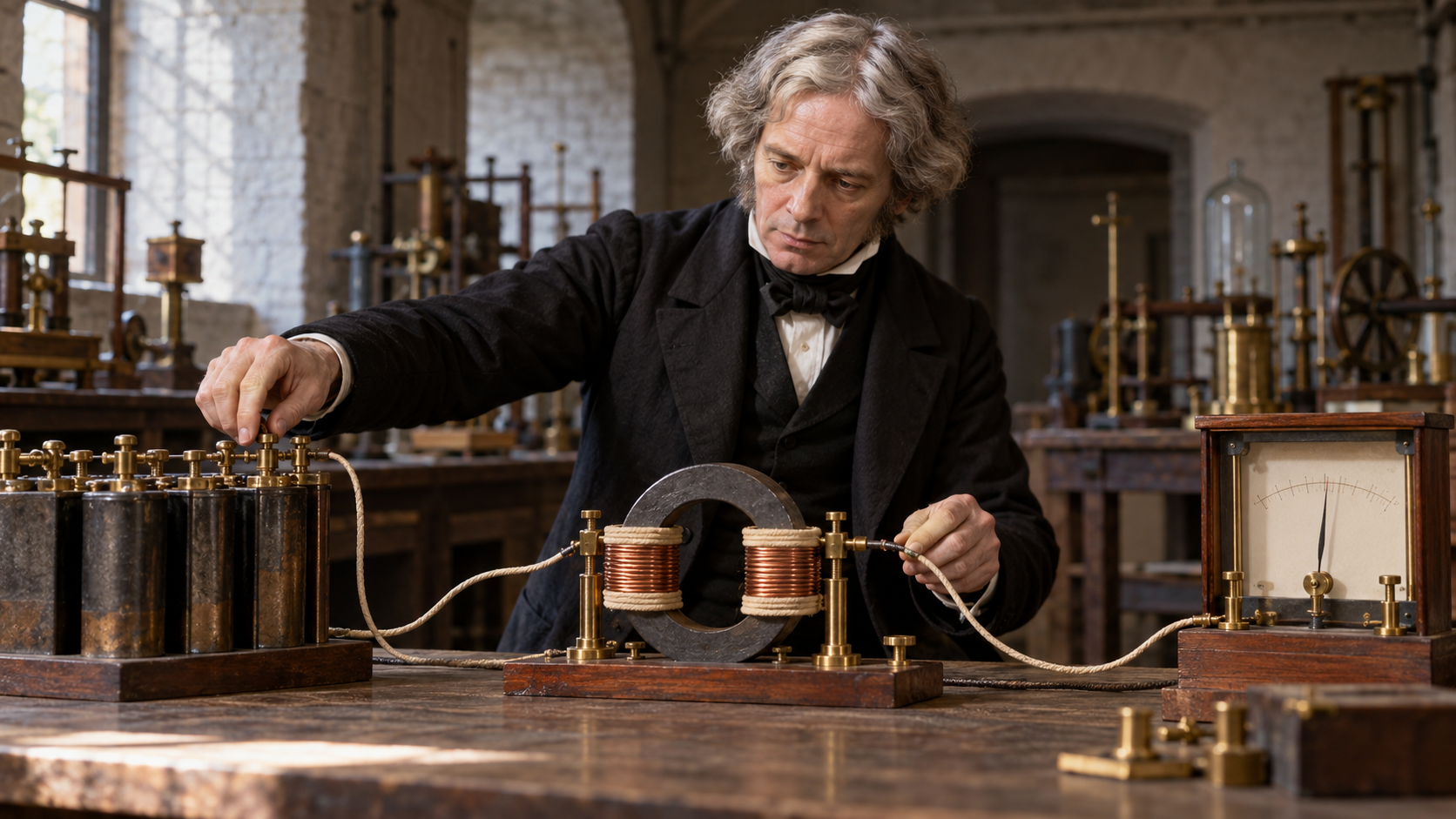
On August 29, 1831, Michael Faraday demonstrated electromagnetic induction in the basement laboratory of the Royal Institution in London. He wound two insulated coils on opposite sides of an iron ring. Connecting one coil to a battery produced a brief current in the other, detected by a galvanometer.
The current appeared only when the battery circuit changed—at connection or disconnection—not while a steady current flowed. Faraday recognized that changing magnetic conditions, rather than a constant field alone, were essential. He soon extended the experiments by moving magnets and conductors relative to one another.
Hans Christian Ørsted had shown that electric current produces magnetism, and Faraday sought the reverse relationship. His ring apparatus acted as an early transformer: a changing current in one circuit created a changing magnetic field in the iron, which induced voltage in a separate circuit.
Electromagnetic induction became the operating principle of generators, transformers, induction motors, microphones, and countless sensors. The experiment linked mechanical motion, magnetism, and electric power, providing a foundation for large-scale generation and distribution even before later mathematics expressed the relation as Faraday’s law. For science history, the event also shows how evidence moves from an observation or engineered test into a durable body of knowledge. Instruments supplied measurements, specialists debated interpretation, and later work refined what the first result could mean. Archives preserve the early record while new methods let researchers ask different questions of it. That continuing revision is the process through which a dated milestone remains scientifically useful. Seen across a longer timeline, scientific milestones are junctions rather than isolated beginnings. Earlier experiments, tools, and institutions made the work possible, while later teams tested limits and carried the result into new settings. What survives is a traceable chain of evidence, correction, and application that allows one moment to remain relevant as knowledge and technology continue to change. The anniversary highlights the difference between a first result and a finished understanding. A successful observation can settle one question while opening several harder ones, and even a failed objective can reshape later designs. Preserved data, specimens, photographs, and hardware allow new generations to revisit the work with better tools. Science advances through that continuity rather than stopping on a memorable date. Its calendar date is an entry point, not an endpoint. The people involved worked with the instruments, assumptions, and social conditions of their time, and later research has both extended and corrected their conclusions. Separating what was known that day from what became clear afterward protects the history from myth and shows how cumulative evidence turns an episode into lasting scientific knowledge.
The windings were electrically separate but magnetically linked through the core.
A galvanometer revealed a brief current in the secondary coil.
Steady battery current produced no continuing response.
Switching the circuit changed magnetic flux and generated a pulse.
Moving magnets or conductors also changes magnetic flux.
That conversion from motion to electricity underlies modern power systems.
Explore more of "On This Day ..."
Discover more events from the same date across news, politics, technology, sports, and other fields. Each link highlights significant moments that shaped history on different fronts.