

On This Day in Science: August 28, 1789
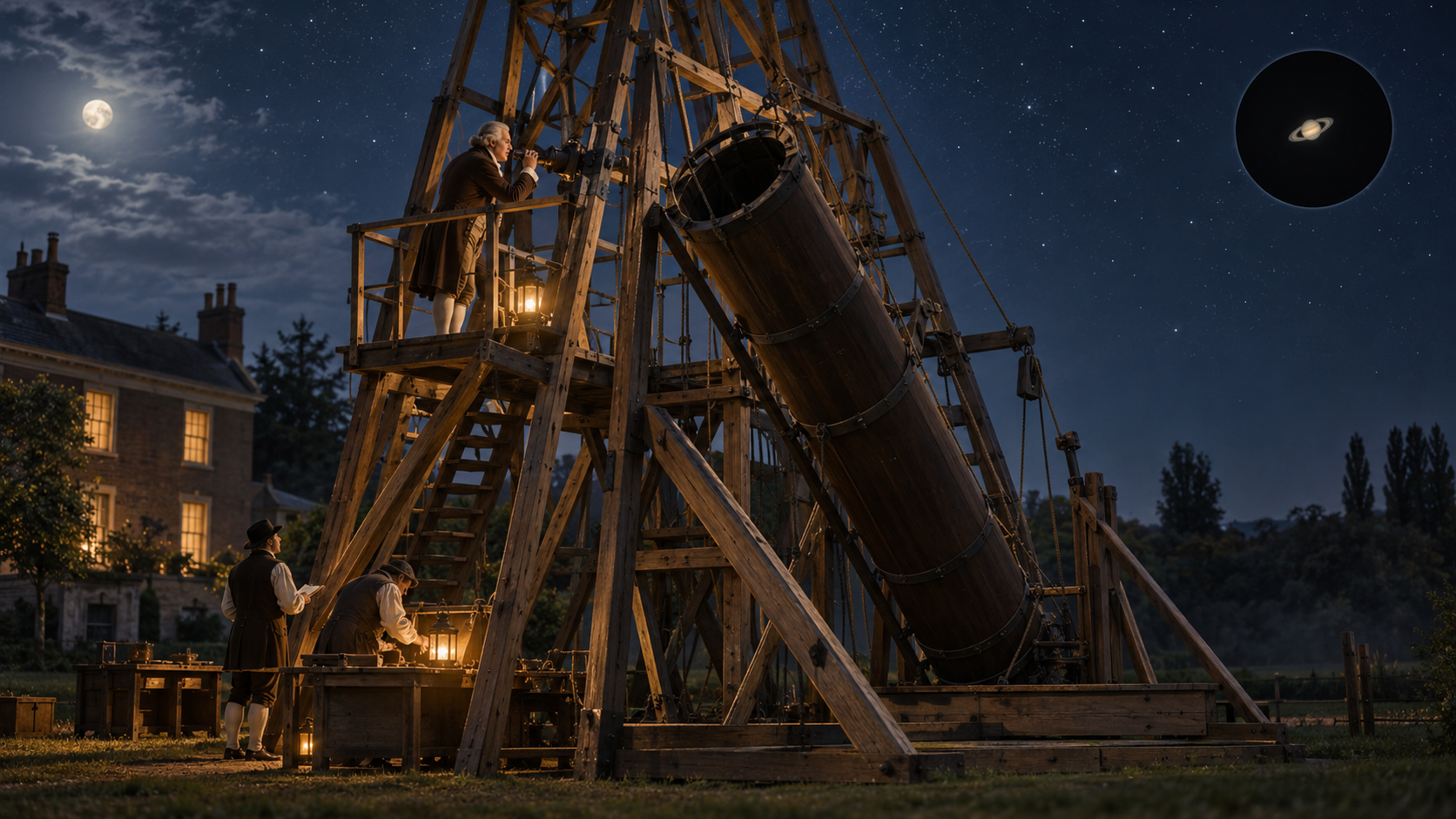
On August 28, 1789, William Herschel observed a small point of light near Saturn and identified a previously unknown moon, later named Enceladus. He made the discovery from Observatory House in Slough, England, using his enormous forty-foot reflecting telescope shortly after the instrument became operational.
Enceladus is difficult to see because it is small, close to bright Saturn, and embedded in the glare of the planet and rings. Herschel’s large metal mirror gathered more light than most contemporary telescopes, but observation still depended on careful tracking, favorable geometry, and repeated comparison.
For nearly two centuries the moon remained a tiny unresolved object. Voyager images showed a bright, geologically varied icy surface, and the Cassini mission later discovered jets of water vapor and ice erupting from fractures near the south pole. Measurements indicate a global subsurface ocean beneath the ice.
The discovery illustrates how the scientific meaning of an object can grow far beyond the first sighting. A faint satellite found visually in 1789 is now a leading target in the search for habitable environments because its plume may provide access to material from an ocean without drilling through the crust. Its calendar date is an entry point, not an endpoint. The people involved worked with the instruments, assumptions, and social conditions of their time, and later research has both extended and corrected their conclusions. Separating what was known that day from what became clear afterward protects the history from myth and shows how cumulative evidence turns an episode into lasting scientific knowledge. For science history, the event also shows how evidence moves from an observation or engineered test into a durable body of knowledge. Instruments supplied measurements, specialists debated interpretation, and later work refined what the first result could mean. Archives preserve the early record while new methods let researchers ask different questions of it. That continuing revision is the process through which a dated milestone remains scientifically useful. Seen across a longer timeline, scientific milestones are junctions rather than isolated beginnings. Earlier experiments, tools, and institutions made the work possible, while later teams tested limits and carried the result into new settings. What survives is a traceable chain of evidence, correction, and application that allows one moment to remain relevant as knowledge and technology continue to change. The anniversary highlights the difference between a first result and a finished understanding. A successful observation can settle one question while opening several harder ones, and even a failed objective can reshape later designs. Preserved data, specimens, photographs, and hardware allow new generations to revisit the work with better tools. Science advances through that continuity rather than stopping on a memorable date.
Enceladus is small and orbits close to the bright planet and rings.
Herschel needed exceptional light-gathering power and careful observation.
The giant reflector used a metal primary mirror and a high observing platform.
Its scale increased sensitivity but made operation difficult.
Voyager revealed an icy surface and Cassini found active plumes.
A buried ocean makes Enceladus a major astrobiology target.
Explore more of "On This Day ..."
Discover more events from the same date across news, politics, technology, sports, and other fields. Each link highlights significant moments that shaped history on different fronts.