

How Estuaries Mix Fresh and Salt Water Explainer
An estuary is a partly enclosed coastal water body where river water interacts with seawater and water level is influenced by tides. The resulting brackish water does not have one fixed salinity. Salt concentration changes from ocean to river, surface to bottom, and hour to hour as tides, freshwater discharge, weather, and basin geometry move and mix the two water sources.
Seawater is usually denser than freshwater because of its dissolved salts. When river flow is strong and tidal stirring is weak, buoyant freshwater can ride above a landward-moving layer of salty water, producing a salt-wedge estuary. The boundary between them can be sharp, but friction and turbulence continually exchange water, salt, sediment, nutrients, and oxygen across it.
Stronger tidal currents stir the water column. A partially mixed estuary retains saltier bottom water but has a broader transition, while a well-mixed estuary has little vertical salinity difference and mainly changes along its length. Deep glacial fjords may have a shallow sill that restricts exchange below, allowing distinct deep-water conditions to persist for long periods.
Wind can either enhance mixing or push surface water in a direction that strengthens layering. River floods freshen the upper estuary and move the salinity boundary seaward; drought and high tides can carry salt farther upstream. Earth’s rotation, channel bends, branching marshes, bottom roughness, and constrictions add three-dimensional circulation that a simple two-layer sketch cannot capture.
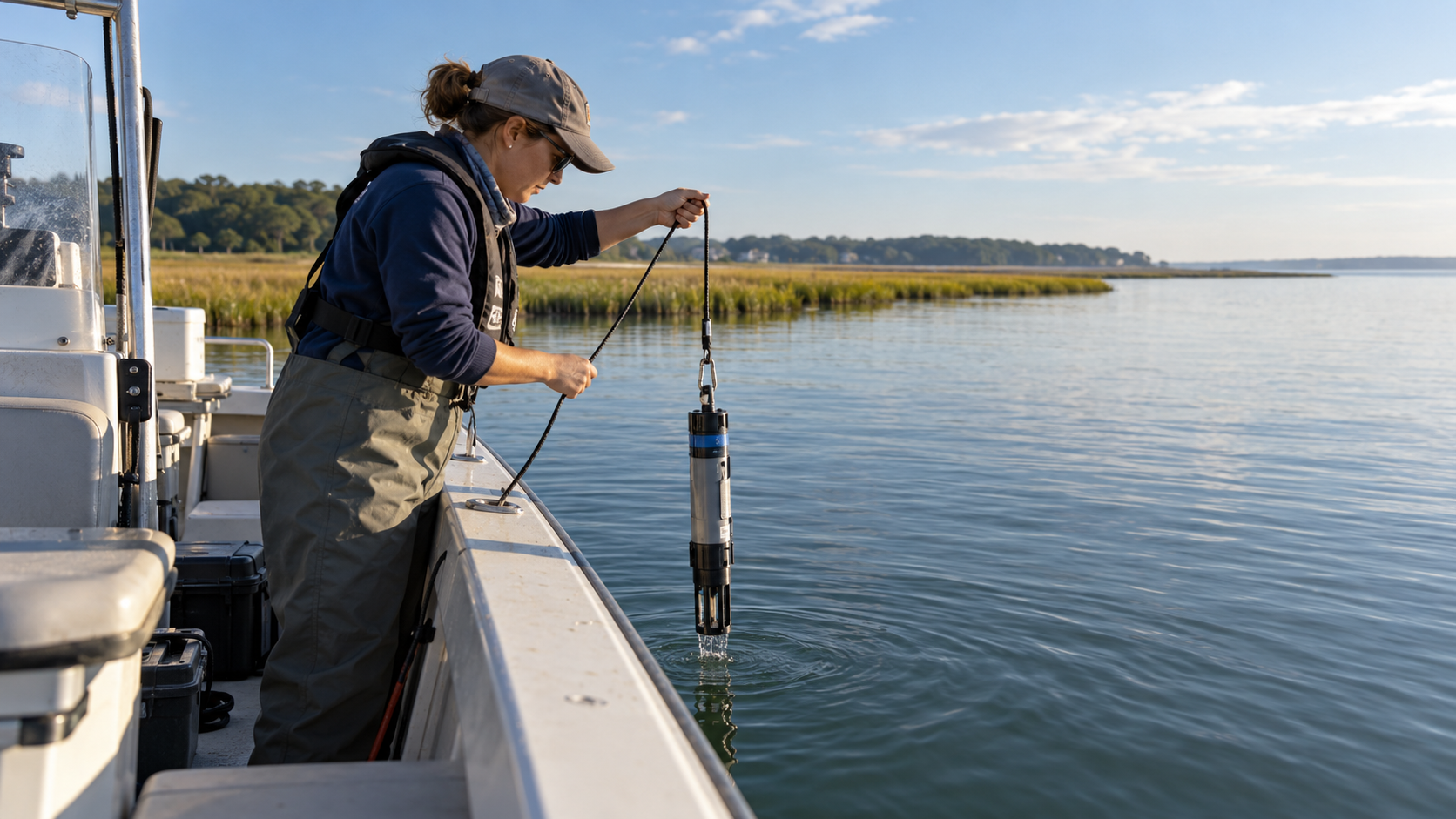
Scientists measure conductivity, temperature, pressure, current velocity, dissolved oxygen, and turbidity from boats, fixed stations, and autonomous instruments. Because conductivity depends strongly on dissolved ions, it provides a practical route to salinity. Repeated profiles reveal isohalines—contours of equal salinity—and show when stratification limits the downward supply of oxygen from the atmosphere.
Estuarine mixing controls where organisms can live and how larvae, pollutants, nutrients, and sediments move. Oysters and marsh plants tolerate particular ranges, while low-oxygen bottom water can stress animals. Each estuary responds differently, so one observation cannot define it permanently. The core process is a changing competition among buoyancy, river flow, tides, wind, friction, and shape.
River water and seawater form dynamic brackish conditions rather than one uniform salinity.
Denser seawater can move beneath buoyant freshwater and create a salt wedge.
Tidal turbulence changes a stratified estuary toward partially or vertically mixed states.
Floods, drought, wind, and tides move salinity boundaries over hours and seasons.
Geometry, depth, sills, channels, friction, and rotation shape three-dimensional circulation.
Salinity profiles help explain oxygen, sediment, nutrient, pollutant, and habitat patterns.
Explore more "Explainers"
Discover additional explainers across politics, science, business, technology, and other fields. Each explainer breaks down a complex idea into clear, everyday language—helping you better understand how major concepts, systems, and debates shape the world around us.