

How Rivers Build Deltas Explainer
A delta is a body of sediment built where a river enters standing water such as an ocean, lake, or reservoir. As the current spreads and slows, it loses capacity to carry sand, silt, and clay. Particles settle in different places according to size, flow, turbulence, and salinity. A delta grows only when deposition outpaces the ability of waves and currents to redistribute or remove sediment.
Coarser sand commonly settles near a channel mouth and forms submerged mouth bars. Water is diverted around the growing bar, which can split one channel into distributaries. During floods, sediment-laden water may overtop banks, raise natural levees, fill wetlands, or cut a shorter route to the basin. Repeated channel switching builds lobes across different parts of the delta plain.
River discharge and sediment supply reflect the entire upstream watershed. Erosion, vegetation, storms, dams, bank stabilization, and land use alter how much material reaches the coast. A large river does not automatically build land if reservoirs trap its sediment or if the load is mostly fine particles carried beyond the nearshore zone. Flood pulses can deliver a disproportionate share.
Marine forces reshape what the river deposits. Strong waves smooth a delta front and move sand alongshore; large tides create channels and tidal flats; weak wave and tidal energy lets river-built lobes project farther outward. Basin depth and shelf slope affect how much sediment is needed. Fresh and salty water also mix in ways that can make fine particles clump and settle.
New deposits compact under their own weight, and soft underlying sediment can subside. Organic soils may shrink when drained, while extraction of groundwater or hydrocarbons can accelerate sinking. Sea-level rise raises the elevation a delta must match. Wetlands can trap sediment and build organic matter, but only if deposition and biological growth keep pace with relative water-level change.
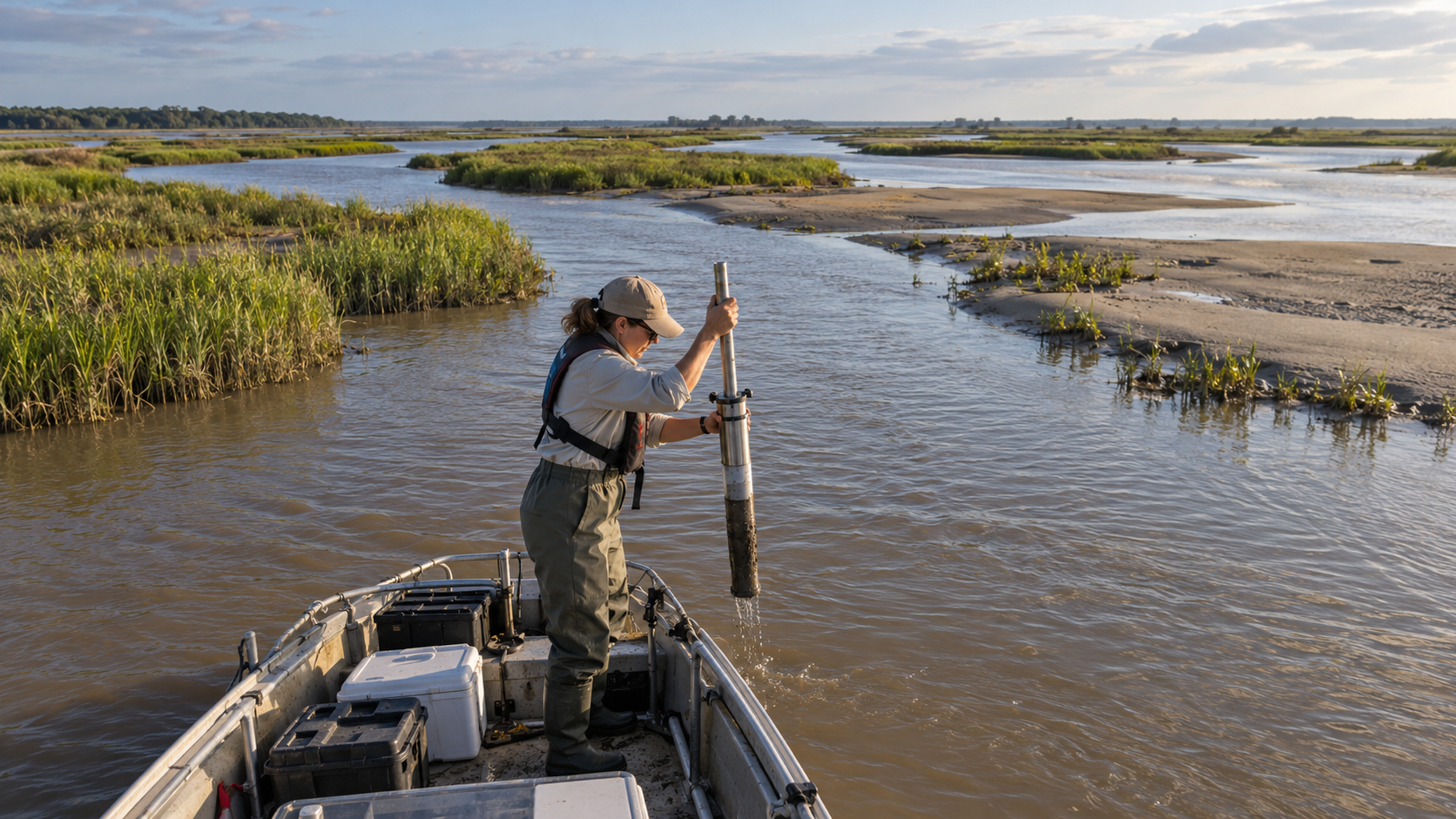
Deltas naturally alternate between construction and abandonment, so one lobe can retreat while another advances. Navigation channels, levees, dams, and restoration projects change those pathways. Scientists use gauges, sediment samples, cores, sonar, satellites, and repeated elevation surveys to track the budget. Delta survival is ultimately a competition among delivered sediment, redistribution, subsidence, and changing water level.
Rivers deposit sediment when they slow as they enter an ocean, lake, or reservoir.
Mouth bars divert flow and help distributary channels split and migrate.
Floods deliver sediment to channels, levees, wetlands, and the delta front.
Waves, tides, salinity, shelf shape, and currents redistribute river deposits.
Compaction, subsidence, and sea-level rise can outpace vertical land building.
A delta advances only where sediment and organic growth exceed removal and sinking.
Explore more "Explainers"
Discover additional explainers across politics, science, business, technology, and other fields. Each explainer breaks down a complex idea into clear, everyday language—helping you better understand how major concepts, systems, and debates shape the world around us.