

On This Day in Science: September 4, 1882
On September 4, 1882, the Pearl Street generating station in lower Manhattan began supplying electricity to customers in a compact district around Wall Street. Built by Thomas Edison’s companies, the plant initially powered several hundred lamps for dozens of customers. It was not the first electric light, but it demonstrated an integrated commercial system for generation and urban distribution.
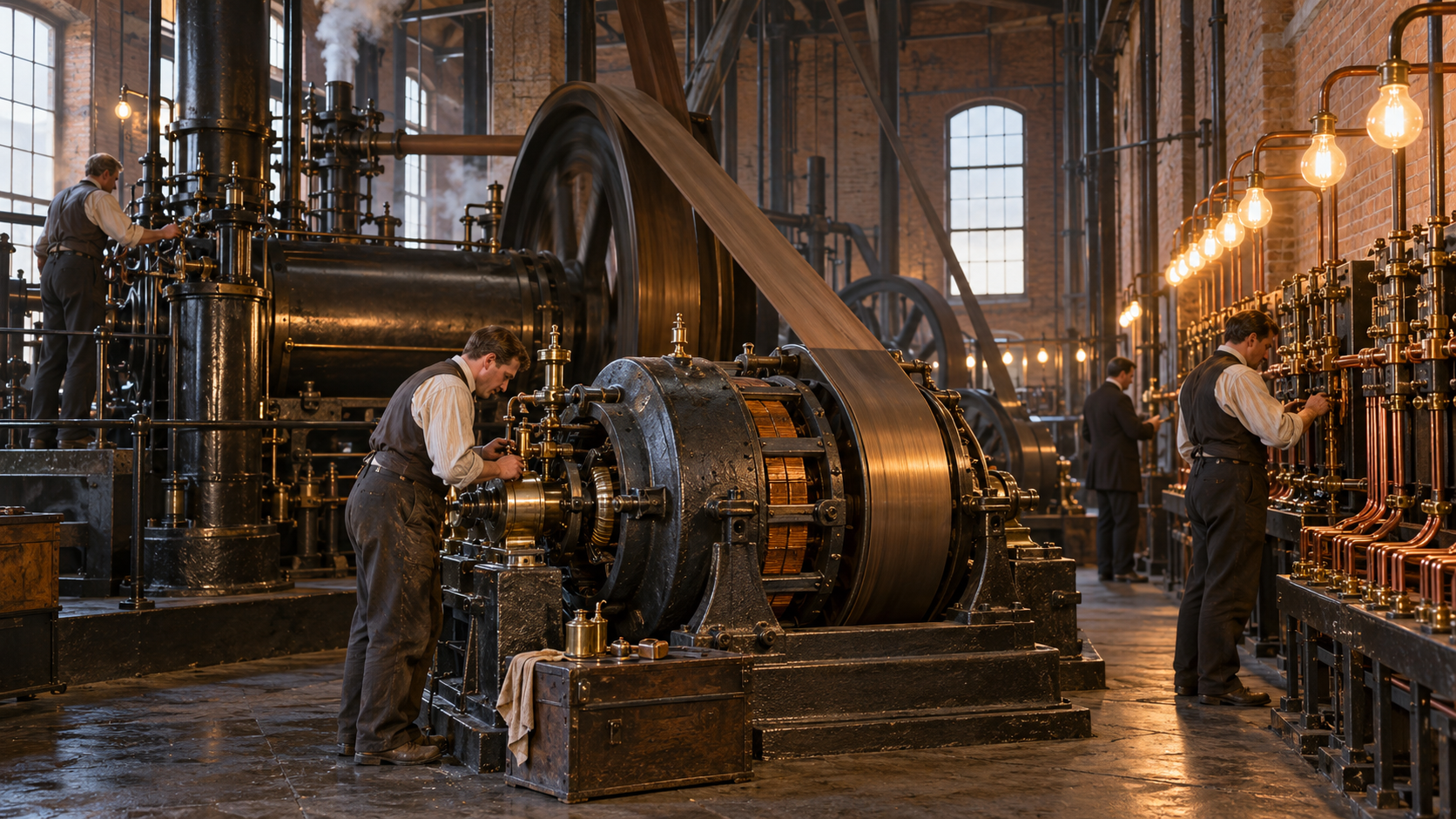
Large steam engines drove direct-current dynamos known as Jumbo generators. Underground copper conductors carried power to buildings, while meters, fuses, junction boxes, switches, and parallel circuits made the network manageable. Edison and his team treated each component as part of one system rather than as an isolated invention.
The station served a limited area because low-voltage direct current suffered losses over distance. Its operation nevertheless showed that electric lighting could be reliable, metered, maintained, and sold as a utility service. The design influenced other central stations even as alternating current later became dominant for long-distance distribution.
Pearl Street’s importance lies in the union of engineering and infrastructure. A practical power system required machinery, cables, safety devices, customer equipment, financing, construction, and trained operators to work together, a pattern that still defines modern energy networks. Its calendar date is an entry point, not an endpoint. The people involved worked with the instruments, assumptions, and social conditions of their time, and later research has both extended and corrected their conclusions. Separating what was known that day from what became clear afterward protects the history from myth and shows how cumulative evidence turns an episode into lasting scientific knowledge. For science history, the event also shows how evidence moves from an observation or engineered test into a durable body of knowledge. Instruments supplied measurements, specialists debated interpretation, and later work refined what the first result could mean. Archives preserve the early record while new methods let researchers ask different questions of it. That continuing revision is the process through which a dated milestone remains scientifically useful. Seen across a longer timeline, scientific milestones are junctions rather than isolated beginnings. Earlier experiments, tools, and institutions made the work possible, while later teams tested limits and carried the result into new settings. What survives is a traceable chain of evidence, correction, and application that allows one moment to remain relevant as knowledge and technology continue to change. The anniversary highlights the difference between a first result and a finished understanding. A successful observation can settle one question while opening several harder ones, and even a failed objective can reshape later designs. Preserved data, specimens, photographs, and hardware allow new generations to revisit the work with better tools. Science advances through that continuity rather than stopping on a memorable date.
Steam engines turned dynamos inside a converted Manhattan building.
Electricity then traveled through underground feeders to nearby customers.
Meters, fuses, sockets, conductors, and generators formed one coordinated system.
The network made electric service practical beyond a laboratory demonstration.
Direct current could serve nearby blocks but lost efficiency over long distances.
Later alternating-current networks expanded the central-station idea to much larger regions.
Explore more of "On This Day ..."
Discover more events from the same date across news, politics, technology, sports, and other fields. Each link highlights significant moments that shaped history on different fronts.