

On This Day in Science: September 3, 1976
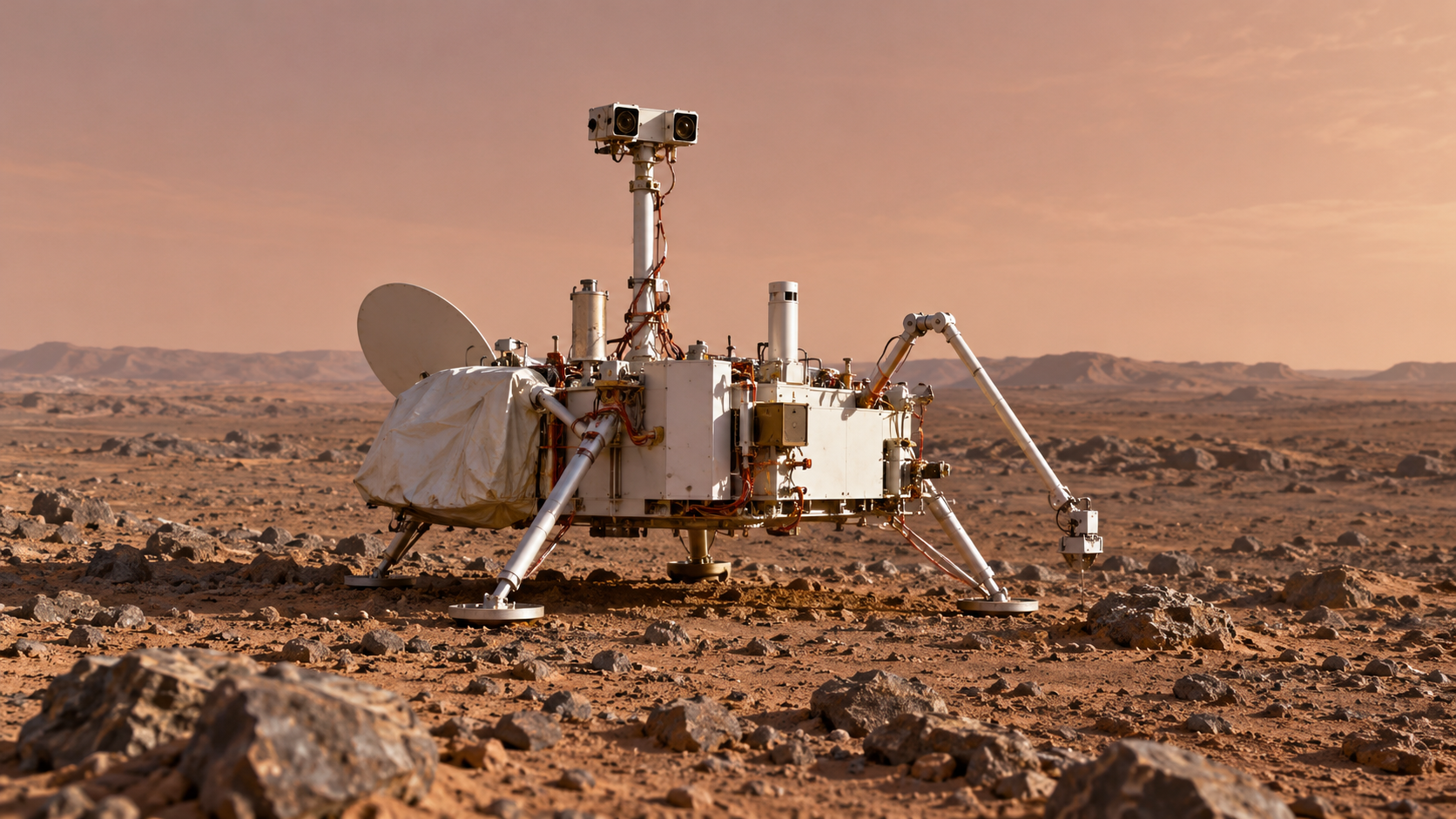
On September 3, 1976, NASA’s Viking 2 lander touched down in Utopia Planitia, a broad northern plain on Mars. The spacecraft used a heat shield, parachute, and terminal descent engines to reach a rocky site about 6,460 kilometers from its Viking 1 counterpart. It soon returned panoramic images of a landscape strewn with angular blocks and patches of fine soil.
Viking 2 carried cameras, a meteorology package, a seismometer, and laboratories for inorganic chemistry and biology experiments. A robotic sampling arm delivered Martian soil to three life-detection tests and to a gas chromatograph-mass spectrometer. The biology results showed unexpected chemical activity, but the mission found no generally accepted proof of life.
The lander operated through seasonal changes and recorded pressure, temperature, wind, and frost. Thin layers of water ice appeared on the surface during winter mornings, giving scientists an early direct look at the Martian water cycle. The seismometer worked, although wind noise and its location on the deck limited interpretation.
Viking 2 transmitted until 1980, far beyond its planned mission. Its photographs and chemical measurements became baseline records for later landers, while its ambiguous biology experiments continue to shape debates about how to search for life without confusing biology and reactive soil chemistry. The anniversary highlights the difference between a first result and a finished understanding. A successful observation can settle one question while opening several harder ones, and even a failed objective can reshape later designs. Preserved data, specimens, photographs, and hardware allow new generations to revisit the work with better tools. Science advances through that continuity rather than stopping on a memorable date. Its calendar date is an entry point, not an endpoint. The people involved worked with the instruments, assumptions, and social conditions of their time, and later research has both extended and corrected their conclusions. Separating what was known that day from what became clear afterward protects the history from myth and shows how cumulative evidence turns an episode into lasting scientific knowledge. For science history, the event also shows how evidence moves from an observation or engineered test into a durable body of knowledge. Instruments supplied measurements, specialists debated interpretation, and later work refined what the first result could mean. Archives preserve the early record while new methods let researchers ask different questions of it. That continuing revision is the process through which a dated milestone remains scientifically useful. Seen across a longer timeline, scientific milestones are junctions rather than isolated beginnings. Earlier experiments, tools, and institutions made the work possible, while later teams tested limits and carried the result into new settings. What survives is a traceable chain of evidence, correction, and application that allows one moment to remain relevant as knowledge and technology continue to change.
Viking 2 descended to Utopia Planitia using a parachute and throttled engines.
Its cameras revealed a rockier surface than planners had expected.
The lander exposed Martian soil to nutrients, gases, and controlled heating.
Chemical reactions occurred, but their biological meaning remained disputed.
Weather instruments followed pressure, wind, and temperature through the seasons.
Frost on the ground provided direct evidence of water cycling in the atmosphere.
Explore more of "On This Day ..."
Discover more events from the same date across news, politics, technology, sports, and other fields. Each link highlights significant moments that shaped history on different fronts.