

On This Day in Science: September 5, 1977
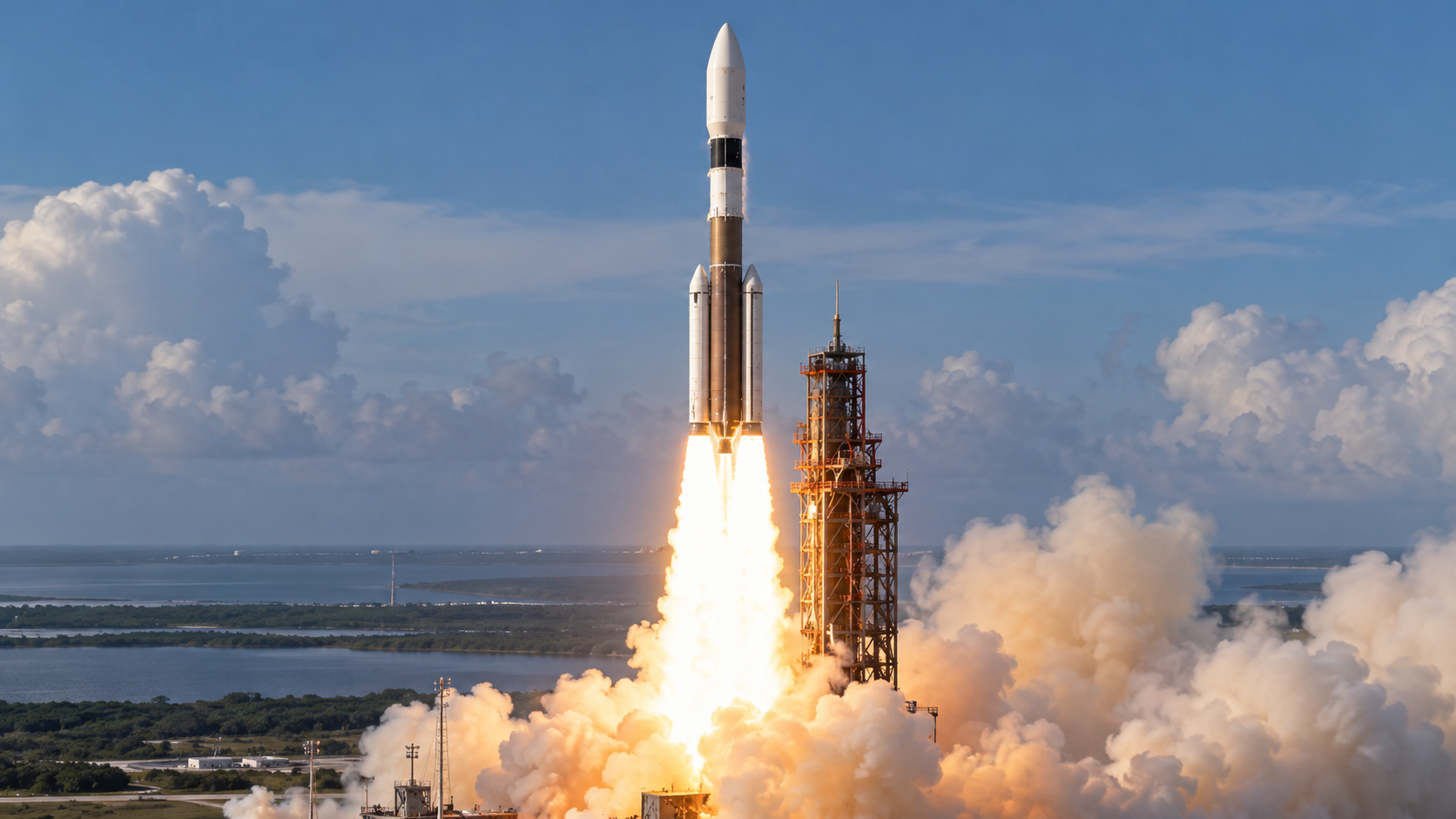
On September 5, 1977, NASA’s Voyager 1 lifted from Cape Canaveral aboard a Titan IIIE-Centaur rocket. Although it launched sixteen days after Voyager 2, a faster trajectory allowed it to reach Jupiter and Saturn first. The spacecraft carried cameras and instruments for fields, particles, plasma, radio waves, and planetary atmospheres.
Voyager 1 passed Jupiter in 1979 and Saturn in 1980. Its observations revealed active volcanoes on Io, intricate structure in planetary rings, new moons, and detailed weather in giant-planet atmospheres. A close encounter with Titan redirected the spacecraft above the plane of the planets, ending the possibility of further planetary flybys but providing crucial data about the moon’s thick atmosphere.
The probe later photographed the Solar System from beyond Neptune, including the famous distant view of Earth called the Pale Blue Dot. In 2012, measurements showed that Voyager 1 had crossed the heliopause and entered interstellar space, where it continues to sample particles, magnetic fields, and plasma waves.
The launch began one of the longest scientific missions ever conducted. Voyager’s longevity reflects conservative design, radioisotope power, careful energy management, and repeated software adaptation across distances that turn each command-and-response cycle into many hours. For science history, the event also shows how evidence moves from an observation or engineered test into a durable body of knowledge. Instruments supplied measurements, specialists debated interpretation, and later work refined what the first result could mean. Archives preserve the early record while new methods let researchers ask different questions of it. That continuing revision is the process through which a dated milestone remains scientifically useful. Seen across a longer timeline, scientific milestones are junctions rather than isolated beginnings. Earlier experiments, tools, and institutions made the work possible, while later teams tested limits and carried the result into new settings. What survives is a traceable chain of evidence, correction, and application that allows one moment to remain relevant as knowledge and technology continue to change. The anniversary highlights the difference between a first result and a finished understanding. A successful observation can settle one question while opening several harder ones, and even a failed objective can reshape later designs. Preserved data, specimens, photographs, and hardware allow new generations to revisit the work with better tools. Science advances through that continuity rather than stopping on a memorable date. Its calendar date is an entry point, not an endpoint. The people involved worked with the instruments, assumptions, and social conditions of their time, and later research has both extended and corrected their conclusions. Separating what was known that day from what became clear afterward protects the history from myth and shows how cumulative evidence turns an episode into lasting scientific knowledge.
Voyager 1 launched after its twin but followed a shorter, quicker trajectory.
It became the first of the pair to reach both Jupiter and Saturn.
The mission saw active volcanism, complex rings, new moons, and a hazy Titan.
Those discoveries changed the outer planets from distant dots into dynamic systems.
Voyager 1 eventually crossed the boundary of the Sun's particle-dominated region.
Its surviving instruments now report from interstellar space.
Explore more of "On This Day ..."
Discover more events from the same date across news, politics, technology, sports, and other fields. Each link highlights significant moments that shaped history on different fronts.