

On This Day in Science: September 6, 2008
On September 6, 2008, the European Space Agency presented the first close images and preliminary results from Rosetta’s flyby of asteroid 2867 Steins the previous night. The spacecraft had passed the small main-belt asteroid at a distance of about 800 kilometers while traveling 8.6 kilometers per second relative to its target.
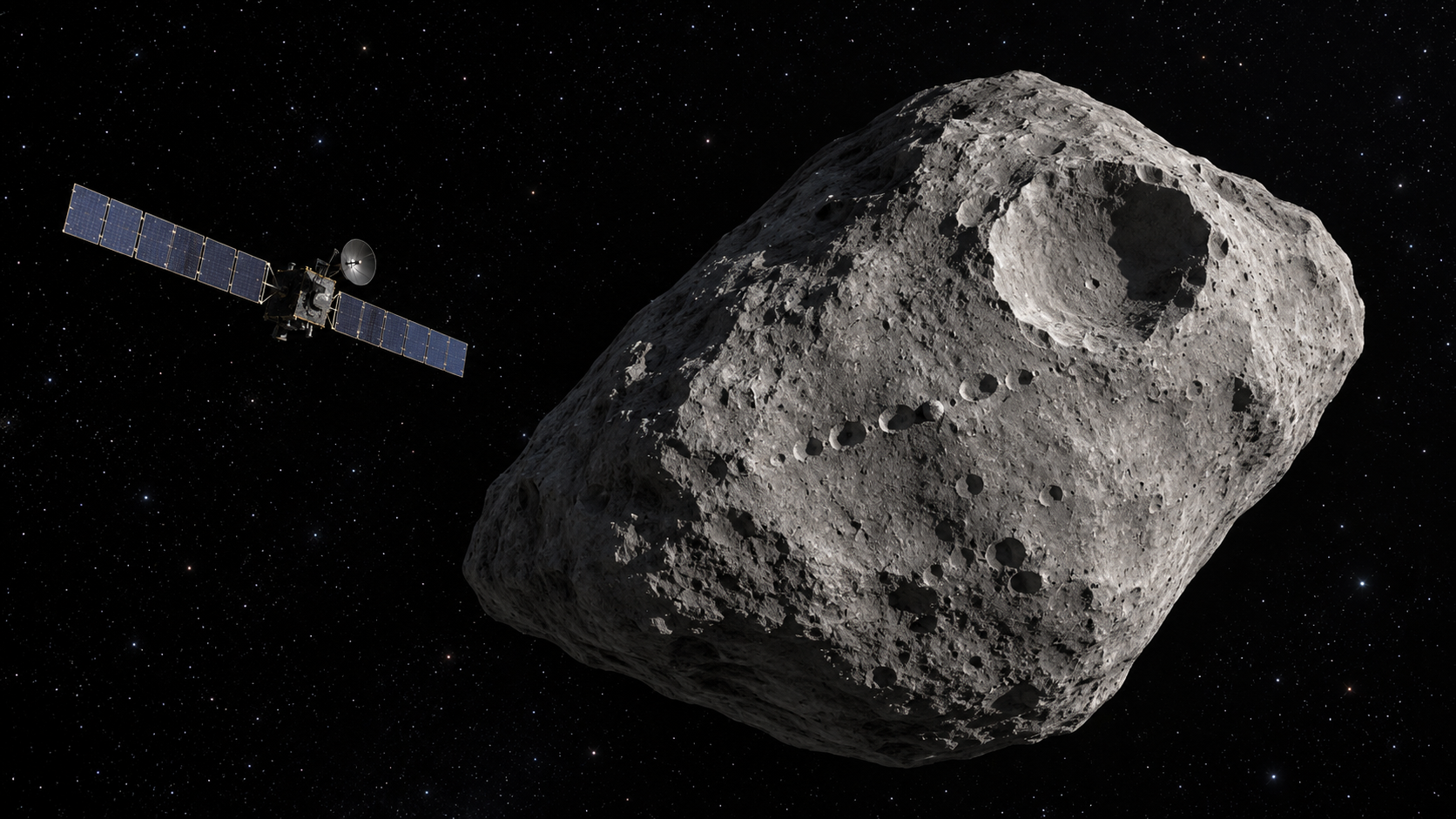
Rosetta’s OSIRIS cameras and other instruments observed Steins before, during, and after closest approach. The images showed an angular, roughly diamond-shaped body about five kilometers across, marked by a large crater and a chain of smaller pits. Its shape and rapid rotation suggested a loosely consolidated object altered by impacts.
The encounter was both science and rehearsal. Rosetta practiced autonomous tracking of a faint moving target while mission teams tested cameras, spectrometers, and navigation methods during the long cruise to Comet 67P/Churyumov-Gerasimenko. A second asteroid flyby, Lutetia in 2010, would be larger and more detailed.
Steins showed how a brief, carefully planned pass can turn a point of light into a geological world. The released images added crater counts, dimensions, and surface structure to the sparse information available from Earth-based observations. Seen across a longer timeline, scientific milestones are junctions rather than isolated beginnings. Earlier experiments, tools, and institutions made the work possible, while later teams tested limits and carried the result into new settings. What survives is a traceable chain of evidence, correction, and application that allows one moment to remain relevant as knowledge and technology continue to change. The anniversary highlights the difference between a first result and a finished understanding. A successful observation can settle one question while opening several harder ones, and even a failed objective can reshape later designs. Preserved data, specimens, photographs, and hardware allow new generations to revisit the work with better tools. Science advances through that continuity rather than stopping on a memorable date. Its calendar date is an entry point, not an endpoint. The people involved worked with the instruments, assumptions, and social conditions of their time, and later research has both extended and corrected their conclusions. Separating what was known that day from what became clear afterward protects the history from myth and shows how cumulative evidence turns an episode into lasting scientific knowledge. For science history, the event also shows how evidence moves from an observation or engineered test into a durable body of knowledge. Instruments supplied measurements, specialists debated interpretation, and later work refined what the first result could mean. Archives preserve the early record while new methods let researchers ask different questions of it. That continuing revision is the process through which a dated milestone remains scientifically useful.
Rosetta crossed within roughly 800 kilometers of Steins at high relative speed.
Automated tracking kept the asteroid centered for a compact burst of observations.
Images revealed a faceted world dominated by a large crater.
A chain of smaller pits recorded additional impacts and internal stress.
The flyby exercised navigation and instruments during Rosetta's long cruise.
Those techniques later supported its historic rendezvous with Comet 67P.
Explore more of "On This Day ..."
Discover more events from the same date across news, politics, technology, sports, and other fields. Each link highlights significant moments that shaped history on different fronts.