

On This Day in Science: September 11, 1985
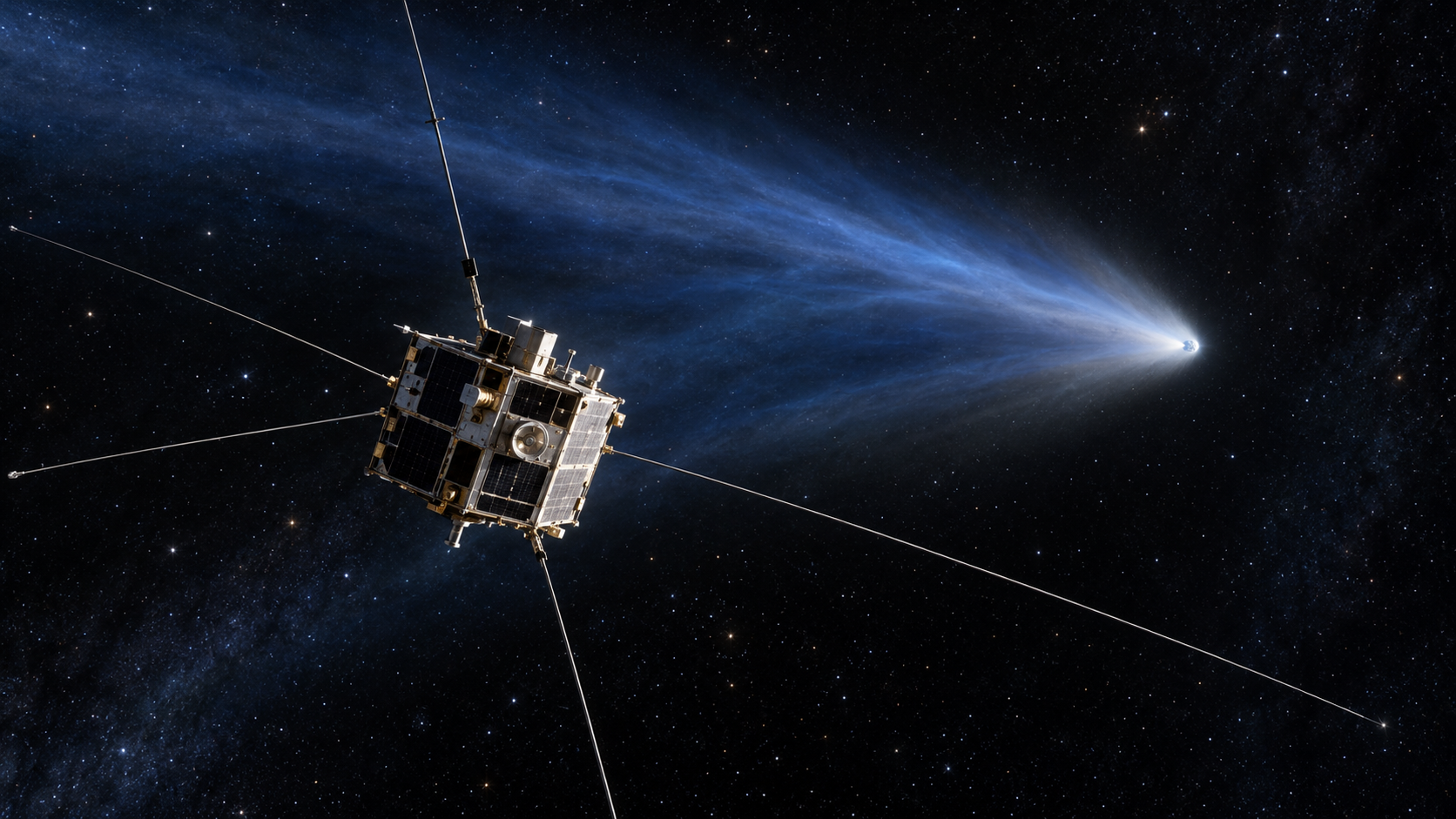
On September 11, 1985, the International Cometary Explorer passed through the tail of Comet 21P/Giacobini-Zinner, becoming the first spacecraft to make a close encounter with a comet. ICE crossed roughly 7,800 kilometers downstream from the nucleus, where instruments sampled the interaction between cometary gases and the solar wind.
The spacecraft had begun life as International Sun-Earth Explorer 3, positioned near the Sun-Earth L1 point to study the solar wind. Engineers then used a complex series of lunar flybys to redirect it onto an interplanetary path. The retargeting turned an existing observatory into a comet mission without a new launch.
ICE carried no camera, so it did not return a close portrait of the nucleus. Instead, particle, plasma, field, and wave instruments measured a structured tail with regions separated by boundaries and a distinctive magnetic environment. Those in-situ results complemented remote observations from Earth.
The flyby proved that cometary plasma could be sampled directly and prepared researchers for the international armada sent toward Halley’s Comet in 1986. It also remains a striking example of mission extension through orbital mechanics and adaptable hardware. The anniversary highlights the difference between a first result and a finished understanding. A successful observation can settle one question while opening several harder ones, and even a failed objective can reshape later designs. Preserved data, specimens, photographs, and hardware allow new generations to revisit the work with better tools. Science advances through that continuity rather than stopping on a memorable date. Its calendar date is an entry point, not an endpoint. The people involved worked with the instruments, assumptions, and social conditions of their time, and later research has both extended and corrected their conclusions. Separating what was known that day from what became clear afterward protects the history from myth and shows how cumulative evidence turns an episode into lasting scientific knowledge. For science history, the event also shows how evidence moves from an observation or engineered test into a durable body of knowledge. Instruments supplied measurements, specialists debated interpretation, and later work refined what the first result could mean. Archives preserve the early record while new methods let researchers ask different questions of it. That continuing revision is the process through which a dated milestone remains scientifically useful. Seen across a longer timeline, scientific milestones are junctions rather than isolated beginnings. Earlier experiments, tools, and institutions made the work possible, while later teams tested limits and carried the result into new settings. What survives is a traceable chain of evidence, correction, and application that allows one moment to remain relevant as knowledge and technology continue to change.
ISEE-3 had studied the solar wind near a gravitational balance region.
Lunar gravity assists transformed it into the International Cometary Explorer.
ICE crossed the region where cometary material meets the solar wind.
Its instruments found boundaries, particles, magnetic fields, and waves rather than surface images.
No earlier spacecraft had sampled a comet at close range.
The mission gave teams practical experience before the 1986 encounters with Halley.
Explore more of "On This Day ..."
Discover more events from the same date across news, politics, technology, sports, and other fields. Each link highlights significant moments that shaped history on different fronts.