

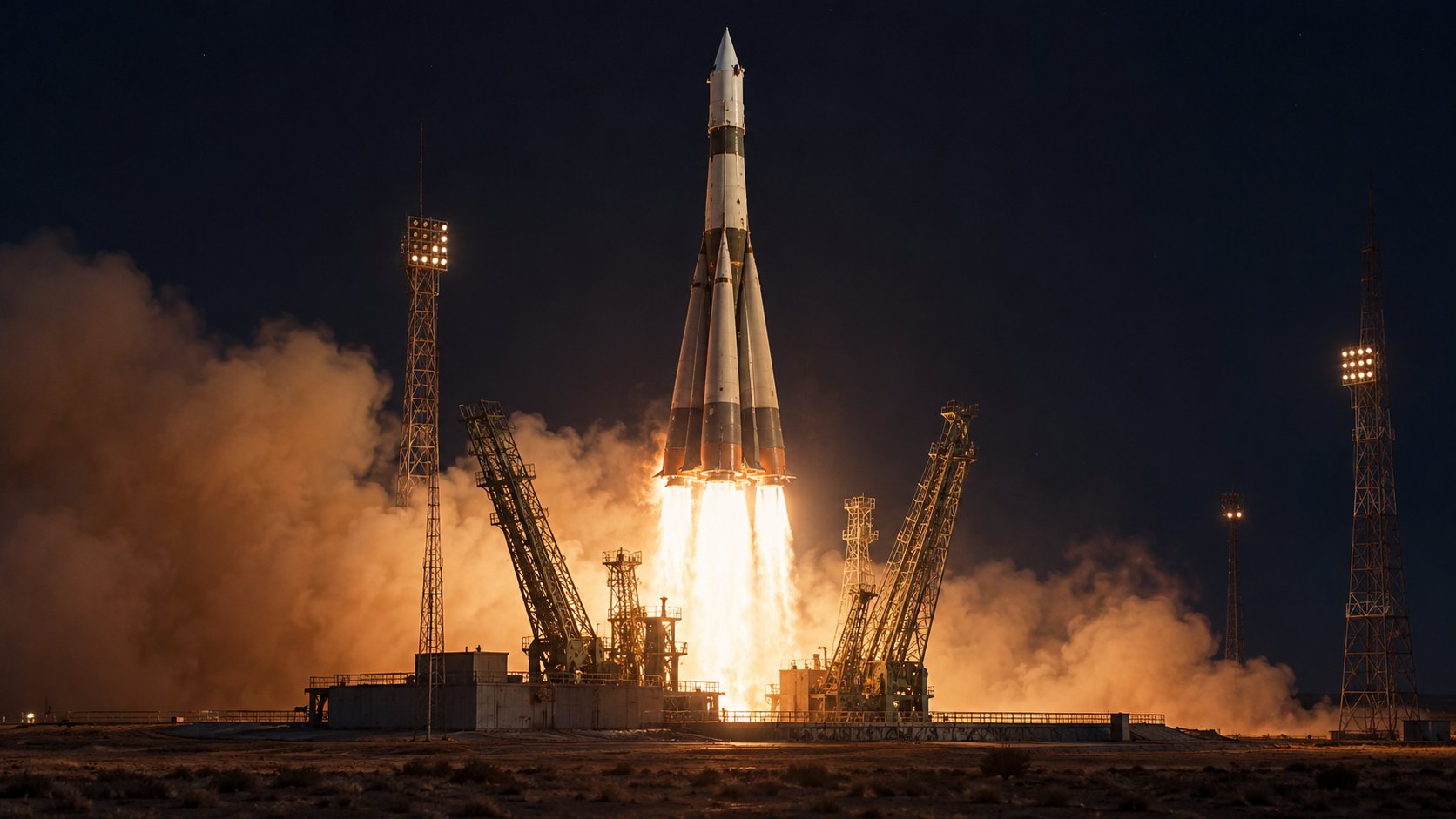
On This Day in Science: September 12, 1959
On September 12, 1959, the Soviet Union launched Luna 2 toward the Moon on a modified R-7 rocket. The spherical spacecraft carried instruments for magnetic fields, radiation, and micrometeoroids along with metal pennants intended to mark its origin. Its flight followed earlier lunar attempts, including Luna 1, which had missed the Moon and entered solar orbit.
Luna 2 transmitted measurements throughout a journey of roughly a day and a half. Ground tracking followed its radio signals while an upper-stage component released a sodium cloud that observers could photograph, helping refine the trajectory. The craft had no braking system; it was designed to strike the lunar surface.
Measurements found no strong lunar magnetic field or radiation belt comparable with Earth’s. Late on September 13 Universal Time, the radio signal ended near the Moon, confirming impact east of Mare Imbrium. The launch had therefore begun the first successful passage of a human-made object to another celestial body.
The compact probe was simple by later standards, but its success required accurate guidance, reliable radio tracking, and sufficient rocket performance to escape Earth. It opened a sequence of increasingly ambitious robotic lunar missions by both Cold War powers. Its calendar date is an entry point, not an endpoint. The people involved worked with the instruments, assumptions, and social conditions of their time, and later research has both extended and corrected their conclusions. Separating what was known that day from what became clear afterward protects the history from myth and shows how cumulative evidence turns an episode into lasting scientific knowledge. For science history, the event also shows how evidence moves from an observation or engineered test into a durable body of knowledge. Instruments supplied measurements, specialists debated interpretation, and later work refined what the first result could mean. Archives preserve the early record while new methods let researchers ask different questions of it. That continuing revision is the process through which a dated milestone remains scientifically useful. Seen across a longer timeline, scientific milestones are junctions rather than isolated beginnings. Earlier experiments, tools, and institutions made the work possible, while later teams tested limits and carried the result into new settings. What survives is a traceable chain of evidence, correction, and application that allows one moment to remain relevant as knowledge and technology continue to change. The anniversary highlights the difference between a first result and a finished understanding. A successful observation can settle one question while opening several harder ones, and even a failed objective can reshape later designs. Preserved data, specimens, photographs, and hardware allow new generations to revisit the work with better tools. Science advances through that continuity rather than stopping on a memorable date.
Luna 2 had no engine for lunar orbit or a soft landing.
Its trajectory was designed to end on the surface after continuous radio tracking.
Detectors measured particles, radiation, magnetic fields, and possible dust impacts.
A released sodium cloud provided an additional visible aid to tracking.
The successful launch placed the probe on a true lunar collision course.
Its impact the next day marked a new reach for human technology.
Explore more of "On This Day ..."
Discover more events from the same date across news, politics, technology, sports, and other fields. Each link highlights significant moments that shaped history on different fronts.