

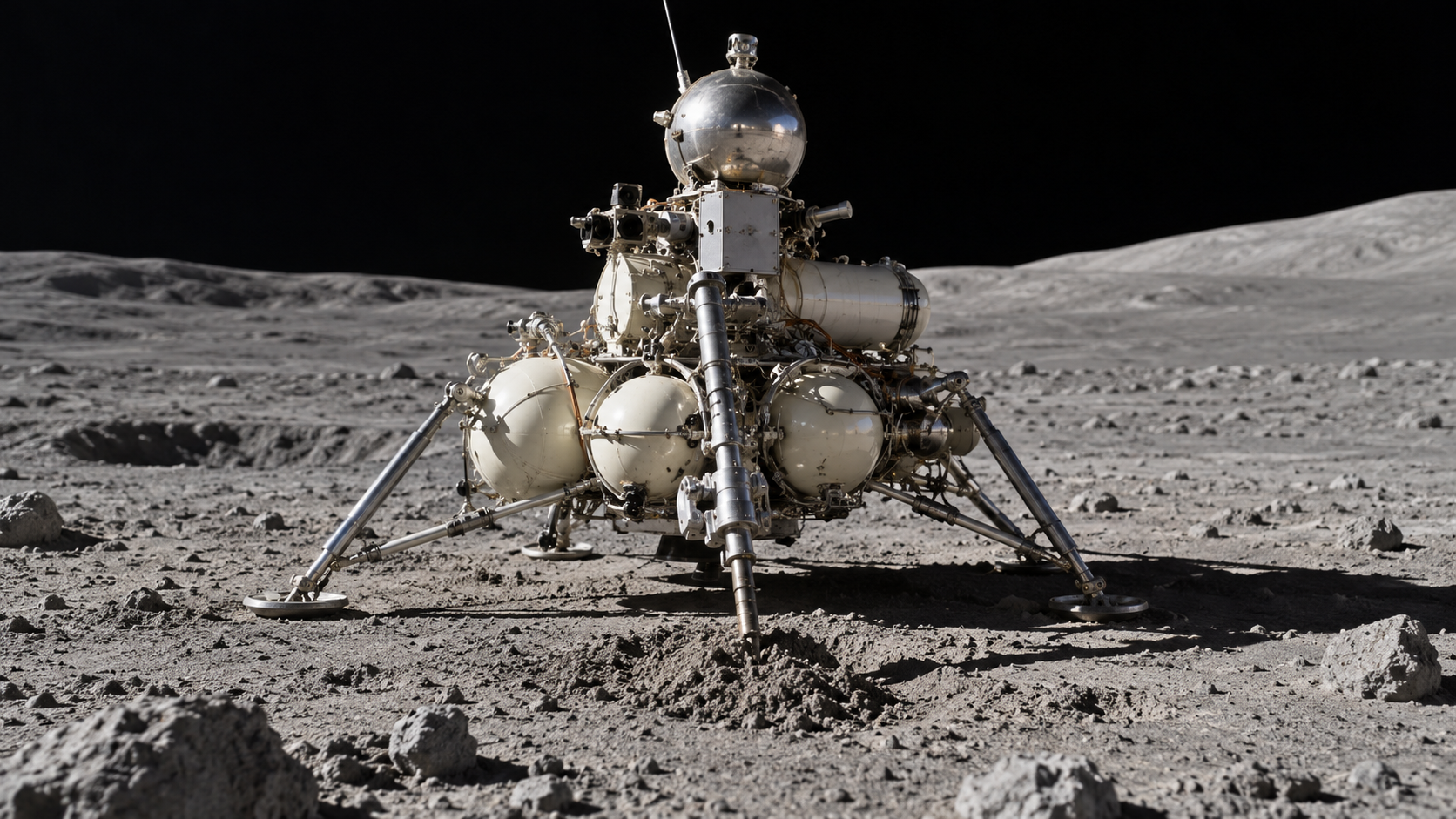
On This Day in Science: September 20, 1970
On September 20, 1970, the Soviet Luna 16 spacecraft made a soft landing in Mare Fecunditatis on the Moon. The uncrewed lander carried a drilling system and a small ascent vehicle, forming the first mission to collect material on another world and return it to Earth entirely by robotic means.
After touchdown, a television system surveyed the site and the drill penetrated the regolith. A core sample about 35 centimeters long was transferred into a sealed return capsule. The ascent stage then launched directly from the lunar surface, leaving the landing platform and most equipment behind.
The capsule reached Earth on September 24 and parachuted into Kazakhstan with roughly 101 grams of lunar soil. Laboratories found fine basaltic material and other components that could be compared with Apollo samples from different sites. Small portions were later exchanged internationally, extending the scientific value of the collection.
Luna 16 demonstrated precision landing, automatic drilling, sample transfer, ascent, navigation, reentry, and recovery in one compact mission. Its success established robotic sample return as a powerful alternative when direct human exploration is impractical. Its calendar date is an entry point, not an endpoint. The people involved worked with the instruments, assumptions, and social conditions of their time, and later research has both extended and corrected their conclusions. Separating what was known that day from what became clear afterward protects the history from myth and shows how cumulative evidence turns an episode into lasting scientific knowledge. For science history, the event also shows how evidence moves from an observation or engineered test into a durable body of knowledge. Instruments supplied measurements, specialists debated interpretation, and later work refined what the first result could mean. Archives preserve the early record while new methods let researchers ask different questions of it. That continuing revision is the process through which a dated milestone remains scientifically useful. Seen across a longer timeline, scientific milestones are junctions rather than isolated beginnings. Earlier experiments, tools, and institutions made the work possible, while later teams tested limits and carried the result into new settings. What survives is a traceable chain of evidence, correction, and application that allows one moment to remain relevant as knowledge and technology continue to change. The anniversary highlights the difference between a first result and a finished understanding. A successful observation can settle one question while opening several harder ones, and even a failed objective can reshape later designs. Preserved data, specimens, photographs, and hardware allow new generations to revisit the work with better tools. Science advances through that continuity rather than stopping on a memorable date.
Automatic guidance brought Luna 16 down on a dark basaltic plain.
Cameras and sensors confirmed that the site was suitable for drilling.
The lander bored into the regolith and moved a core into a sealed container.
No astronaut was present to adjust the machinery or select material by hand.
A small ascent stage carried only the sample capsule back toward Earth.
The architecture proved that remote geology could include laboratory analysis at home.
Explore more of "On This Day ..."
Discover more events from the same date across news, politics, technology, sports, and other fields. Each link highlights significant moments that shaped history on different fronts.