

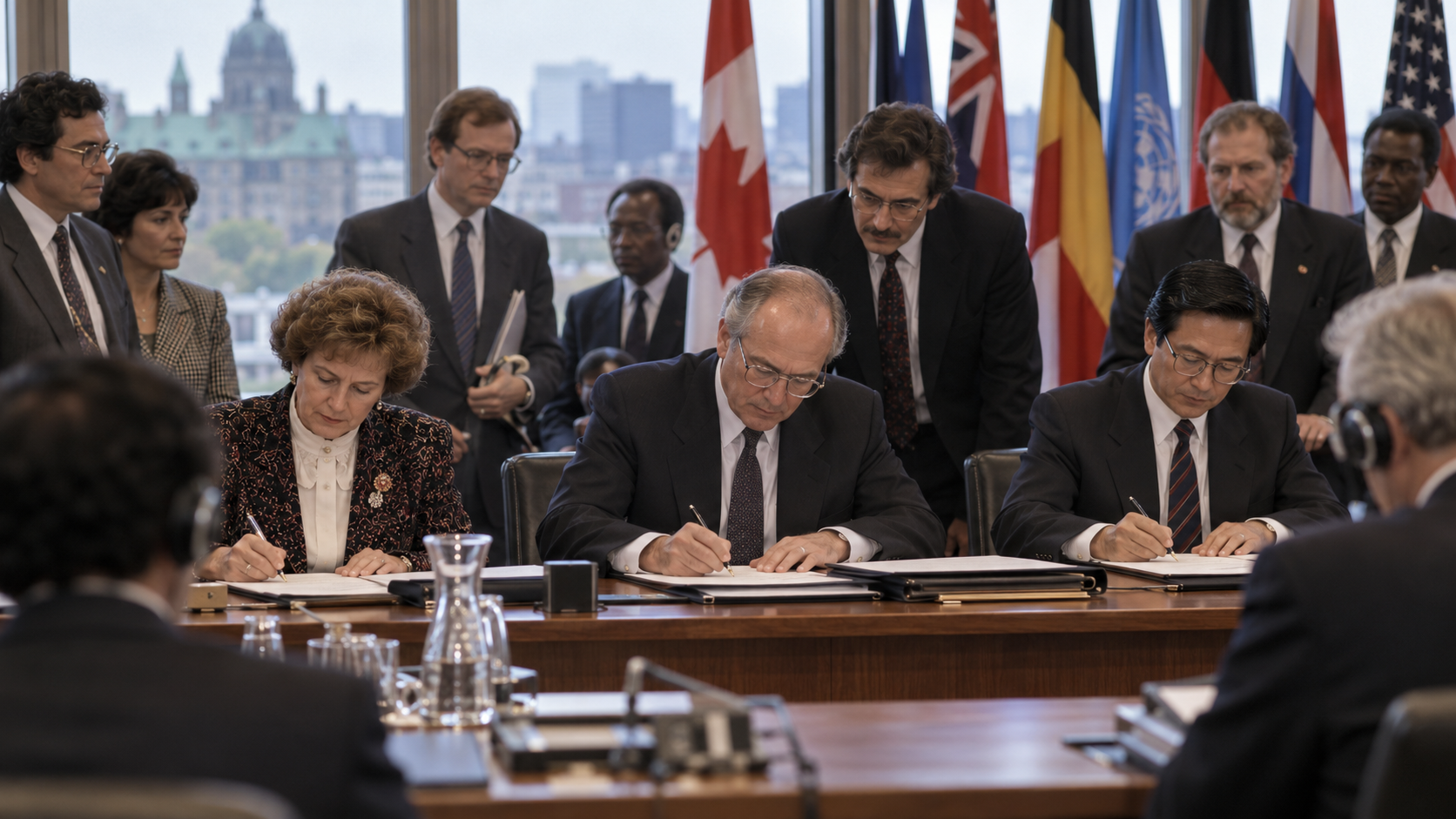
On This Day in Science: September 16, 1987
On September 16, 1987, representatives meeting in Montreal adopted the Montreal Protocol on Substances that Deplete the Ozone Layer and opened it for signature. The agreement created binding schedules to reduce production and consumption of chlorofluorocarbons and other chemicals known to destroy stratospheric ozone.
The protocol grew from atmospheric measurements, laboratory chemistry, modeling, and observations of severe springtime ozone loss over Antarctica. Ozone high in the atmosphere absorbs much of the Sun’s harmful ultraviolet radiation. Chlorine and bromine released from long-lived industrial compounds can participate in catalytic reactions that remove many ozone molecules.
The treaty was designed to change as evidence and technology advanced. Parties repeatedly strengthened controls, added substances, financed transitions in developing countries, and assessed progress through scientific, environmental, and technical panels. That adjustable structure helped the agreement achieve universal ratification.
Measurements show that concentrations of major controlled substances have declined and the ozone layer is on a long path toward recovery, although the process takes decades. The protocol is therefore a landmark in using shared science, monitoring, and coordinated policy to address a planetary environmental risk. Its calendar date is an entry point, not an endpoint. The people involved worked with the instruments, assumptions, and social conditions of their time, and later research has both extended and corrected their conclusions. Separating what was known that day from what became clear afterward protects the history from myth and shows how cumulative evidence turns an episode into lasting scientific knowledge. For science history, the event also shows how evidence moves from an observation or engineered test into a durable body of knowledge. Instruments supplied measurements, specialists debated interpretation, and later work refined what the first result could mean. Archives preserve the early record while new methods let researchers ask different questions of it. That continuing revision is the process through which a dated milestone remains scientifically useful. Seen across a longer timeline, scientific milestones are junctions rather than isolated beginnings. Earlier experiments, tools, and institutions made the work possible, while later teams tested limits and carried the result into new settings. What survives is a traceable chain of evidence, correction, and application that allows one moment to remain relevant as knowledge and technology continue to change. The anniversary highlights the difference between a first result and a finished understanding. A successful observation can settle one question while opening several harder ones, and even a failed objective can reshape later designs. Preserved data, specimens, photographs, and hardware allow new generations to revisit the work with better tools. Science advances through that continuity rather than stopping on a memorable date.
Ultraviolet light can free chlorine and bromine from long-lived industrial gases.
Those atoms participate in reaction cycles that destroy ozone without being consumed quickly.
Control schedules could be tightened as measurements and substitutes improved.
Regular assessments tied later decisions to continuing scientific evidence.
Many ozone-depleting compounds remain in the atmosphere for decades.
Declining concentrations are a success, but monitoring must continue across generations.
Explore more of "On This Day ..."
Discover more events from the same date across news, politics, technology, sports, and other fields. Each link highlights significant moments that shaped history on different fronts.