

On This Day in Science: October 4, 1957
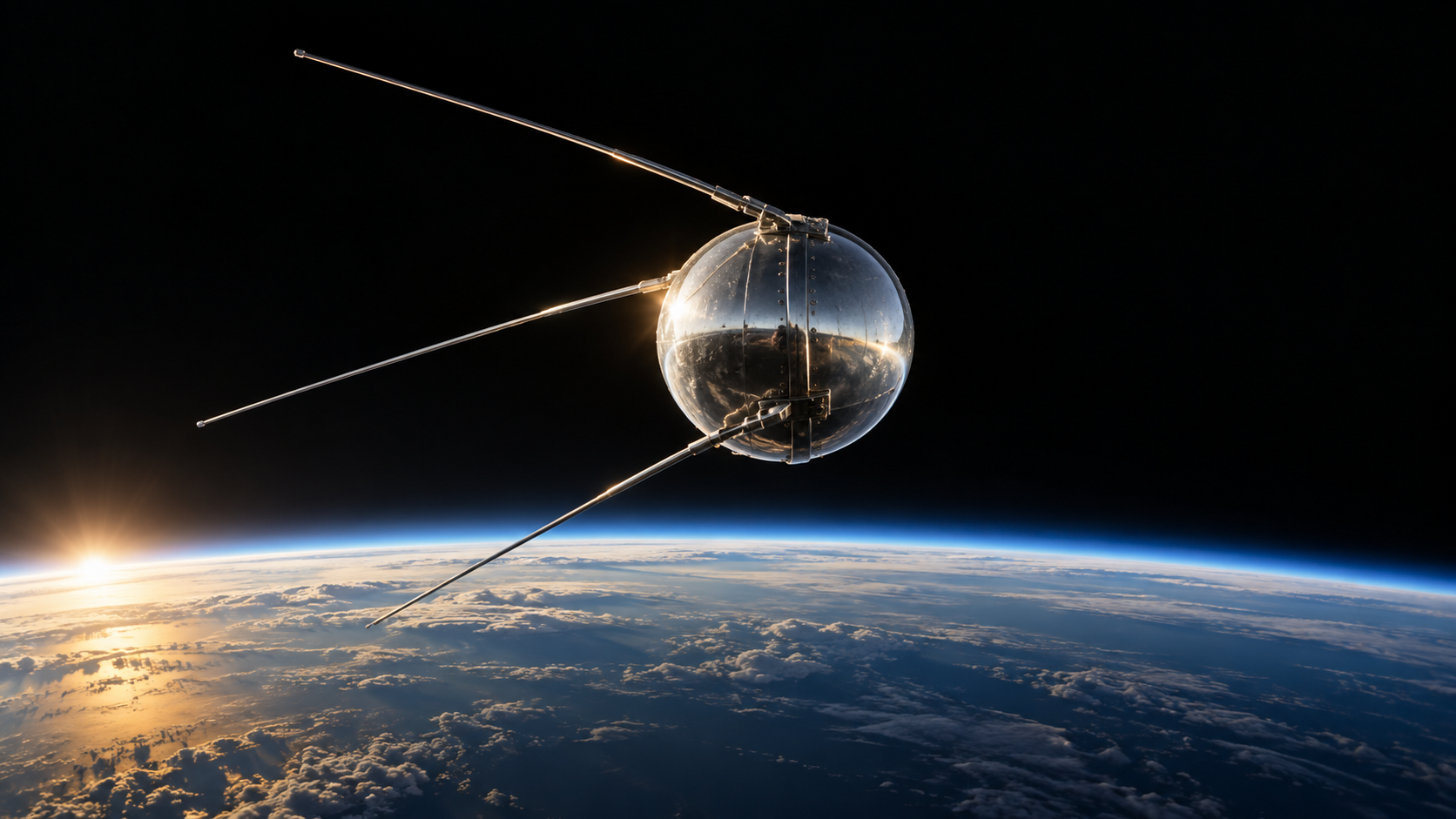
On October 4, 1957, the Soviet Union launched Sputnik 1 from the Baikonur launch site in Kazakhstan. The polished aluminum sphere became the first human-made object placed in Earth orbit, circling the planet in about ninety-six minutes while broadcasting simple radio pulses.
Sputnik measured about 58 centimeters across and carried four long whip antennas. Its transmitters let scientists and amateur radio operators track the satellite and study how radio signals passed through the ionosphere. The carrier rocket also became a bright object visible from the ground.
The launch occurred during the International Geophysical Year, a multinational scientific campaign. Its immediate political effect was far larger than the satellite’s compact scientific payload: the achievement demonstrated Soviet rocket capability and intensified investment in education, missiles, and space programs in the United States and elsewhere.
Sputnik’s batteries transmitted for about three weeks, and the satellite reentered in January 1958. Its short flight established an enduring new environment for research, communications, weather observation, navigation, and exploration while making space technology a central feature of international competition. Its calendar date is an entry point rather than an endpoint. The people involved worked with the tools, assumptions, institutions, and social conditions of their time. Later research has extended some conclusions and corrected others, showing how science advances by keeping evidence open to comparison instead of treating a memorable event as final. What makes the event scientifically important is not only priority, but the ability of others to check, repeat, compare, or build on the result. That process can reveal limitations hidden by the excitement of a first success. It also explains why careful archives and transparent measurements matter as much as the date remembered by the public. Modern interpretations benefit from evidence that the original participants did not possess. New instruments and analytical methods can recover additional detail, while historical scholarship clarifies questions of credit, context, and consequence. Holding the original achievement and those later corrections together produces a more accurate account than either celebration or dismissal alone. The anniversary also illustrates how a scientific milestone becomes useful through records that later researchers can inspect. Instruments, notebooks, images, specimens, and engineering reports preserve more than a celebratory date: they show what was actually measured, what remained uncertain, and how conclusions changed as better methods became available. Placed in a longer timeline, the event was a junction rather than a finished answer. Earlier discoveries and technical work made it possible, while later teams tested its limits and applied the result in new settings. That traceable sequence of evidence and revision is what turns one day into a durable part of scientific history.
Sputnik's simple transmitters broadcast on two radio frequencies.
Tracking the beeps helped observers determine its orbit and probe the upper atmosphere.
The satellite was presented as part of a global scientific campaign.
Its launch also carried unmistakable strategic meaning during the Cold War.
One compact spacecraft changed expectations about access to orbit.
National programs soon expanded into science satellites, human flight, and lunar exploration.
Explore more of "On This Day ..."
Discover more events from the same date across news, politics, technology, sports, and other fields. Each link highlights significant moments that shaped history on different fronts.