

On This Day in Science: October 5, 1923
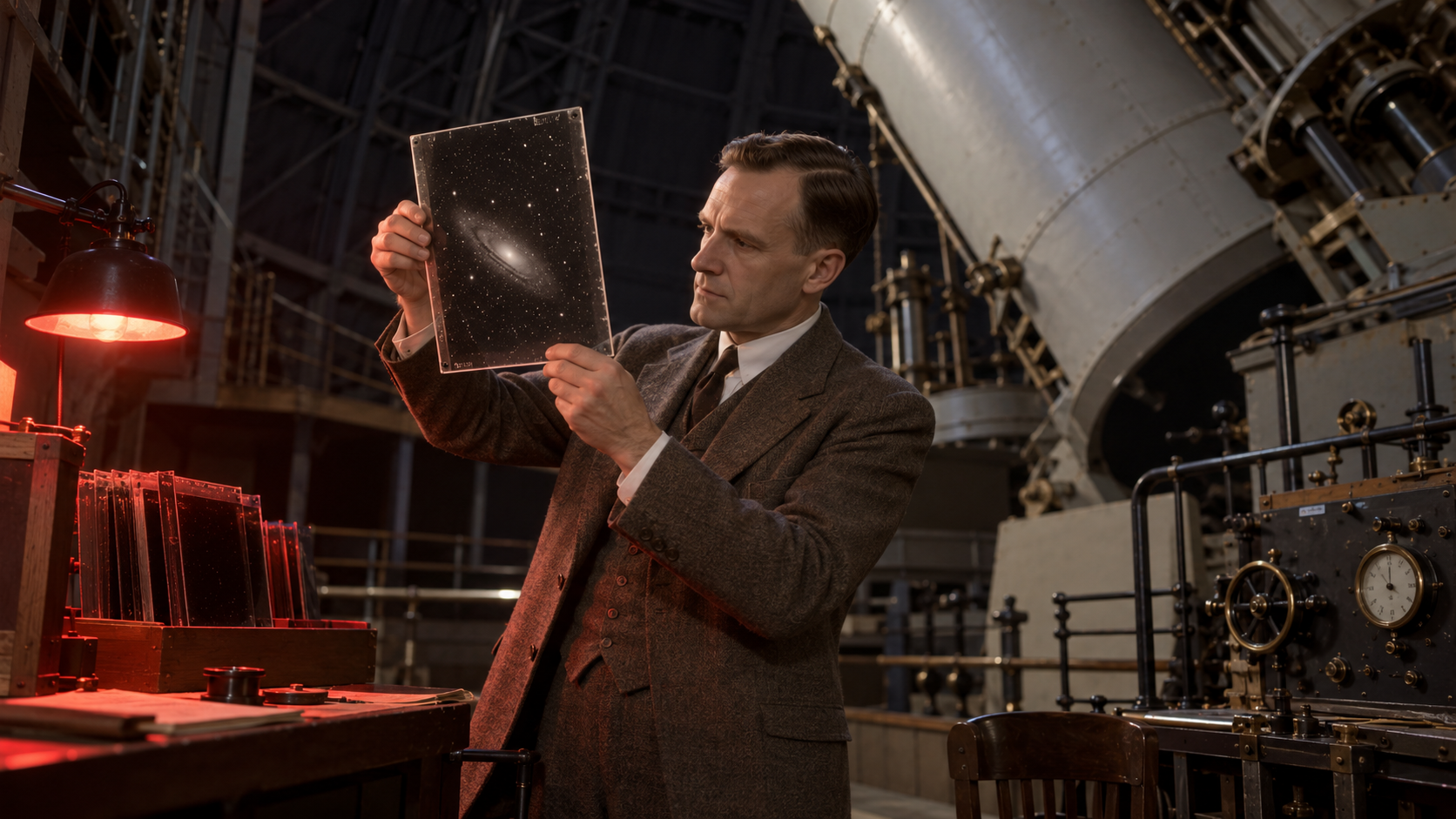
On October 5, 1923, Edwin Hubble used the 100-inch Hooker Telescope at Mount Wilson Observatory in California to photograph part of the Andromeda nebula. On the glass plate he marked several apparent novae, then recognized that one variable star was a Cepheid and famously changed its label to “VAR!”
Cepheid variables brighten and fade with a period related to their true luminosity. By comparing intrinsic brightness with observed brightness, astronomers can estimate distance. Hubble’s measurements placed Andromeda far beyond the scale then assigned to the Milky Way.
The result supplied decisive evidence in the debate over whether spiral nebulae were nearby clouds or separate “island universes.” Hubble continued gathering plates and announced distances to Andromeda and other galaxies in 1924, extending a distance method developed through the work of Henrietta Swan Leavitt and others.
The October plate did not alone complete the argument, and its significance became clear through follow-up measurements. It remains a compact record of a major change in cosmic scale: the Milky Way became one galaxy among many rather than the whole stellar universe. What makes the event scientifically important is not only priority, but the ability of others to check, repeat, compare, or build on the result. That process can reveal limitations hidden by the excitement of a first success. It also explains why careful archives and transparent measurements matter as much as the date remembered by the public. Modern interpretations benefit from evidence that the original participants did not possess. New instruments and analytical methods can recover additional detail, while historical scholarship clarifies questions of credit, context, and consequence. Holding the original achievement and those later corrections together produces a more accurate account than either celebration or dismissal alone. The anniversary also illustrates how a scientific milestone becomes useful through records that later researchers can inspect. Instruments, notebooks, images, specimens, and engineering reports preserve more than a celebratory date: they show what was actually measured, what remained uncertain, and how conclusions changed as better methods became available. Placed in a longer timeline, the event was a junction rather than a finished answer. Earlier discoveries and technical work made it possible, while later teams tested its limits and applied the result in new settings. That traceable sequence of evidence and revision is what turns one day into a durable part of scientific history. The episode also separates a first demonstration from mature understanding. A successful observation or flight can settle one question while exposing harder problems in reliability, interpretation, safety, and scale. Preserved data allow later generations to revisit the achievement without confusing what was known on the date with what became clear afterward.
Hubble first treated the point as a nova before recognizing a repeating variable.
His handwritten correction preserved the moment the observation changed meaning.
Cepheid periods reveal their approximate true luminosities.
Comparing that value with apparent brightness turns a fluctuating star into a cosmic yardstick.
Andromeda's distance was too great for it to lie inside the accepted Galactic boundary.
Follow-up work helped establish a universe filled with separate galaxies.
Explore more of "On This Day ..."
Discover more events from the same date across news, politics, technology, sports, and other fields. Each link highlights significant moments that shaped history on different fronts.