

On This Day in Science: October 13, 1884
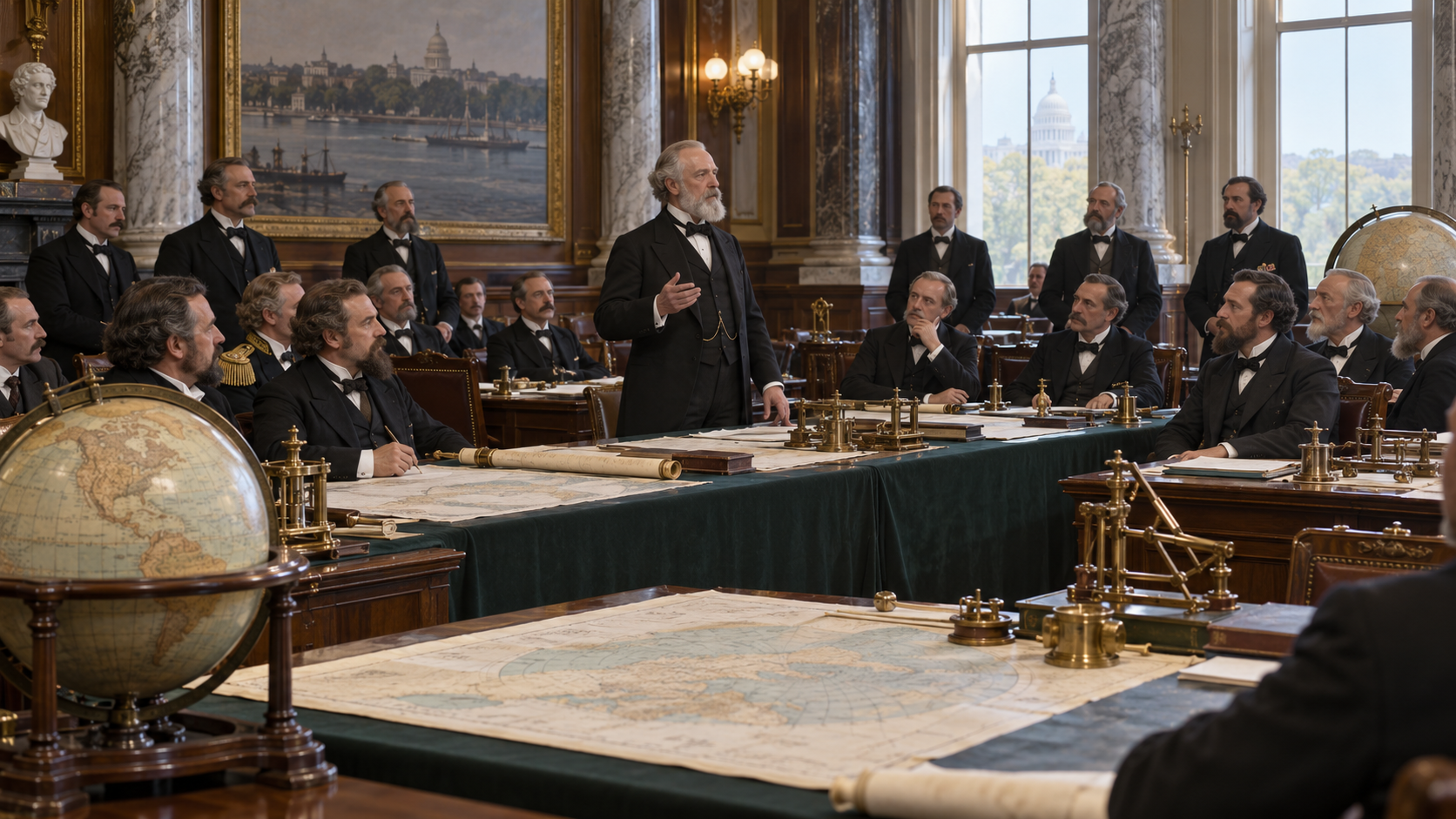
On October 13, 1884, delegates at the International Meridian Conference in Washington, D.C., adopted the meridian through the Royal Observatory at Greenwich as the common zero of longitude. The resolution passed by a large majority, although France abstained and San Domingo voted against it.
Navigators and mapmakers had long used several national prime meridians. By the late nineteenth century, expanding steamship routes, railways, telegraph networks, and international charts made a common reference increasingly valuable. Greenwich already appeared on most nautical charts because of Britain’s maritime reach.
The conference also recommended a universal day beginning at mean midnight on the prime meridian and counted longitudes east and west from Greenwich. It did not immediately impose modern time zones, and individual nations adopted standards on their own schedules.
The vote aligned maps, navigation, and timekeeping around one practical convention rather than discovering a physically privileged line. Greenwich Mean Time and later Coordinated Universal Time developed through improved astronomical clocks, radio signals, and atomic standards while retaining that geographic reference. The anniversary also illustrates how a scientific milestone becomes useful through records that later researchers can inspect. Instruments, notebooks, images, specimens, and engineering reports preserve more than a celebratory date: they show what was actually measured, what remained uncertain, and how conclusions changed as better methods became available. Placed in a longer timeline, the event was a junction rather than a finished answer. Earlier discoveries and technical work made it possible, while later teams tested its limits and applied the result in new settings. That traceable sequence of evidence and revision is what turns one day into a durable part of scientific history. The episode also separates a first demonstration from mature understanding. A successful observation or flight can settle one question while exposing harder problems in reliability, interpretation, safety, and scale. Preserved data allow later generations to revisit the achievement without confusing what was known on the date with what became clear afterward. Its calendar date is an entry point rather than an endpoint. The people involved worked with the tools, assumptions, institutions, and social conditions of their time. Later research has extended some conclusions and corrected others, showing how science advances by keeping evidence open to comparison instead of treating a memorable event as final. What makes the event scientifically important is not only priority, but the ability of others to check, repeat, compare, or build on the result. That process can reveal limitations hidden by the excitement of a first success. It also explains why careful archives and transparent measurements matter as much as the date remembered by the public.
National observatories and charts used different longitude origins.
The differences complicated shared navigation, timetables, and geographic data.
No physical feature makes Greenwich the unique zero of longitude.
Delegates selected a widely used reference to make international systems compatible.
Observatory measurements once tied civil time directly to Earth's rotation.
Modern UTC uses atomic clocks while preserving the Greenwich-based global framework.
Explore more of "On This Day ..."
Discover more events from the same date across news, politics, technology, sports, and other fields. Each link highlights significant moments that shaped history on different fronts.