

On This Day in Science: October 16, 1846
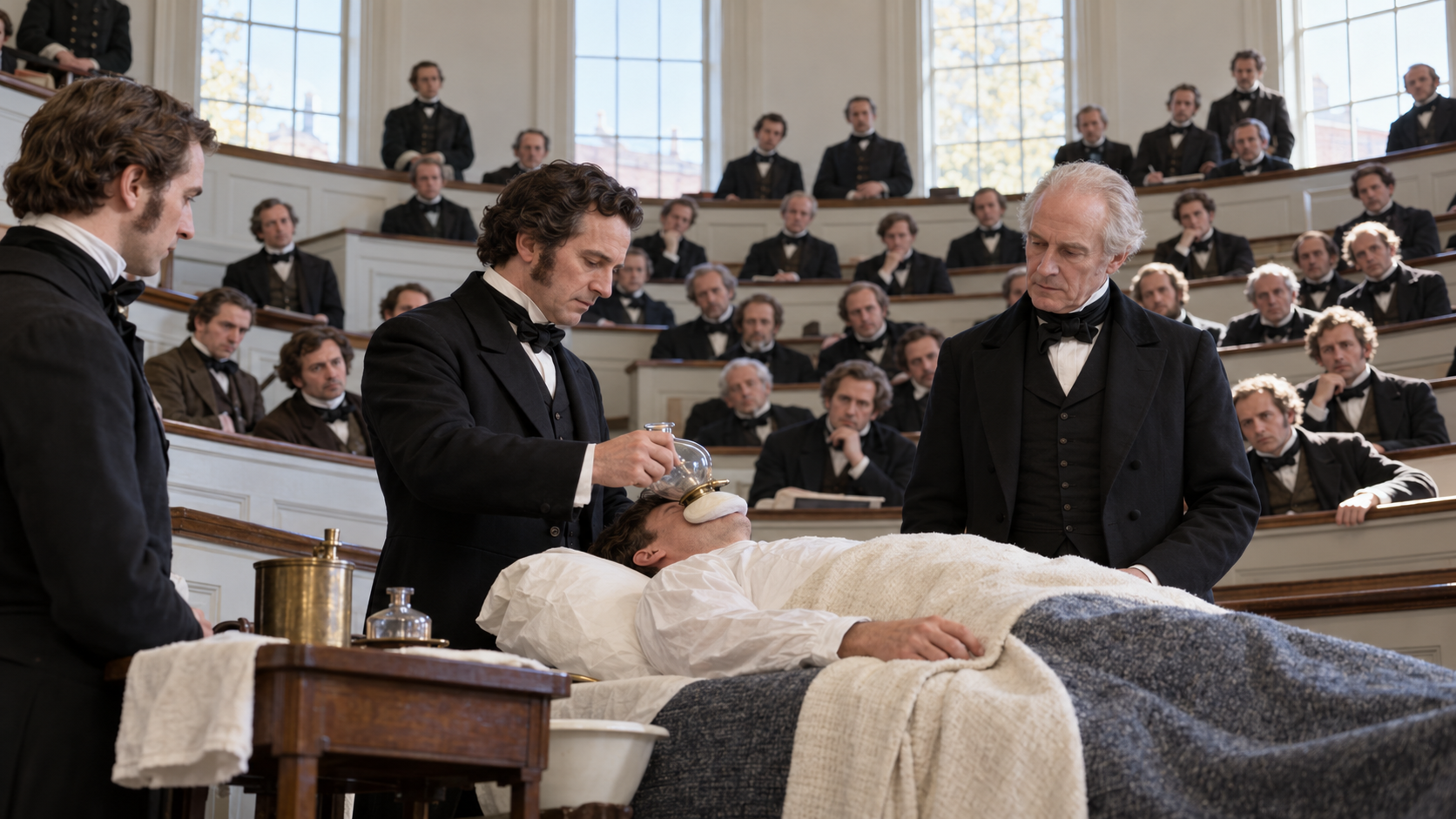
On October 16, 1846, dentist William T. G. Morton publicly demonstrated ether anesthesia during an operation at Massachusetts General Hospital in Boston. Surgeon John Collins Warren removed a neck tumor from patient Gilbert Abbott after Morton administered ether vapor through a glass inhaler.
Pain relief in surgery had a complicated history, and ether’s anesthetic effects were known before the demonstration. Crawford Long had used ether in operations beginning in 1842, while Horace Wells had attempted a public nitrous-oxide demonstration. Morton’s event became especially influential because physicians witnessed it and reported the result.
The operation was not entirely painless by modern standards, and early anesthesia carried major risks from uncertain dosing, flammable vapor, and limited control of breathing. Even so, the demonstration persuaded many surgeons that unconsciousness could be deliberately and reproducibly achieved during an operation.
Ether spread internationally within months and enabled longer, more deliberate procedures. Modern anesthesiology later combined safer drugs, airway management, monitoring, and specialized training, but the event in the room now called the Ether Dome became a defining public turning point. Its calendar date is an entry point rather than an endpoint. The people involved worked with the tools, assumptions, institutions, and social conditions of their time. Later research has extended some conclusions and corrected others, showing how science advances by keeping evidence open to comparison instead of treating a memorable event as final. What makes the event scientifically important is not only priority, but the ability of others to check, repeat, compare, or build on the result. That process can reveal limitations hidden by the excitement of a first success. It also explains why careful archives and transparent measurements matter as much as the date remembered by the public. Modern interpretations benefit from evidence that the original participants did not possess. New instruments and analytical methods can recover additional detail, while historical scholarship clarifies questions of credit, context, and consequence. Holding the original achievement and those later corrections together produces a more accurate account than either celebration or dismissal alone. The anniversary also illustrates how a scientific milestone becomes useful through records that later researchers can inspect. Instruments, notebooks, images, specimens, and engineering reports preserve more than a celebratory date: they show what was actually measured, what remained uncertain, and how conclusions changed as better methods became available. Placed in a longer timeline, the event was a junction rather than a finished answer. Earlier discoveries and technical work made it possible, while later teams tested its limits and applied the result in new settings. That traceable sequence of evidence and revision is what turns one day into a durable part of scientific history.
Morton administered ether before Warren began the operation.
Witnesses made the result more persuasive than an isolated private claim.
Several practitioners had experimented with ether and nitrous oxide.
Credit remains shared and contested because discovery, use, and public demonstration were different acts.
Reliable anesthesia allowed surgeons to work more slowly and extensively.
Later advances in antisepsis, transfusion, and monitoring expanded what operations could safely achieve.
Explore more of "On This Day ..."
Discover more events from the same date across news, politics, technology, sports, and other fields. Each link highlights significant moments that shaped history on different fronts.