

How Trees Pull Water to Their Leaves Explainer
Trees move water from soil to leaves without a heartlike pump. Water enters fine roots, crosses living tissues, and reaches xylem conduits made mostly from dead, hollow cells. From there it can travel many meters upward. The main energy source is sunlight, which drives evaporation from moist cell walls inside leaves.
Water vapor diffuses through open stomata into drier air. Evaporation curves air-water interfaces within tiny leaf pores and lowers water potential, placing the remaining liquid under tension. Because water molecules cohere through hydrogen bonding, the pull is transmitted down continuous columns in xylem. Adhesion to conduit walls helps stabilize those columns but is not a separate elevator.
Roots absorb water when their water potential is higher than that of the xylem. Membranes and dissolved solutes regulate entry, and radial pathways converge at the vascular tissue. Root pressure can push water modest distances under some conditions, causing guttation or sap flow, but it is usually insufficient to explain transport to a tall canopy.
Xylem anatomy balances efficiency against safety. Wide vessels move large volumes with less resistance but may be more vulnerable to embolism, where gas interrupts a water column. Narrow tracheids and network connections provide alternative paths. Drought, freezing, heat, and physical damage can increase cavitation, while plants isolate or sometimes restore affected conduits.
Stomata regulate the tradeoff between carbon dioxide uptake for photosynthesis and water loss. Guard cells respond to light, humidity, carbon dioxide, hormones, and leaf water status. When soil dries or atmospheric demand rises, partial closure protects hydraulic function but also limits photosynthesis and cooling. Leaves and branches may be shed if stress becomes severe.
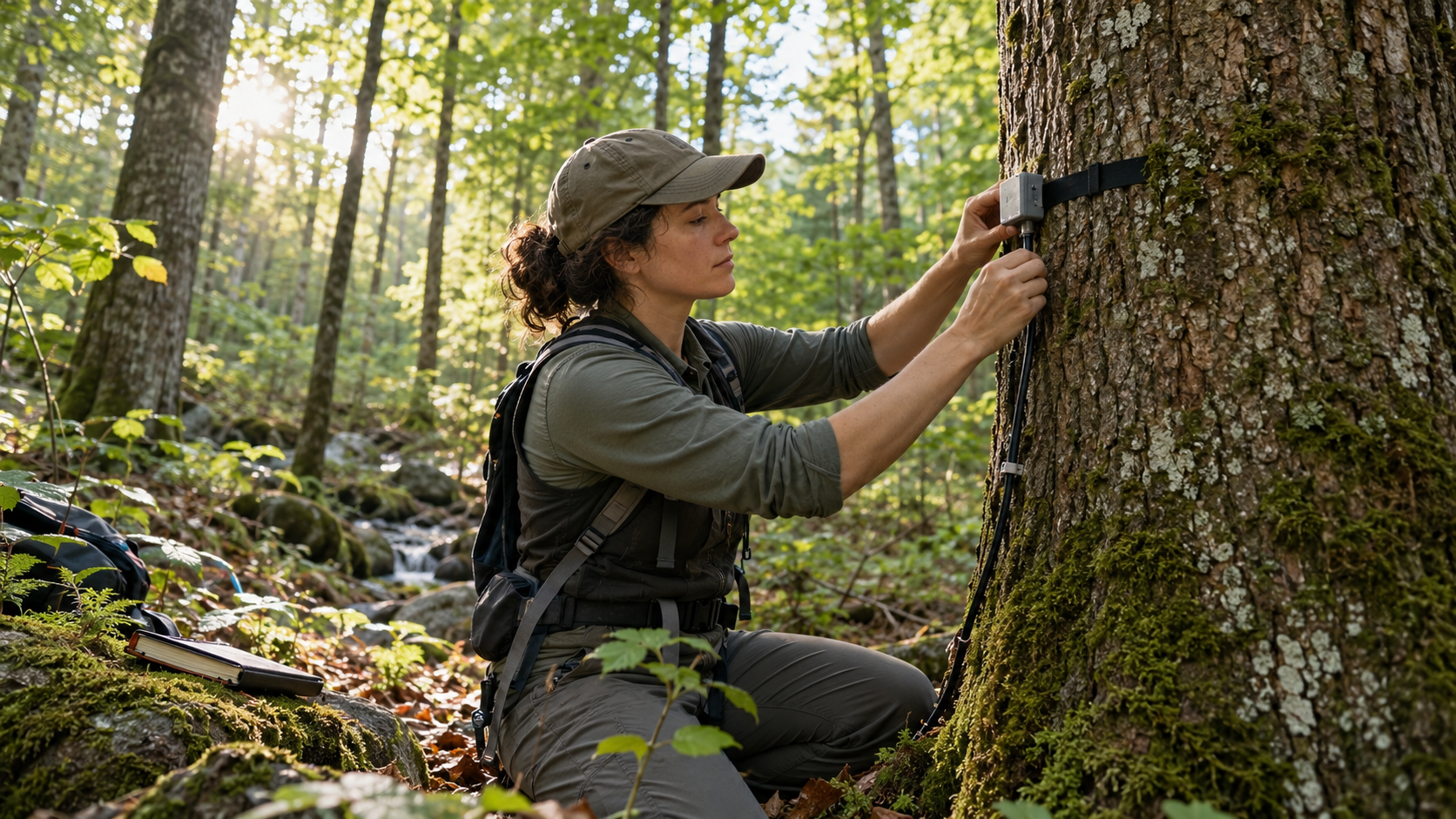
Researchers measure sap flow, leaf water potential, xylem pressure indirectly, isotopes, canopy exchange, and conduit structure. No single measurement describes an entire tree, and storage in elastic tissues can buffer daily demand. Hydraulic limits help explain tree height, drought mortality, species distributions, and how forests respond to a warmer, drier atmosphere.
Water enters roots and converges on hollow xylem conduits.
Leaf evaporation lowers water potential and places xylem water under tension.
Cohesion transmits the pull through connected water columns.
Xylem structure balances transport efficiency against embolism risk.
Stomata trade carbon dioxide uptake and cooling against water conservation.
Sap storage and alternate pathways buffer short changes in canopy demand.
Explore more "Explainers"
Discover additional explainers across politics, science, business, technology, and other fields. Each explainer breaks down a complex idea into clear, everyday language—helping you better understand how major concepts, systems, and debates shape the world around us.