

How Magnetic Levitation Balances Forces Explainer
Magnetic levitation occurs when magnetic forces balance an object’s weight without ordinary load-bearing contact. A complete system must also control sideways motion, pitch, roll, and the gap to its guideway. Simply placing two permanent magnets with like poles together rarely makes stable free suspension because the object can slide or flip into a lower-energy position.
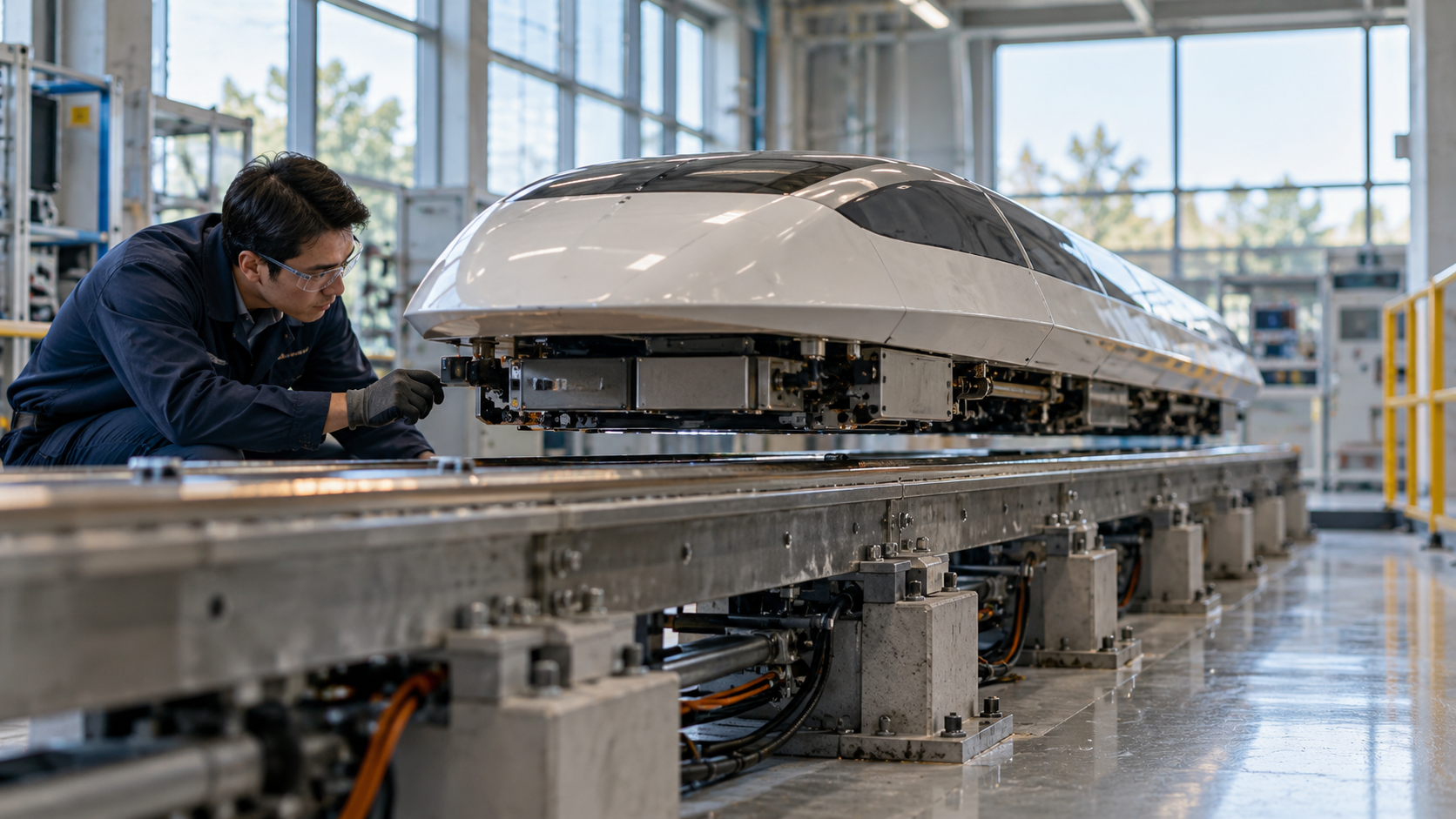
Electromagnetic suspension, or EMS, uses attractive forces between actively controlled electromagnets and ferromagnetic rails. Gap sensors measure the separation many times per second, and a feedback controller adjusts current to prevent contact. The operating gap can be small, so control response and guideway precision are central to safe operation.
Electrodynamic suspension, or EDS, uses repulsive or restoring forces produced by changing magnetic fields, induced currents, or superconducting magnets. Some designs develop strong lift only after reaching speed and use wheels at low speed. Magnetic geometry can also provide passive guidance in selected directions, though damping and control are still needed for a comfortable ride.
Levitation removes wheel-rail rolling contact, but it does not eliminate resistance. Air drag dominates at high speed, and changing magnetic fields create electrical losses and heating. Guideway roughness, crosswinds, curves, and passenger loads continually alter the required forces. The vehicle and track are one tightly coupled electromagnetic and structural system.
Propulsion is often supplied by a linear motor, essentially an electric motor unrolled along the guideway. Sequential magnetic fields pull or push the vehicle forward, while a separate pattern may provide braking. Position sensing synchronizes the field with the moving vehicle. Regenerative braking can return some kinetic energy to the electrical system.
Engineers test gap stability, fail-safe support, electromagnetic compatibility, cryogenics where used, power consumption, and guideway tolerances. Maglev can reduce mechanical wear and allow high speed, but infrastructure cost and routing remain major constraints. The defining idea is not frictionless travel; it is controlled force balance plus coordinated guidance and propulsion.
Magnetic lift must balance weight while other degrees of freedom remain controlled.
EMS uses active attraction and rapid feedback to maintain a small gap.
EDS uses repulsion or induced restoring forces and may require forward speed.
Air drag, electrical loss, and structural motion remain after contact is removed.
Linear motors create propulsion by moving a magnetic field along the guideway.
Safe systems include sensing, damping, backup support, and precise infrastructure.
Explore more "Explainers"
Discover additional explainers across politics, science, business, technology, and other fields. Each explainer breaks down a complex idea into clear, everyday language—helping you better understand how major concepts, systems, and debates shape the world around us.