

How Gyroscopes Maintain Orientation Explainer
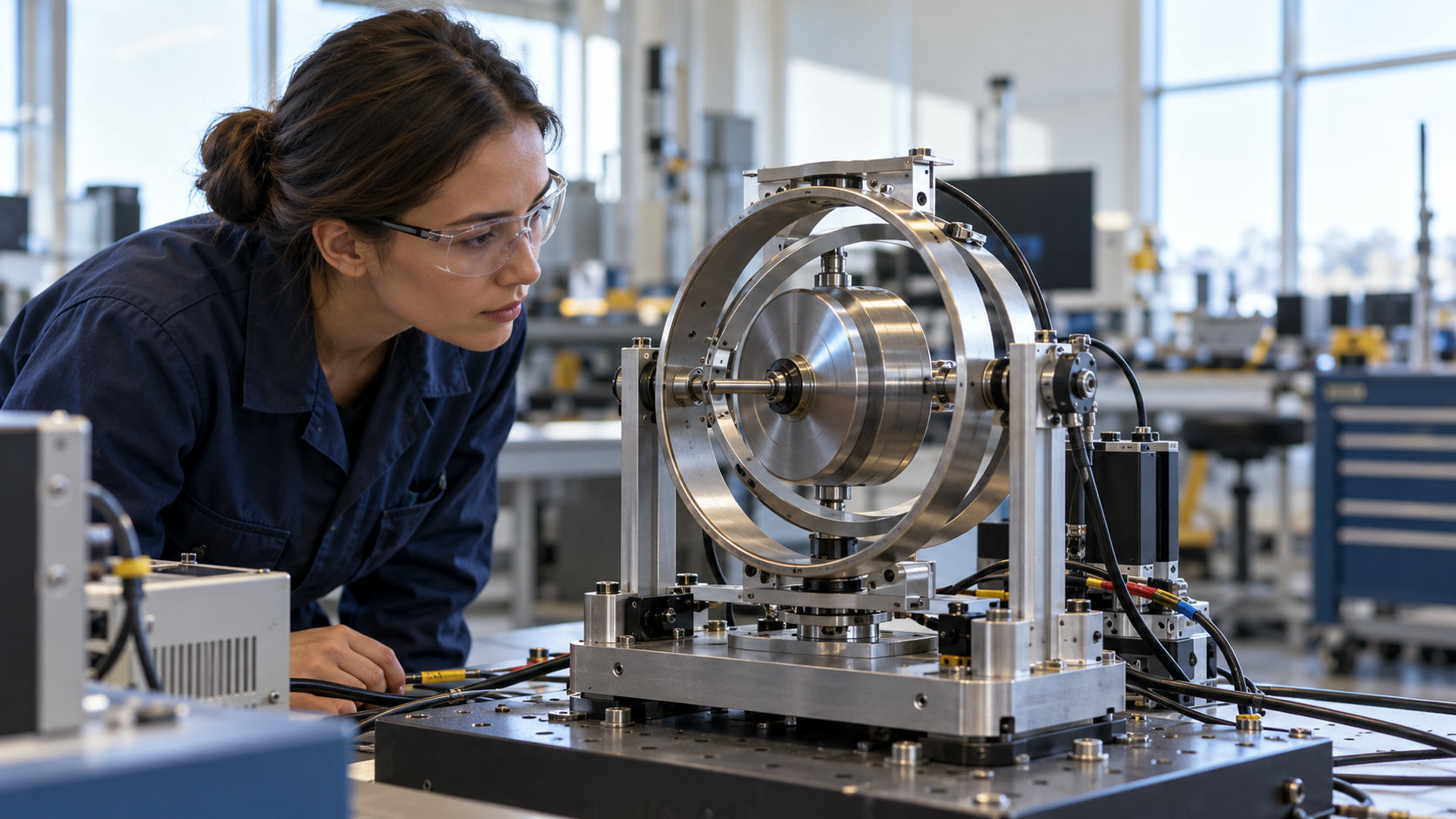
A mechanical gyroscope contains a spinning rotor whose angular momentum points along its rotation axis. Angular momentum combines rotation rate, mass distribution, and direction. Without an external torque, it remains constant, so the axis keeps the same direction in an inertial frame even while the support or vehicle around it moves.
When gravity or another force applies a torque, the rotor does not simply fall in the torque’s direction. Torque changes angular momentum sideways, making the axis turn through precession. Faster spin or greater rotational inertia produces more angular momentum and therefore a slower directional change for the same applied torque.
Gimbals let a rotor rotate while its mounting frame changes orientation. A free gyro can provide a reference direction, while a rate gyro measures angular velocity. Real bearings create friction and small torques, causing drift. Gimbal geometry can also reach configurations where axes align and one rotational degree of freedom is lost, called gimbal lock.
Many modern gyroscopes contain no spinning wheel. MEMS devices vibrate microscopic masses and measure Coriolis forces that appear when the chip rotates. Fiber-optic and ring-laser gyros compare light traveling in opposite directions around a loop. Each technology trades size, cost, sensitivity, bias stability, noise, and operating range.
A sensor does not hold a vehicle still by itself. Aircraft, spacecraft, phones, and robots integrate rate measurements to estimate attitude, then combine them with accelerometers, magnetometers, star trackers, GPS, or cameras. A control system commands wheels, thrusters, or steering surfaces to correct orientation. Integration errors accumulate unless other references constrain them.
Gyroscopes illustrate conservation laws, but phrases such as “resists gravity” can mislead. A spinning top eventually slows and falls because friction reduces angular momentum and changing motion alters torque. Engineers calibrate bias, scale factor, temperature response, and alignment so the mathematical orientation estimate remains tied to the physical reference frame.
A spinning rotor’s angular momentum points along its axis.
Torque changes angular momentum and creates precession.
Gimbals allow independent rotation but can suffer drift and gimbal lock.
MEMS, fiber-optic, and ring-laser gyros sense rotation by different physics.
Navigation combines gyros with other sensors to limit accumulated error.
Control actuators, not the sensor alone, physically correct a vehicle’s orientation.
Explore more "Explainers"
Discover additional explainers across politics, science, business, technology, and other fields. Each explainer breaks down a complex idea into clear, everyday language—helping you better understand how major concepts, systems, and debates shape the world around us.