

How Fluorescence Produces Visible Light Explainer
Fluorescence is light emitted shortly after a substance absorbs light or other electromagnetic energy. An incoming photon promotes an electron to an excited molecular state, but the molecule usually loses some energy before sending a new photon back out. The useful explanation follows energy and charge while respecting the material properties at each boundary. Keeping track of losses explains why practical performance falls short of an ideal limit.
Absorption works only when the photon energy matches an allowed transition. The excited molecule then relaxes through vibrations and collisions, transferring some energy to its surroundings as heat before it reaches a lower excited state. Geometry and composition set the available pathways, so small design changes can alter the response.
When the electron returns to a lower electronic state, the molecule can emit a photon. Because energy was lost during relaxation, the emitted photon usually has less energy and a longer wavelength than the absorbed light, called a Stokes shift. The process continues only while a driving difference overcomes losses, resistance, or competing motion.
Emission typically stops within nanoseconds after excitation ends, distinguishing fluorescence from longer-lived phosphorescence. Molecular structure, solvent, temperature, concentration, and nearby quenchers influence brightness, color, and lifetime by opening competing nonradiative pathways. Real devices add interfaces and imperfections that idealized diagrams usually leave out.
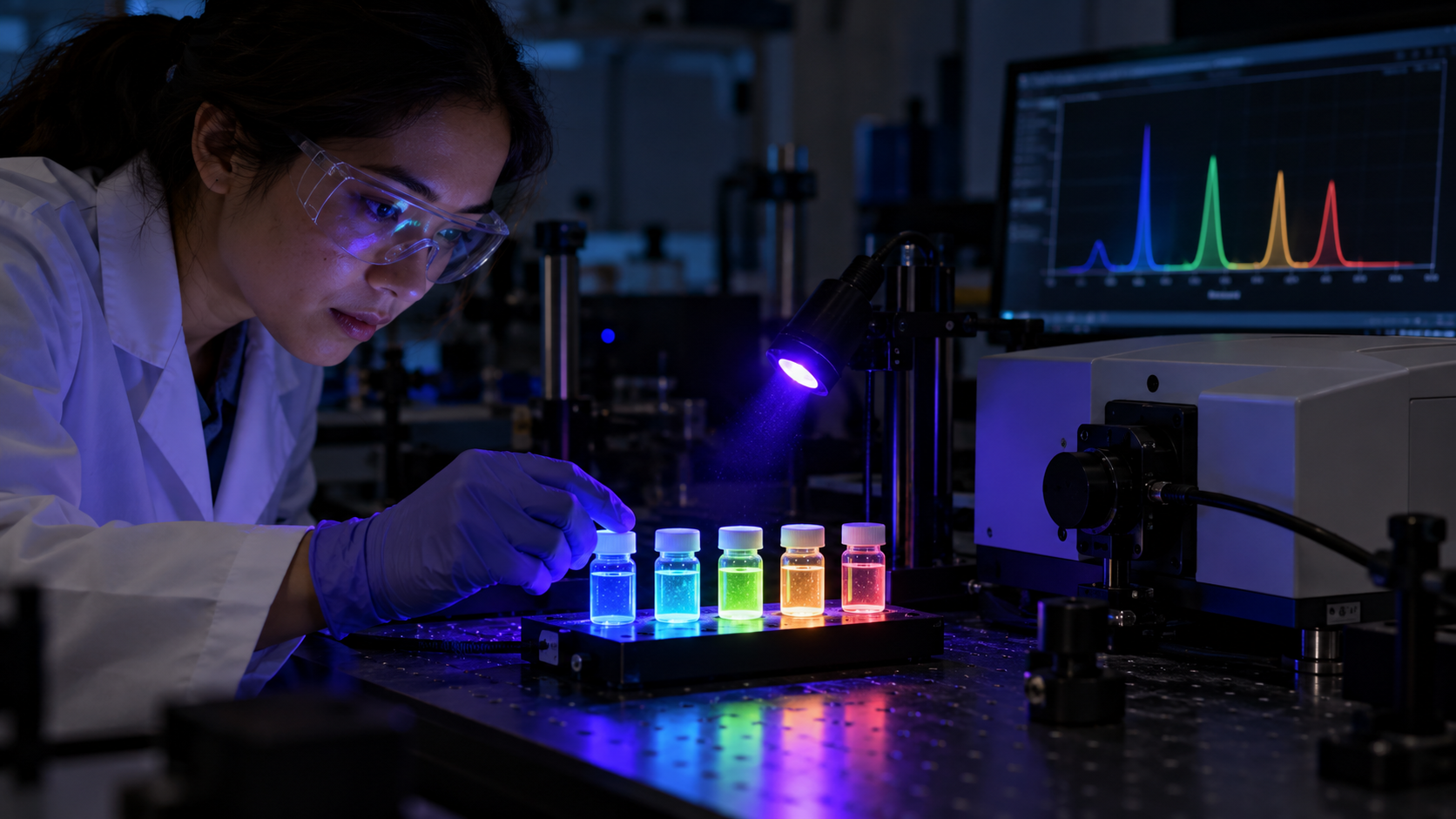
Spectrometers measure absorption and emission across wavelength, while time-resolved instruments measure how quickly the glow decays. Calibration matters because detector sensitivity, stray light, sample thickness, and reabsorption can distort an apparent spectrum or intensity. Scientists test the model by changing one condition and measuring the predicted optical, thermal, or electrical signal.
Fluorescent molecules enable microscopy, chemical sensing, mineral identification, lighting, and security marking. Their signal can be extremely selective, but photobleaching, background glow, and environmental sensitivity mean brightness alone is not a direct measure of amount. The core physics is dependable, but efficiency and scale depend on engineering details and operating conditions.
A molecule absorbs a photon that matches an allowed energy transition.
The excited state loses part of its energy through motion and collisions.
A lower-energy photon is emitted when the electron relaxes.
Emission is usually shifted to a longer wavelength than excitation.
Quenching and photobleaching can reduce the observed signal.
Spectral and lifetime measurements reveal different molecular information.
Explore more "Explainers"
Discover additional explainers across politics, science, business, technology, and other fields. Each explainer breaks down a complex idea into clear, everyday language—helping you better understand how major concepts, systems, and debates shape the world around us.