

How Diffusion Spreads Particles Explainer
Diffusion is the spreading produced by random molecular or particle motion. Individual particles move in every direction, but when one region contains more particles, more random steps leave that region than enter it from a sparse neighbor. The useful explanation follows energy, matter, and fields while respecting material properties at each boundary. Keeping track of losses explains why practical performance falls short of an ideal limit.
The net result is flux down a concentration gradient even though no particle senses where concentration is lower. Fick’s first law expresses that flux as proportional to the gradient and a diffusion coefficient. Geometry and composition set the available pathways, so small design changes can alter the response.
Fick’s second law describes how concentration changes with time as local imbalances smooth out. A narrow pulse broadens, and the characteristic distance reached grows with the square root of elapsed time rather than directly with time. The process continues only while a driving difference overcomes losses, resistance, or competing motion.
The diffusion coefficient depends on temperature, particle size, the surrounding medium, and interactions. Obstacles, binding, pores, or crowded interiors can slow transport or make it depart from the simplest constant-coefficient model. Real systems add interfaces and imperfections that idealized diagrams usually leave out.
Diffusion can occur without bulk flow, while convection carries material with the average motion of a fluid. Real systems often combine both, so experiments must separate spreading caused by random motion from transport caused by currents. Scientists test the model by changing one condition and measuring the predicted thermal, optical, or electrical signal.
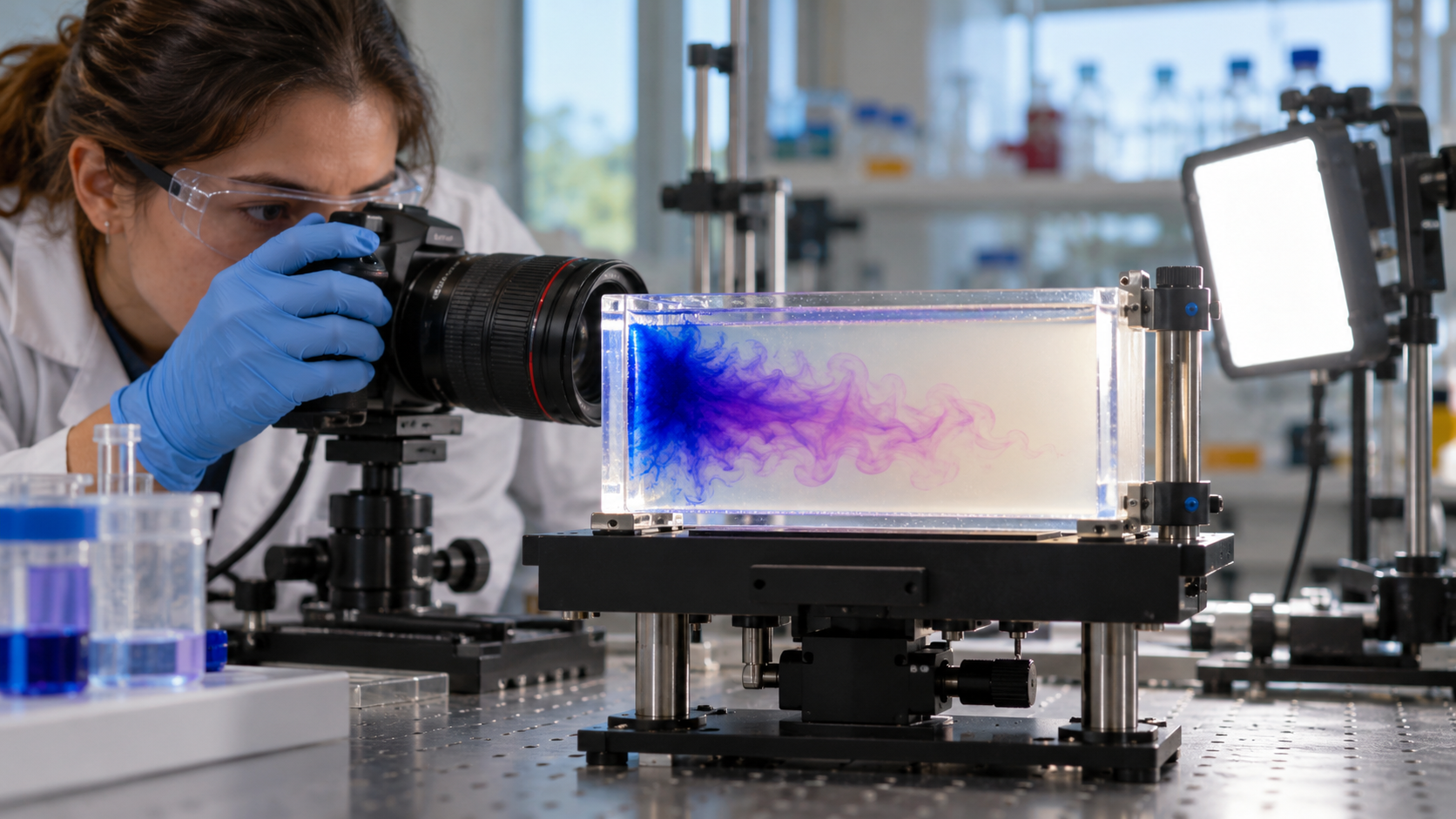
Researchers release tracers, record concentration profiles, and fit them over space and time. Equal concentration marks equilibrium at the observed scale, not an end to molecular motion, because particles continue exchanging randomly. The core physics is dependable, but efficiency and scale depend on operating conditions and experimental uncertainty.
Particles undergo random thermal motion in all directions.
Crowded regions produce more outward than inward random steps.
The imbalance creates net flux down the concentration gradient.
Concentration profiles broaden according to diffusion equations.
Temperature, size, and medium set the diffusion coefficient.
Equilibrium removes net flux but not microscopic motion.
Explore more "Explainers"
Discover additional explainers across politics, science, business, technology, and other fields. Each explainer breaks down a complex idea into clear, everyday language—helping you better understand how major concepts, systems, and debates shape the world around us.