

How Blackbody Radiation Tracks Temperature Explainer
A blackbody is an ideal object that absorbs all incident electromagnetic radiation and emits a characteristic thermal spectrum. Its spectral shape depends only on absolute temperature, making it a foundational reference rather than a material color. The useful explanation follows energy, matter, and fields while respecting material properties at each boundary. Keeping track of losses explains why practical performance falls short of an ideal limit.
Planck’s law gives the emitted radiance at each wavelength. Raising temperature increases emission across the spectrum and shifts the peak toward shorter wavelengths, summarized by Wien’s displacement law. Geometry and composition set the available pathways, so small design changes can alter the response. Scale changes the balance among surface effects, bulk behavior, and heat flow.
The Stefan-Boltzmann law states that total radiated power per unit area grows with the fourth power of absolute temperature. A modest temperature increase can therefore produce a much larger increase in total thermal emission. The process continues only while a driving difference overcomes losses, resistance, or competing motion.
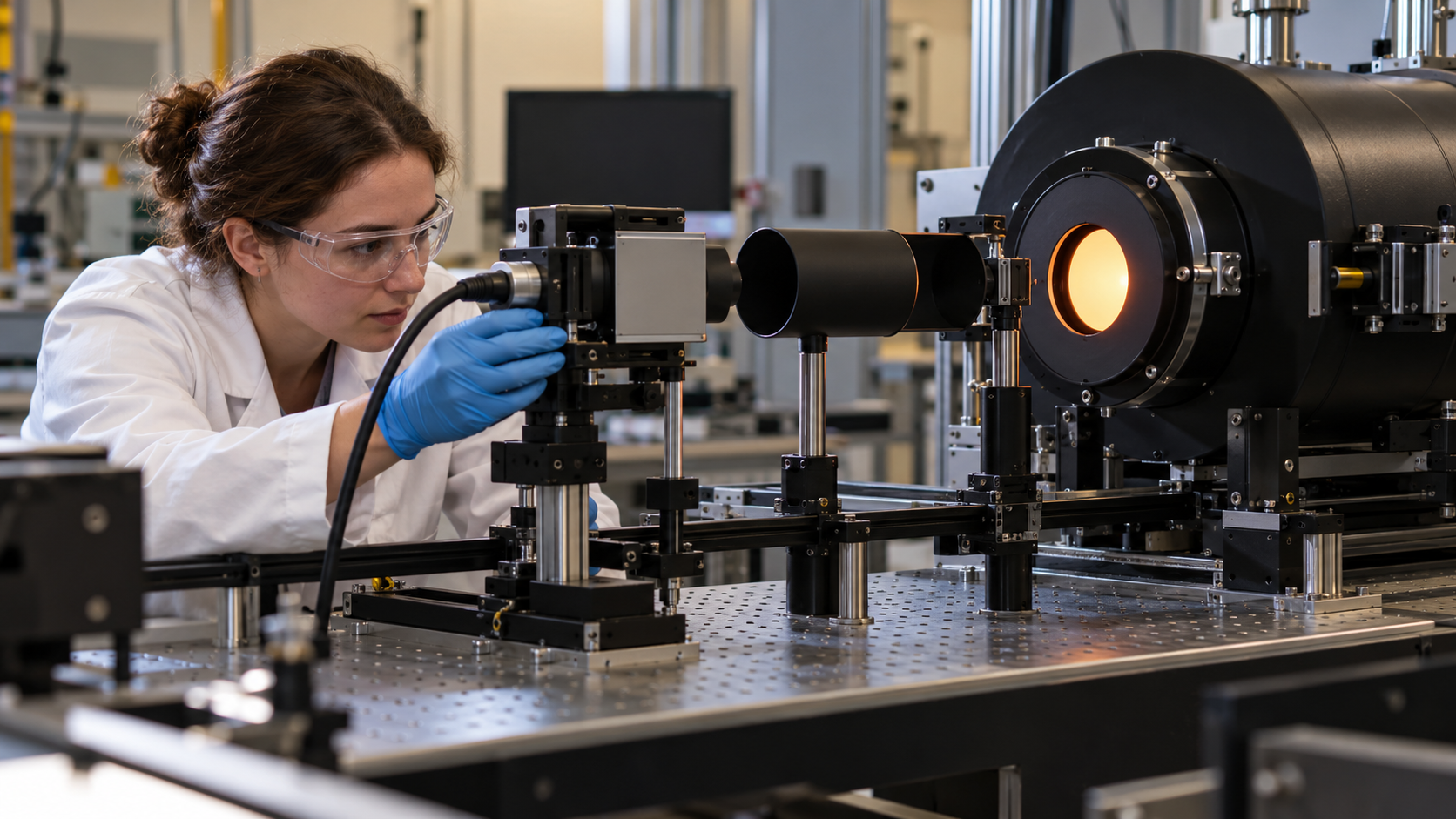
Real objects are not perfect blackbodies and have wavelength-dependent emissivity. Cavity sources with small apertures approximate the ideal closely because radiation undergoes many internal absorptions before escaping through the opening. Real systems add interfaces and imperfections that idealized diagrams usually leave out.
Astronomers compare stellar continua with blackbody curves to estimate effective temperatures, while thermal imagers infer object temperatures from infrared radiance. Both uses require correction for emissivity, atmosphere, instrument response, and viewing geometry. Scientists test the model by changing one condition and measuring the predicted thermal, optical, or electrical signal.
A fitted blackbody temperature is a model-dependent effective value, not always the physical temperature of every layer. Researchers calibrate detectors against traceable sources and use multiple wavelengths to expose departures from the ideal spectrum. The core physics is dependable, but efficiency and scale depend on operating conditions and experimental uncertainty.
An ideal blackbody absorbs all incoming radiation.
Thermal motion produces a continuous emission spectrum.
Planck’s law fixes the spectral curve for a given temperature.
Hotter bodies emit more power and peak at shorter wavelengths.
Real surfaces introduce emissivity below the ideal.
Calibrated multiwavelength measurements estimate effective temperature.
Explore more "Explainers"
Discover additional explainers across politics, science, business, technology, and other fields. Each explainer breaks down a complex idea into clear, everyday language—helping you better understand how major concepts, systems, and debates shape the world around us.