

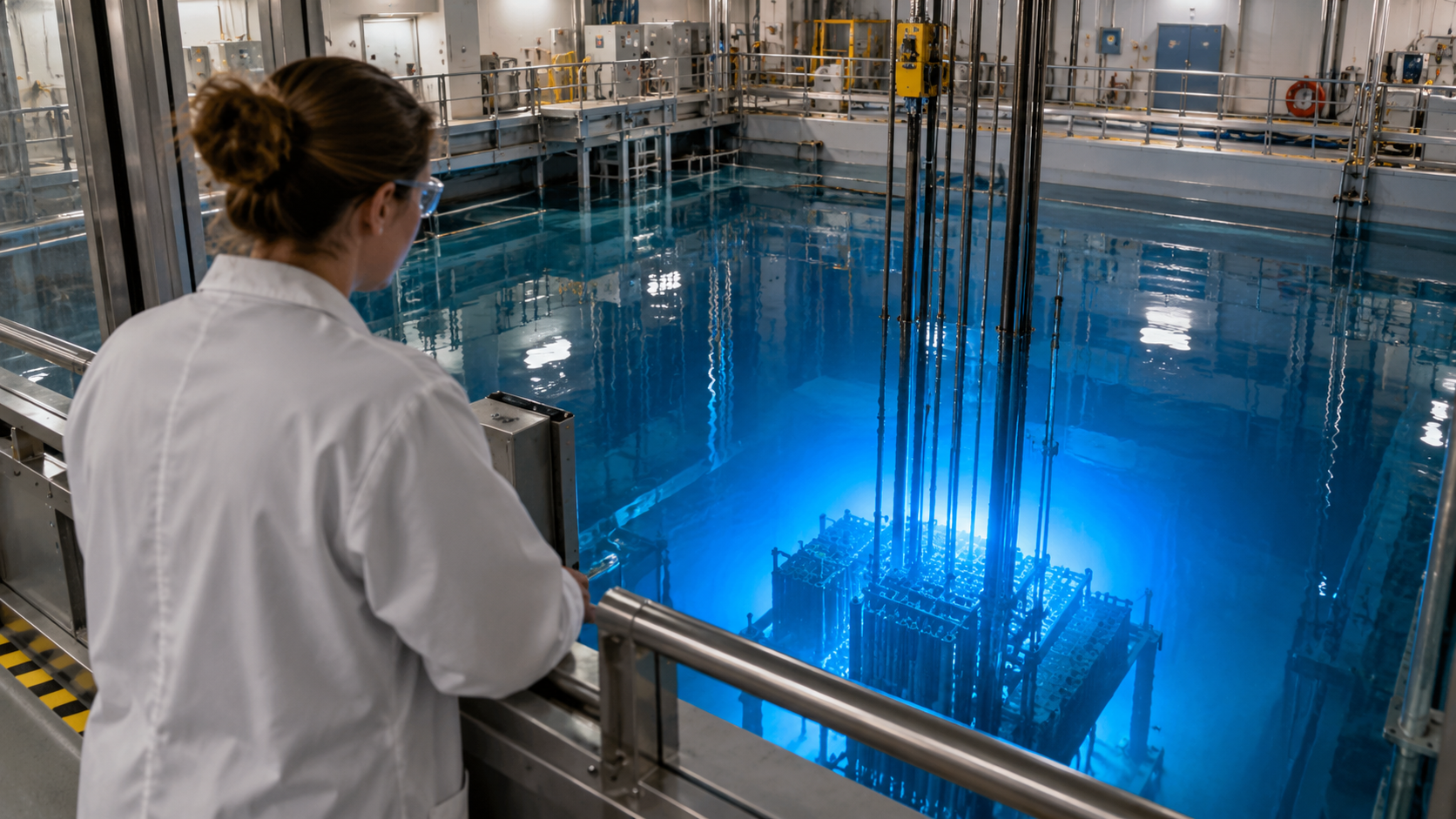
How Cherenkov Radiation Produces Blue Light Explainer
Cherenkov radiation occurs when a charged particle travels through a transparent medium faster than light’s phase velocity in that medium. It does not exceed light’s speed in vacuum, the universal relativistic limit. The useful explanation follows energy, matter, and fields while respecting material properties at each boundary. Keeping track of losses explains why practical performance falls short of an ideal limit.
The moving charge polarizes nearby molecules. When its speed is below the medium’s light speed, those disturbances largely cancel, but above the threshold their emitted electromagnetic waves add coherently along a cone. Geometry and composition set the available pathways, so small design changes can alter the response.
The geometry resembles a sonic boom: wavefronts overlap at a characteristic angle determined by particle speed and refractive index. Detectors can use that cone to infer a particle’s direction and, with other measurements, its speed. The process continues only while a driving difference overcomes losses, resistance, or competing motion.
Cherenkov emission is stronger at shorter visible wavelengths under many conditions, contributing to the familiar blue or violet appearance in water. Absorption, detector sensitivity, and human vision also influence the observed color. Real systems add interfaces and imperfections that idealized diagrams usually leave out.
Reactor pools can glow because energetic charged particles pass through water, while particle-physics and cosmic-ray instruments use transparent radiators to identify or track particles. The light is not the same as blue nuclear fuel burning. Scientists test the model by changing one condition and measuring the predicted thermal, optical, or electrical signal.
Researchers measure photon timing, wavelength, and cone angle while accounting for dispersion because refractive index varies with wavelength. The threshold depends on the specific medium, so the same particle may radiate in one material but not another. The core physics is dependable, but efficiency and scale depend on operating conditions and experimental uncertainty.
A charged particle enters a transparent dielectric medium.
Its electric field polarizes nearby molecules.
Above the medium-specific light speed, wavefronts overlap coherently.
The combined radiation forms a directional cone.
Short visible wavelengths often make the glow appear blue.
Cone angle and timing help identify energetic particles.
Explore more "Explainers"
Discover additional explainers across politics, science, business, technology, and other fields. Each explainer breaks down a complex idea into clear, everyday language—helping you better understand how major concepts, systems, and debates shape the world around us.