


Stephen Miller Begins as White House Chief of Staff After GOP Midterm Losses
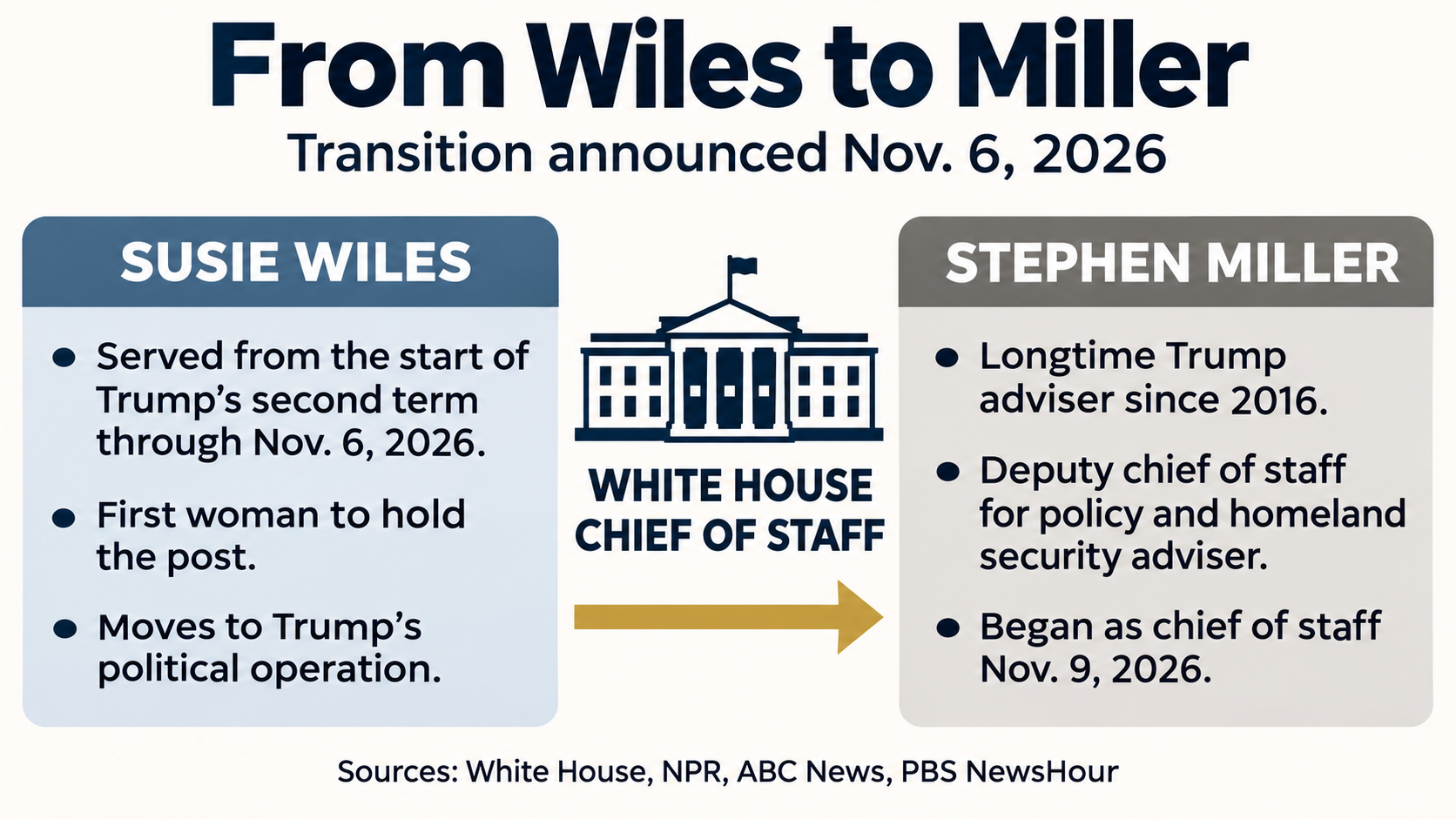
Stephen Miller began his first day as White House chief of staff Monday, completing a rapid transition announced after Republicans lost control of Congress in the 2026 midterm elections. President Donald Trump said on Nov. 6 that Miller would replace Susie Wiles, who had led the White House staff from the start of Trump’s second term and was the first woman to hold the position.
The White House described Miller as its 33rd chief of staff. The administration’s announcement said he had served Trump since the beginning of the president’s political rise and credited him with helping shape the administration’s policy agenda. NPR, ABC News and PBS NewsHour all reported that Miller’s move took effect Nov. 9. Wiles said she would continue working for Trump, and the president said she would move to his political operation.
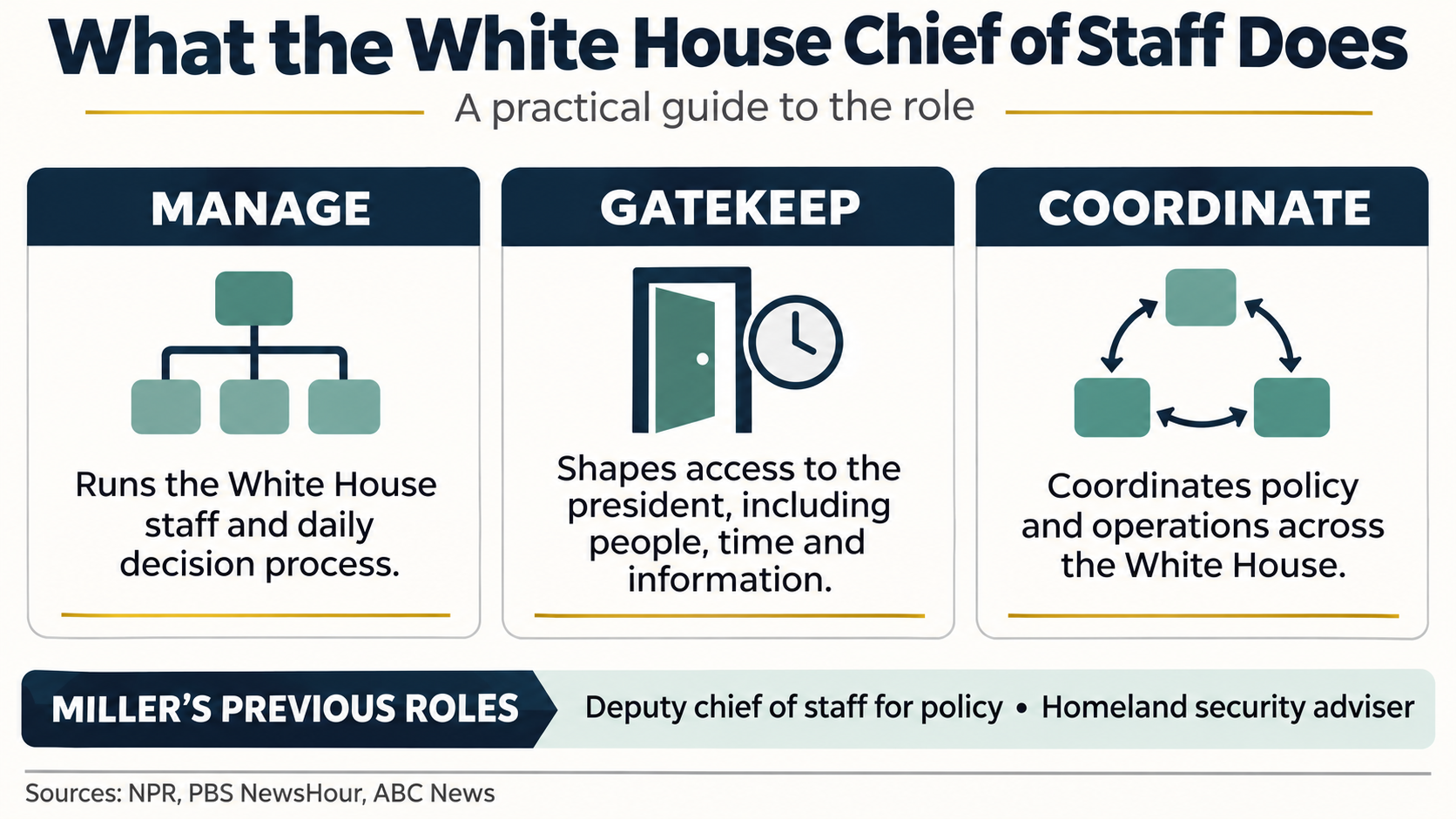
The appointment is a change in personnel rather than a new policy action. It does not by itself alter immigration law, congressional control, agency rules or court orders. Its importance comes from the chief of staff’s position at the center of White House management. The chief typically organizes the president’s staff, helps structure the decision process and controls access to the president’s time and information.
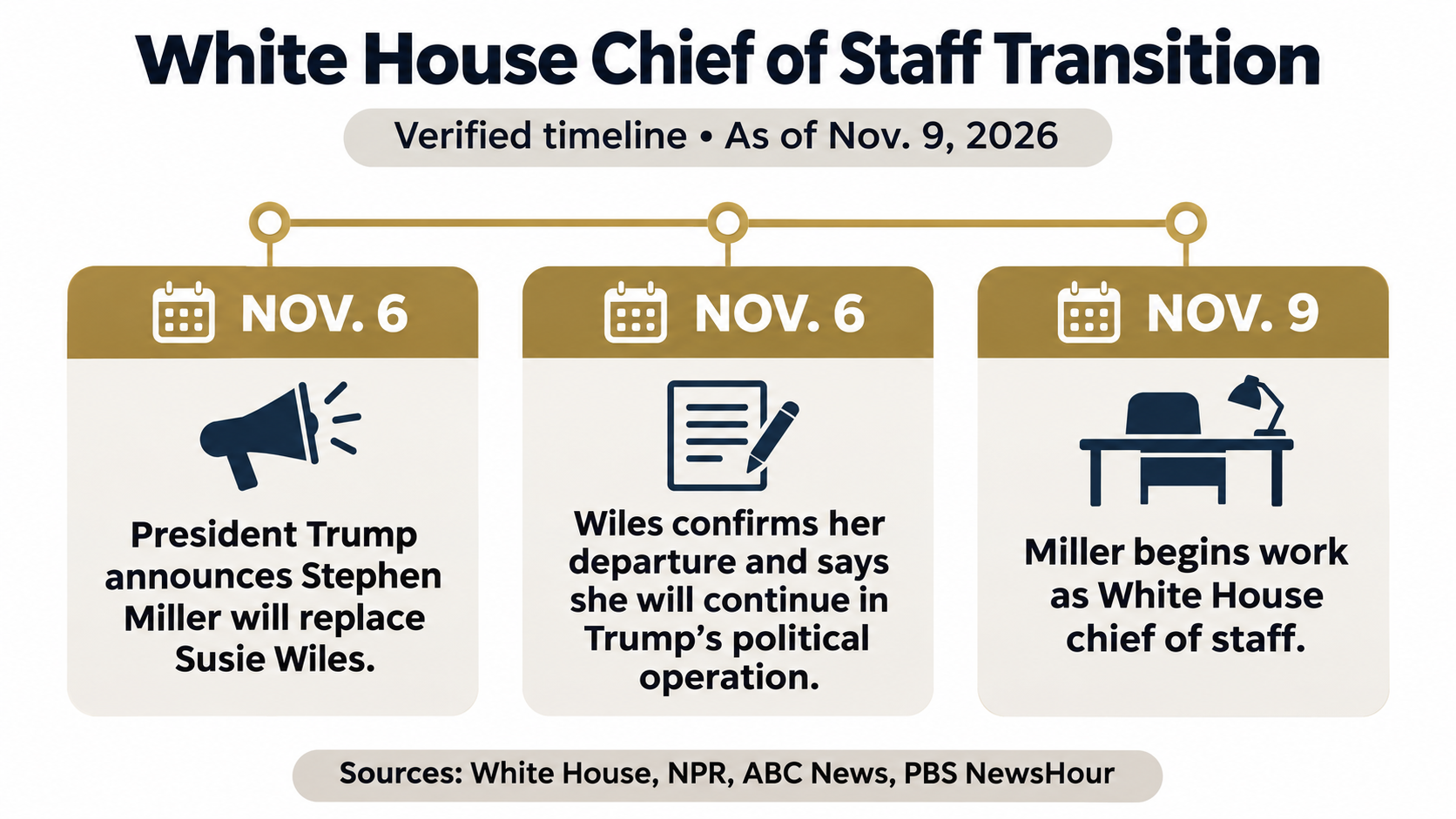
Verified timeline as of Nov. 9, 2026. Sources: White House, NPR, ABC News and PBS NewsHour.
What changed at the top of the White House
Wiles’s departure ended a tenure that had been notably steadier than the frequent staff turnover of Trump’s first administration. NPR reported that she built a reputation as a disciplined manager who reduced leaks and kept tighter control over staff operations. ABC News reported that she submitted her resignation after it became clear Trump blamed her for the midterm results, citing unnamed sources. The White House did not use that description in its announcement and praised her service.
Trump told reporters that he wanted to make a change and described Miller as politically astute and a strong manager. Miller had already been serving as deputy chief of staff for policy and as a homeland security adviser. He has worked in Trump’s orbit since the 2016 campaign, first as a speechwriter and policy adviser and later as one of the administration’s most influential voices on immigration and executive power.
Wiles said in her public statement that her role was changing but that she remained committed to Trump’s mission. The White House announcement included praise for both Wiles and Miller from members of the administration and Republican officials. That record establishes continuity within Trump’s political organization even as management of the White House shifts to Miller.
Why the chief of staff matters
The chief of staff is not a cabinet secretary and does not need to win a legislative vote to take office. The role’s influence is organizational. A chief can decide which disputes are elevated, which meetings make the president’s schedule and whether competing advisers get a fair opportunity to present their views. David Cohen, a University of Akron political scientist who studies the position, told NPR that the chief acts as an important gatekeeper for the president’s time, information and visitors.
That gatekeeping function can be especially consequential in a divided government. Democrats are set to control both the House and Senate in January, according to NPR and ABC News. The administration will need to work with lawmakers on funding, nominations, oversight and any legislation that requires congressional approval. Miller’s ability to coordinate policy may help the White House present a more unified strategy, but a highly ideological approach could make bargaining harder.
Miller’s previous portfolio centered on policy and homeland security. PBS NewsHour described him as a principal architect of Trump’s immigration crackdown and reported that his responsibilities had expanded into national security. The promotion gives him a broader management job that includes issues beyond immigration, while also increasing his ability to shape how those policies reach the president.
The political context
The timing connects the personnel change to the election even though the appointment itself does not explain the full result. Republicans suffered major losses in the midterms, and Democrats won incoming majorities in both chambers. NPR reported that voter data indicated opposition to the administration’s aggressive immigration enforcement contributed to Democratic gains. Other issues also shaped the election, and the available sources do not establish that one policy alone caused the outcome.
The White House framed Miller’s promotion as a choice for experience, loyalty and continuity. Vice President JD Vance thanked Wiles and congratulated Miller. Other administration officials praised Miller’s work ethic and familiarity with Trump’s agenda. Their statements were endorsements, not independent evidence that every administration claim about crime, immigration or the economy was correct.
Democratic leaders responded sharply. House Democratic leader Hakeem Jeffries and Senate Democratic leader Chuck Schumer described Miller as extreme and promised opposition. Their statements reflected political judgments about Miller’s record, not disputes over whether he had been appointed. ABC News also reported dissent from some Republicans. Outgoing Sen. Thom Tillis of North Carolina called Miller the worst possible choice and questioned whether a polarizing figure could help the administration work with incoming Democratic majorities.
What the appointment changes — and what it does not
Miller can now shape the entire White House workflow rather than primarily a policy portfolio. He may influence which priorities receive staff time, how disagreements are resolved and how the administration prepares for confrontations with Congress. He can also promote a tighter chain of command if aides recognize his authority and if Trump uses the office as the central channel for decisions.
The job does not give Miller independent authority to write statutes, appropriate money or set aside court rulings. Immigration enforcement remains bounded by existing law, funding, agency capacity and litigation. Congress can conduct oversight, control appropriations and legislate. Courts can review specific government actions. Agencies still must follow the procedures that apply to their rules and decisions.
The distinction is important because reporting about a powerful adviser can easily blur influence with formal authority. Miller’s appointment may signal the direction Trump wants, but any concrete change must be evaluated through the actual executive order, regulation, enforcement directive, budget request or legislative proposal that follows.
The management decisions readers can verify
The first measurable test will be how Miller organizes the senior staff. Personnel announcements, meeting structures and formal assignments will show whether policy disputes are being routed through one coordinated process or handled by competing centers of influence. That evidence matters more than broad predictions about what a chief of staff might do.
Funding and congressional oversight create a second test. With a Dec. 11 funding deadline and incoming Democratic majorities, the White House will have to answer requests from lawmakers, negotiate over spending and decide which disputes are worth escalating. Those choices will reveal whether the new chief emphasizes bargaining, confrontation or a mix of both.
The third test is the form of any policy change. A speech, press statement or staff appointment can indicate priorities, but it does not carry the same legal effect as an executive order, agency directive, regulation or enacted statute. Readers can separate political signaling from government action by checking the document, issuing authority, effective date, funding and any court challenge attached to each step.
The same standard applies to claims from both parties: identify the speaker, distinguish prediction from confirmed action and revisit the record when agencies, Congress or courts provide new evidence.
What comes next
Miller’s first immediate task is operational: take control of a White House staff adjusting to election losses while the current Congress returns for a lame-duck session. NPR reported that federal funding expires Dec. 11, giving lawmakers and the administration a near-term deadline. The White House also faces nominations, oversight demands and a transition to divided government in January.
Readers should watch for evidence of how Miller runs the process rather than assuming that every prior policy preference will automatically become government action. Useful indicators include changes to the senior staff, who receives new policy assignments, whether agencies issue formal directives, how the White House approaches funding negotiations and whether Trump’s promised cooperation with Democrats produces specific agreements.
For now, the verified development is straightforward: Trump replaced Wiles with Miller, Wiles moved toward political work, and Miller began as chief of staff on Nov. 9. The larger consequences will depend on how he uses the job and how Congress, agencies and courts respond to the administration’s next concrete actions.
Left View: Miller’s Promotion Raises New Accountability Questions
Stephen Miller’s first day as White House chief of staff places a forceful advocate of President Trump’s immigration program in the administration’s most influential staff position. Trump announced the change Nov. 6, after Republicans lost control of Congress in the midterms, and Miller formally began the job Nov. 9. Susie Wiles, the first woman to serve as chief of staff, is leaving the White House staff but continuing with Trump’s political operation.
From a progressive perspective, the central issue is not whether a president may choose a loyal chief of staff. The president plainly has broad discretion over that appointment. The concern is how Miller may use the chief’s gatekeeping power after a campaign in which voters expressed substantial dissatisfaction with the administration and its immigration enforcement.
NPR reported that data from the election indicated Democrats gained support partly because of opposition to aggressive immigration enforcement. That does not prove immigration was the only cause of Republican losses, and it does not turn an election into a detailed policy referendum. It does mean the administration has evidence that its approach carried political costs. Promoting the official most closely associated with that approach can reasonably be read as a decision to defend it rather than reconsider it.
Power over the process
The chief of staff’s power is often indirect. The chief manages the staff, schedules access and organizes the flow of information to the president. Those functions can determine whether legal objections, civil-rights concerns and implementation warnings reach the Oval Office in time to matter. A chief who acts as a neutral broker can make the decision process more rigorous. A chief who screens out dissent can make the White House more unified but less able to identify errors.
Miller’s public record gives critics reason to focus on that distinction. PBS NewsHour and NPR described him as a major architect of Trump’s immigration restrictions. The policies associated with his work include large-scale detention and deportation efforts and, in the first Trump term, family separation at the border. Supporters call that record evidence of seriousness about enforcement. Civil-rights advocates see it as a warning about due process, family unity and the government’s treatment of immigrants.
The appointment itself changes none of those policies. Concrete consequences still require orders, agency actions, funding and enforcement decisions. Yet the person managing the White House can decide which options are developed and how rapidly they are pushed. That makes process accountability particularly important.
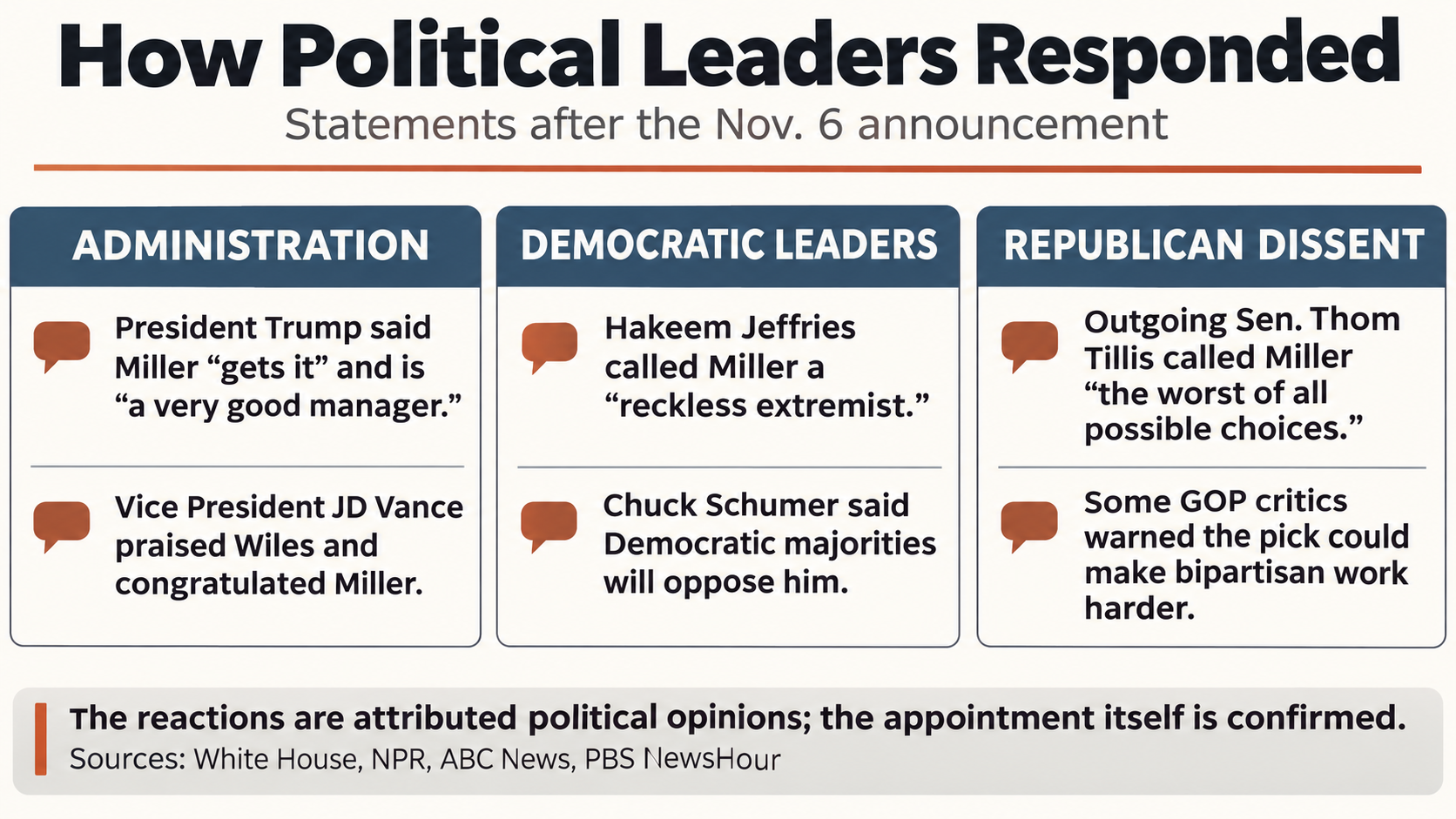
These are attributed political reactions, not findings of fact. Sources: White House, NPR, ABC News and PBS NewsHour.
A mandate with limits
Progressives are likely to emphasize that the 2026 midterms created incoming Democratic majorities in both chambers. That result gives Democrats institutional power to conduct oversight, question officials, set legislative priorities and shape appropriations. It does not give Congress direct control over the president’s personal staff, nor does it erase Trump’s authority as president.
The strongest progressive response therefore rests on checks and evidence rather than rhetoric. Congress can demand records through lawful oversight, examine agency spending and investigate whether enforcement practices comply with statutes and court orders. Courts can review challenged actions. Inspectors general and career officials can document implementation problems. News organizations and civil-society groups can test official claims against public records.
Democratic leaders used unusually harsh language in reacting to Miller’s appointment. Their anger reflects long-running disputes over immigration and executive power, but strong labels do not replace a factual account of what the new chief actually does. Each policy should be evaluated on its text, legal authority, implementation and effects. Treating every move as predetermined would be as misleading as assuming that a personnel promotion has no consequences.
The counterargument for continuity
Trump and Miller’s supporters argue that a president needs a chief who understands his program and can make the government act coherently. Miller has served Trump for roughly a decade and already held senior policy and homeland security roles. That experience may reduce the learning curve, strengthen coordination and clarify responsibility inside the White House. In a period of divided government, supporters may see discipline as necessary rather than dangerous.
Conservatives also argue that voters elected Trump to enforce immigration law and that election losses do not nullify the president’s remaining term. They point to border control, crime and public safety as legitimate policy concerns. Those arguments deserve direct engagement. A lawful government must enforce statutes, and the executive branch is responsible for managing the border and immigration system.
The counterpoint is that enforcement is not exempt from due process, statutory limits, proportionality or judicial review. Political support for border control does not automatically validate every tactic. A disciplined White House should be able to pursue its goals while incorporating legal analysis, agency capacity and evidence about human consequences.
Representation, management and public trust
Wiles’s departure also has a representational dimension: she was the first woman to serve as White House chief of staff. That milestone should not shield any official from evaluation, and the available reports do not establish that gender played a role in her exit. Still, her tenure demonstrated that the post could be held by a woman after decades of male chiefs.
Reports described Wiles as a stabilizing manager who limited leaks and kept staff operations under control. Miller now inherits that benchmark. His success should be judged not only by how forcefully he advances Trump’s preferences but also by whether the White House produces lawful, informed and administratively competent decisions.
Public trust will depend on transparency about those decisions. The White House’s Nov. 6 announcement praised Miller and listed supportive reactions, but it also made broad claims about crime, the border and fraud without providing a neutral evidentiary review. Those assertions should be treated as the administration’s account. Independent data and the underlying agency records remain necessary.
Personnel stability also affects the career staff and agency officials who must translate political direction into workable programs. Clear instructions can reduce confusion, but a culture that treats technical objections as disloyalty can hide foreseeable problems. Progressives will look for whether civil servants, government lawyers and affected communities have a meaningful route to raise evidence before decisions become public commitments.
What progressives should watch
The most telling evidence will come after the personnel story fades: whether senior lawyers and policy experts can present dissenting views; whether immigration directives include clear legal authority and safeguards; whether Congress receives timely information; and whether the administration corrects errors when courts or inspectors identify them.
Miller’s promotion is not proof that any specific future abuse will occur. It is a reason for close scrutiny because the chief of staff can narrow or widen the range of advice the president hears. Incoming Democratic majorities will have tools to test the administration’s claims, but those tools must be used carefully and with respect for the separation of powers.
The left-leaning case is ultimately institutional: a president may choose a loyal aide, while Congress, courts, the press and the public may insist that loyalty never substitute for law, evidence or accountability. Miller’s first days will show whether he treats the chief’s office as a coordinating center for the whole government process or as an engine for one policy faction.

Explore Related Streets
Discover interconnected perspectives across the Knowledge Streets —each Street brings its own lens to the political landscape.

Politics Street
Politics Street covers campaigns, elections, legislation, and the shifting dynamics shaping power in America and beyond.

Government Streets
Policy, budgets, agencies, and oversight across federal, state, and local government—plain-English explainers and timely analysis.

Defense Street
Daily defense posture, procurement, readiness, strategy, and technology—curated updates for leaders and curious citizens.

Left Streets
Progressive politics, policy ideas, movement priorities, and media framing—news and analysis from the left lane.

Right Streets
Conservative politics, policy priorities, movement debates, and media framing—news and analysis from the right lane.

Citizen Streets
How government affects everyday life—services, rights, civic tools, and practical guides to participate with confidence.
More in Politics

Explore our other Politics related sites:
Politics Street
Government Streets
Constitution Street
Defense Street
Left Streets
Right Streets
Citizen Streets
News Street Network

