Senate Takes Up Sweeping Bipartisan Energy Permitting Bill

AI-generated realistic editorial illustration of the U.S. Capitol at dusk with high-voltage transmission infrastructure in the foreground
Approx. 15–18 min read Multi-Perspective Coverage

FULL STORY - THREE VIEWS

Senate Takes Up Sweeping Bipartisan Energy Permitting Bill

The Senate returned to Washington on Nov. 9 with a procedural vote scheduled on a bipartisan package that would rewrite major parts of the federal permitting system for energy, transmission, mining, transportation and other infrastructure. The vote is on whether to begin considering H.R. 2347, a House-passed tax bill being used as the legislative vehicle for a 494-page substitute amendment. It is not a final vote on the permitting package, and even a successful motion to proceed would leave debate, amendments and passage votes ahead.

The proposal is called the Bipartisan American Affordability and Jobs Act of 2026. Republican senators Mike Lee and Shelley Moore Capito developed it with Democratic senators Martin Heinrich and Sheldon Whitehouse, leaders of the committees overseeing energy, public lands and environmental policy. They released an updated substitute on Nov. 7 after negotiations and criticism from lawmakers, businesses, environmental organizations and Tribal leaders.
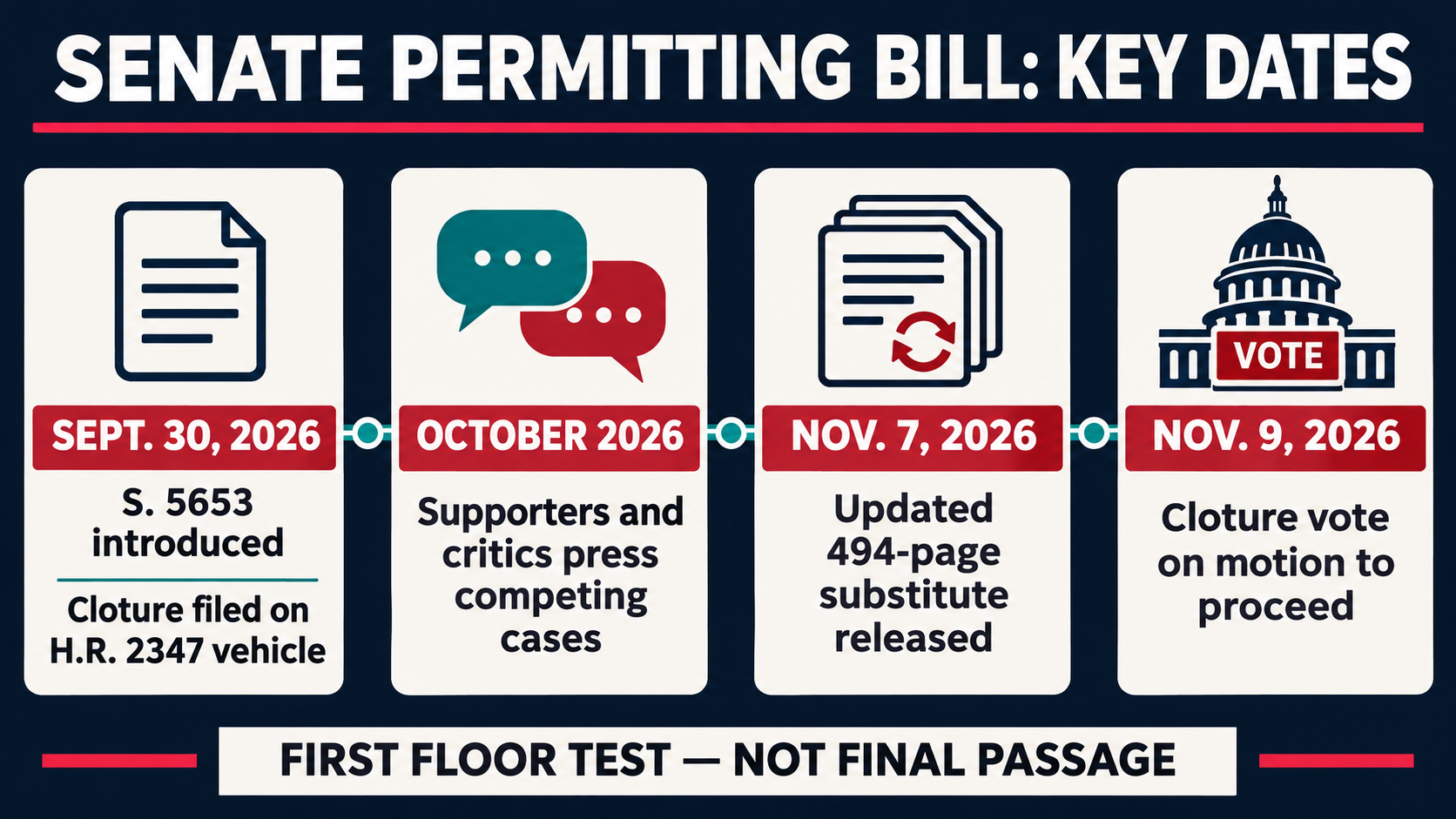
Timeline showing the Sept. 30 introduction, Nov. 7 substitute amendment, Nov. 9 procedural vote and later steps for the Senate permitting bill
The permitting package reached its first floor test after an updated substitute was released two days earlier. Sources: U.S. Senate and committee records.

What senators are voting on

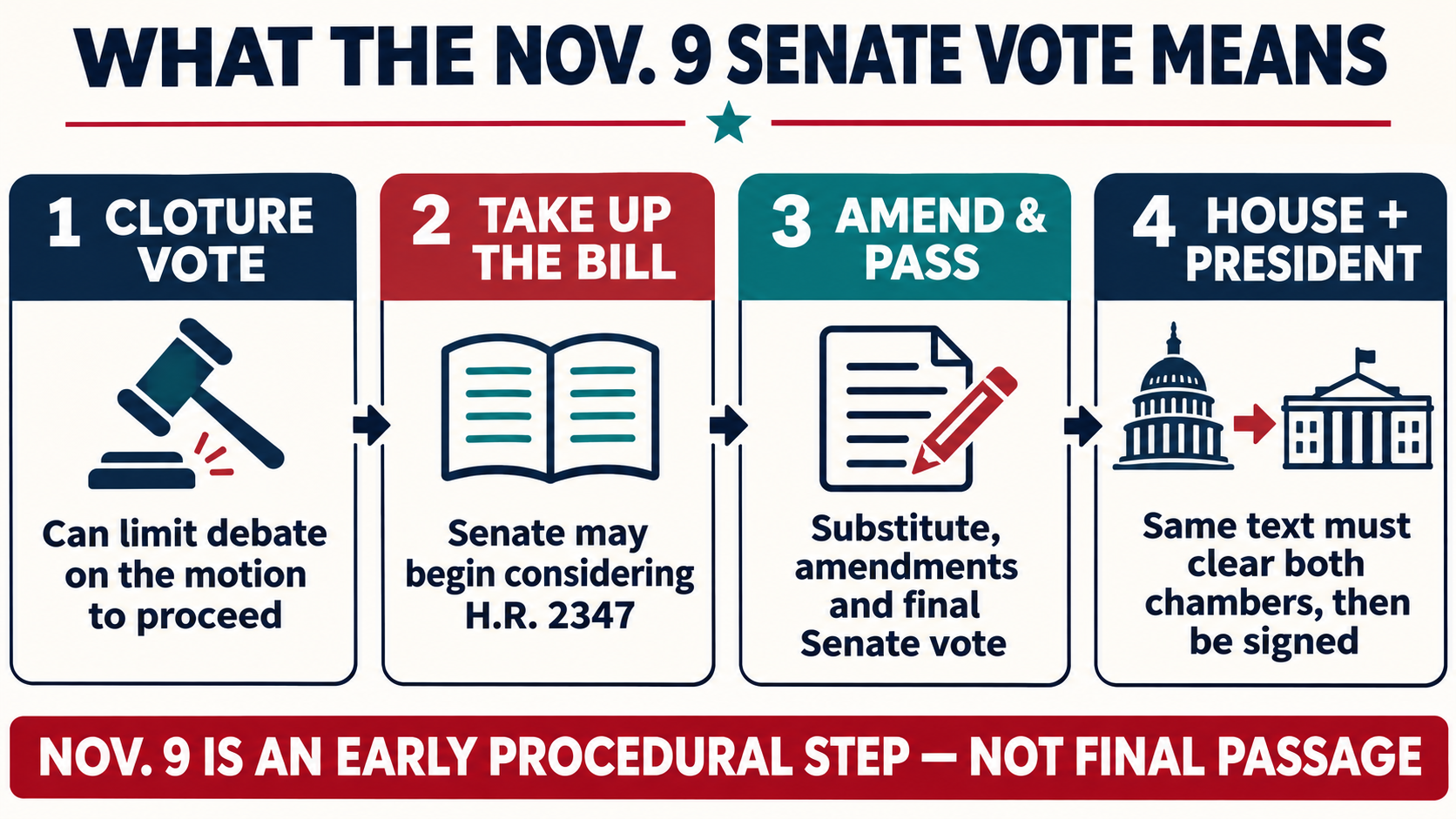
The immediate question is cloture on the motion to proceed. Cloture is the Senate mechanism for limiting debate. If the motion receives the required support, the chamber can move toward formally taking up the bill. The scheduled vote does not approve the substitute amendment, does not send legislation to the House and does not make any of the proposed permitting changes law. The Senate would still have to adopt the text and pass the resulting measure, the House would have to agree to the same legislation, and the president would have to sign it.

H.R. 2347 originally addressed the tax treatment of damages received because of sexual abuse. Senate leaders plan to use a complete substitute amendment containing the permitting package. That technique supplies a vehicle eligible for floor action, but readers should distinguish the calendar number from the policy text senators intend to debate.

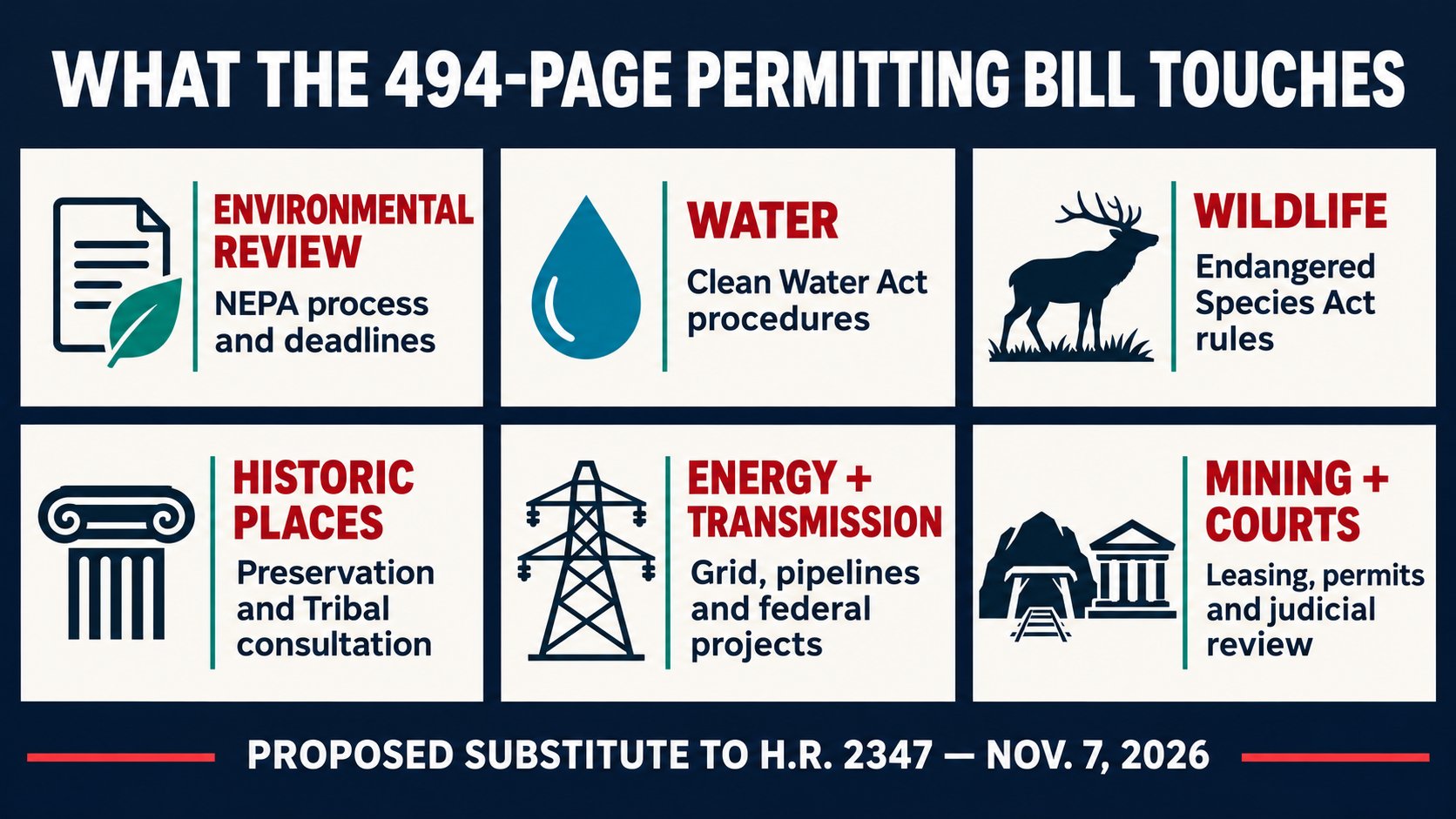
The proposal itself is broad. The updated substitute would revise provisions of the National Environmental Policy Act, the Clean Water Act, the Endangered Species Act and the National Historic Preservation Act. It also contains rules for electric transmission, federal energy leasing, mining, pipelines, hydropower, public lands and project litigation. A new federal tracker would publish information about certain reviews and deadlines. Other sections seek greater certainty for permits and set new procedures or time limits for agency action and judicial review.

The argument for faster approvals

Supporters begin with a problem acknowledged across much of the political spectrum: large projects can take many years to receive federal approvals, while electricity demand is rising and the grid lacks enough transmission capacity to connect new generation. Delays affect renewable energy, nuclear power, natural gas, mines, factories, data centers, roads, water projects and housing-related infrastructure. The bill’s sponsors say a more predictable system could lower financing costs, strengthen energy reliability and create jobs without eliminating federal review.

That coalition includes groups that do not usually support the same projects. Business organizations want shorter timelines for industrial facilities, pipelines, mines and transportation work. Clean-energy advocates need long-distance transmission and faster connections for wind, solar and storage. Labor groups see construction and manufacturing jobs. The U.S. Chamber of Commerce endorsed the package and argued that projects representing about $1.5 trillion in investment are waiting for approvals, though that advocacy estimate is not an official government count.

The four Senate authors also present the package as a negotiated exchange. Republicans secured changes intended to narrow reviews, reduce uncertainty and accelerate conventional energy and resource projects. Democrats secured transmission provisions and funding, staffing or standards meant to help agencies process permits, along with language they say preserves environmental values and improves clean-energy deployment. Whitehouse said the update incorporated feedback from environmental, labor and Tribal organizations. Axios reported that the substitute revised permit-reversal rules and added safeguards involving wildlife and Tribal consultation.

The argument that the package goes too far

Opponents agree that some reviews are too slow but say the legislation responds with permanent changes to foundational laws rather than targeted administrative improvements. Environmental and conservation organizations warn that narrower review, shorter litigation windows and new limits on challenges could reduce the ability of communities to prevent harm before construction begins. They also object to taking up a major 494-page substitute shortly after its release and without the committee hearings and reports normally used to build a public legislative record.

Tribal governments and advocates have raised separate concerns about consultation, sacred sites, cultural resources and treaty interests. A joint opposition letter released by conservation groups on Nov. 9 said transmission reform should not come at the expense of Tribal sovereignty, judicial review or community input. New Mexico reporting described objections from Pueblo leaders who fear faster approvals could affect projects near culturally important land. The sponsors say the manager’s amendment strengthened consultation language, but critics argue the changes remain inadequate.

The political timing is part of the dispute. The vote comes during a lame-duck session after an election that will change control of Congress in January. Supporters say a bipartisan agreement is difficult to assemble and should not be discarded when energy demand and project delays are urgent. Opponents say the next Congress should review the legislation through hearings and allow newly elected lawmakers to shape the policy. That disagreement concerns process as well as substance.

What changed in the substitute

The Nov. 7 substitute is the text the sponsors want the Senate to consider, replacing the version introduced as S. 5653. They described the revisions as clarifying, conforming and technical changes informed by feedback. The amendment includes nearly 500 pages, so broad claims about what it fixes should be treated cautiously. The official text shows what the measure says; later agency rules and court interpretation would shape its effects.

One example is permit certainty. Developers argue that a permit should not be withdrawn after they have invested substantial money unless there are exceptional circumstances, illegality or a court order. Environmental groups worry that rigid protections can make it harder to correct agency mistakes or respond to new information. Another is judicial review: faster deadlines can resolve uncertainty, but they also give communities and Tribes less time to recognize a threat, assemble evidence and file a case. The central tradeoff is not simply review versus no review; it is how much review occurs, who participates and when a decision becomes final.

Transmission illustrates the package’s cross-partisan logic. The United States needs more power lines to serve growing demand and connect generation, but interstate lines often cross multiple jurisdictions and face disagreements about siting and cost allocation. The bill seeks to create clearer routes for federal action and address who pays for certain grid upgrades, including upgrades associated with large data centers. Faster transmission can support both low-carbon power and new fossil-fuel or industrial demand, so the same provision can attract supporters with very different energy goals.

What the vote will tell us

The first test is whether the bipartisan sponsorship can produce enough votes to move beyond the motion to proceed. A favorable vote would show that a working Senate coalition is willing to debate the package, but it would not establish that the coalition can survive amendments or agree on final text. Senators who support beginning debate may still oppose the bill at passage, and senators who dislike parts of the substitute may seek changes on the floor.

A failed cloture vote would leave the introduced S. 5653 and the proposed H.R. 2347 substitute without a clear path in the current session. Negotiators could revise the text, try another procedural route or carry the issue into the new Congress. A successful vote would begin a more consequential phase in which amendment rules, floor time and House support matter. Because the House will have new leadership in January, the calendar can shape the bargaining leverage of every faction.
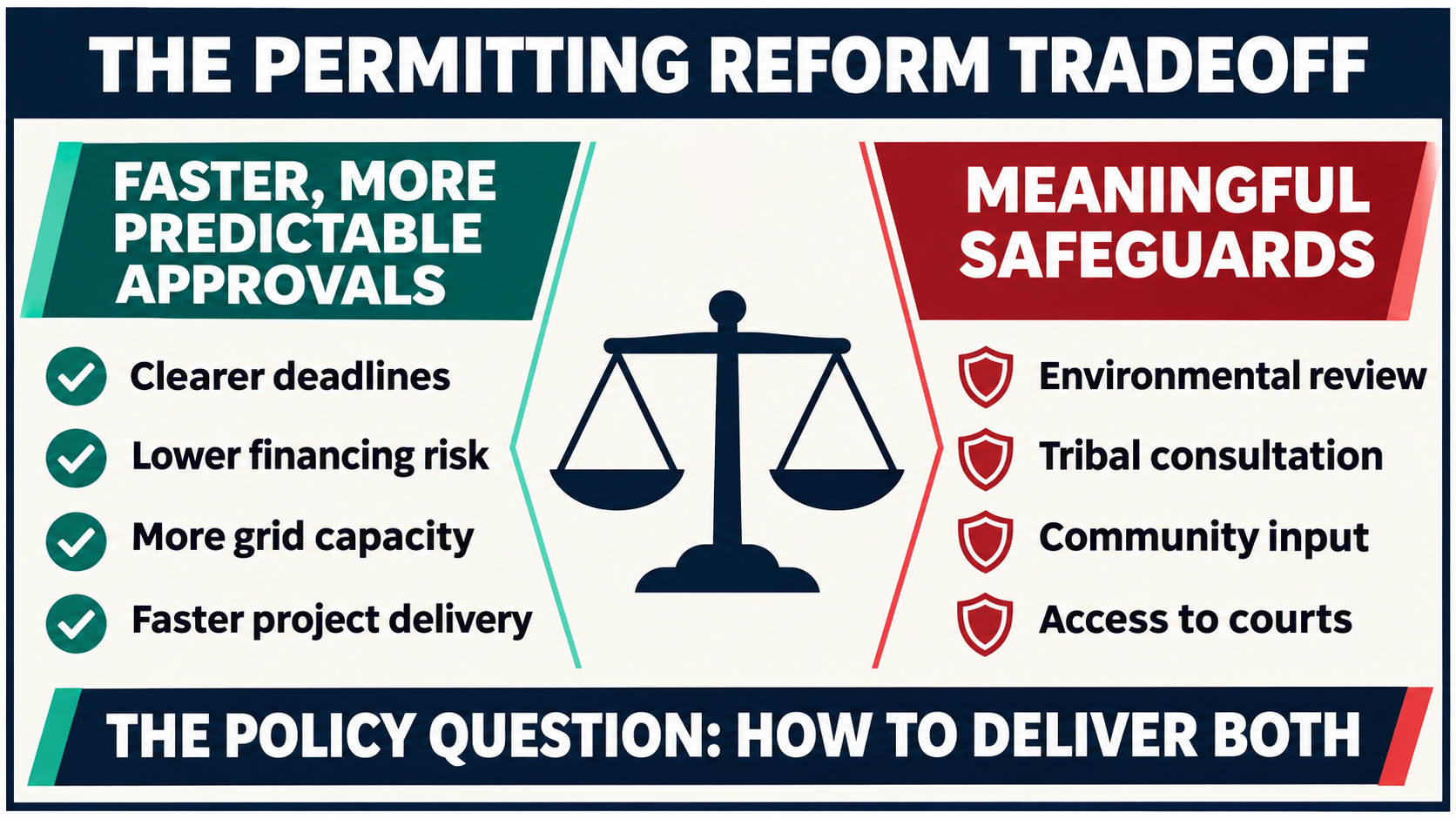
Balanced infographic comparing the goals of faster project approvals with concerns about environmental review, Tribal consultation and court access
The central dispute is how to increase permitting speed while preserving meaningful review, consultation and accountability.

What to watch next

Readers should watch the official Senate roll call, the amendment offered to H.R. 2347 and any changes negotiated before final passage. The most important questions are procedural: whether the motion to proceed succeeds, whether the substitute is adopted, what amendments receive votes and whether the Senate and House approve identical language. Statements describing the Nov. 9 action as final passage would be premature unless the chamber completes those later steps.

Policy details deserve equal attention. Watch for changes to litigation deadlines, permit-reversal standards, Tribal consultation, historic-site review, water certification, wildlife safeguards and transmission cost rules. Agency funding and staffing also matter because statutory deadlines alone cannot eliminate backlogs if offices lack technical capacity. Finally, any enacted legislation would still require regulations, guidance and implementation across multiple departments.

The verified development is therefore significant but limited: the Senate is holding the first procedural test of a bipartisan, 494-page permitting package that could reshape how the federal government approves major infrastructure. The vote can open debate or stall the effort. It cannot by itself enact the bill, approve a particular project or settle the larger national argument over how to build faster without weakening public and environmental protections.
Left View: Build Clean Infrastructure Faster Without Silencing Communities

Progressives have a real reason to want permitting reform. The country cannot decarbonize the electric grid, electrify transportation, build abundant housing or expand public transit on a timetable measured in decades. Wind, solar, storage and geothermal projects often wait for transmission that has not been approved or funded. Environmental-review offices are understaffed. Local veto points can protect vulnerable communities, but they can also allow well-resourced opponents to delay projects whose public benefits are broad and urgent. A credible climate agenda therefore needs a construction agenda.

The Senate’s Bipartisan American Affordability and Jobs Act responds to that need, and its Democratic authors are not wrong to treat the status quo as unacceptable. Martin Heinrich and Sheldon Whitehouse have spent years arguing for clean energy and climate policy. The package includes transmission provisions, agency-process reforms and tools intended to move projects through review with clearer deadlines. Those changes could help connect renewable power, modernize the grid and reduce the financing costs created by years of uncertainty.

But acknowledging the need to build does not require endorsing every bargain labeled permitting reform. The updated substitute is nearly 500 pages and would amend several laws that give the public, Tribal nations and affected communities a voice before federal decisions cause irreversible damage. Senators received the replacement text only two days before the scheduled procedural vote. That is not enough time for lawmakers, sovereign Tribal governments or the public to evaluate how dozens of interlocking provisions will operate. Speed in building infrastructure should not become speed in rewriting democratic safeguards.

The strongest case for reform is also the case for care

The left’s best argument for faster permitting is climate urgency. Long-distance transmission lines are indispensable because the best renewable resources are often far from population centers. Grid interconnection queues are crowded, and electricity demand is rising as manufacturing, data centers and electrification expand. If every project can be delayed indefinitely, fossil-fuel plants stay online longer and clean-energy investment becomes more expensive. Communities also need faster delivery of water systems, public transit, schools, housing and resilience projects.

Yet the benefits and burdens of construction are not evenly distributed. A project that lowers regional electricity costs can still damage a sacred site, divide habitat or expose one neighborhood to pollution. Federal environmental and historic-preservation laws exist partly because agencies and developers repeatedly imposed those costs on people with the least political power. Consultation and public comment are not decorative delays; they are ways to find information, improve a project and force decision-makers to account for harms they might otherwise ignore.

That history makes Tribal objections especially important. Tribal nations are governments with treaty rights and sovereign interests, not one more stakeholder group to be balanced away. Pueblo leaders and conservation organizations say the substitute’s new language does not fully protect consultation or cultural resources. Supporters say the manager’s amendment reflects Tribal feedback, but a last-minute revision is not a substitute for meaningful government-to-government review. Congress should demonstrate exactly how the text protects sacred places and legal obligations before asking senators to lock it into permanent law.

Deadlines need capacity and accountability

Lawmakers often describe permitting delays as a problem created by excessive analysis. In practice, many delays come from too few staff, incomplete applications, conflicting agency missions, weak early coordination and developers changing projects during review. Setting a deadline can focus an agency, but it cannot make a biologist, engineer, archaeologist or Tribal liaison appear. If Congress wants faster decisions, it should provide stable funding for the people who do the work, require better data from applicants and build coordination into the earliest stages.

The Senate package contains funding and tracking provisions that could help. Those elements deserve support and perhaps expansion. A public tracker can show where a review is stuck, which agency is responsible and whether a developer supplied necessary information. Standardized project data and early community engagement can prevent late surprises. Programmatic reviews can address recurring issues once rather than forcing each project to start from zero. These are reforms that increase both speed and quality.

By contrast, shortening the time to sue or limiting judicial remedies can transfer the cost of agency error to the public. Communities may learn of a threat only after a technical decision is buried in a large record. Tribes may need time to identify cultural resources or consult members. Courts are not the first choice for every dispute, but the possibility of review gives agencies an incentive to follow the law. A durable reform should speed decisions while preserving a meaningful path to correct decisions that are unlawful or unsupported.

A broad package creates broad risks

The proposal covers far more than clean energy. It can facilitate transmission and renewable generation, but it can also accelerate fossil-fuel infrastructure, mining and development on public lands. Some supporters accept that mix as the price of a bipartisan deal. Progressives should be honest about the trade: the package is not a climate bill whose benefits are automatically green. Its environmental effect will depend on which projects receive financing, how agencies implement the new rules and whether communities retain the power to prevent the worst harms.

The lame-duck timing compounds the concern. Voters have chosen a different Congress, and the next House will have a new majority. Passing a sweeping rewrite before that Congress convenes may be legally valid, but it reduces the legitimacy that hearings, committee reports and a transparent amendment process can provide. Supporters argue that the window for bipartisan action may close. That may be true, yet political scarcity should not excuse inadequate scrutiny of legislation that alters bedrock law.

The Nov. 9 vote is only on whether to move toward consideration, so senators can vote to open debate without committing to final passage. Still, the motion gives the package momentum and consumes leverage. Democratic senators should use that leverage to demand enforceable Tribal consultation, protection for cultural and environmental justice interests, adequate agency funding, transparent project data and a judicial-review system that is fast but real. If those protections cannot be secured, postponing the package is better than making permanent mistakes.

What a progressive permitting bargain could look like

A stronger approach would distinguish among project types instead of applying the same theory everywhere. Congress could prioritize interstate transmission, grid interconnections, brownfield redevelopment, building electrification and projects with demonstrable climate or community benefits. It could reward developers that use previously disturbed land, negotiate community-benefit agreements and engage Tribes before selecting a route. It could create faster processes for low-conflict projects while retaining fuller review where risks are high or irreversible.

It should also address the demand side of the grid. Data centers and other large loads should pay their fair share of required upgrades rather than shifting costs to households. Transmission planning should account for reliability, affordability and decarbonization across regions. Labor standards and domestic supply chains can ensure that faster construction produces durable jobs. None of those goals requires treating environmental law as the sole cause of delay.

The central progressive principle is simple: abundance and democracy must advance together. America needs to build much more, and the people most affected by that building deserve meaningful power in the process. The Senate package recognizes the first truth but has not yet earned confidence on the second. Opening debate may create a chance to repair the balance. Final support should depend on whether the bill delivers faster clean infrastructure without weakening the rights, lands and voices that public-interest law was designed to protect.

Right View: America Cannot Compete If Every Major Project Takes a Decade

The United States has allowed a reasonable idea—review major projects before approving them—to grow into a system that too often rewards delay, litigation and bureaucratic risk avoidance. The result is visible across the economy. Power lines wait years for permission, mines needed for domestic supply chains remain tied up, factories face uncertain energy costs and communities cannot replace aging roads or water systems on a predictable schedule. A country that cannot build cannot remain prosperous, secure or independent.

The Bipartisan American Affordability and Jobs Act is an overdue attempt to restore a bias toward action. Republican senators Mike Lee and Shelley Moore Capito negotiated the package with Democrats Martin Heinrich and Sheldon Whitehouse, producing a coalition that understands the permitting problem from different angles. Conservatives want reliable energy, domestic mining, stronger infrastructure and limits on administrative overreach. Democrats want more transmission and faster clean-energy deployment. Those interests overlap in a basic national goal: decisions should be timely, rules should be clear and a lawful permit should mean something.

The Nov. 9 cloture vote does not enact the bill. It allows the Senate to move toward debating the legislation, offering amendments and deciding whether the final package deserves passage. Senators should support that step. Rejecting even consideration would preserve a process nearly everyone admits is too slow while telling investors, workers and allies that Washington cannot resolve a problem it has studied for years.

Permitting delay is an affordability problem

Regulation is often discussed as an abstract legal issue, but delay appears in household bills. When a transmission line cannot be built, lower-cost electricity cannot reach customers. When a pipeline or power plant is delayed, reliability margins shrink and utilities pay more for backup capacity. When a mine or processing facility cannot open, manufacturers depend on foreign suppliers. Developers also pay lawyers, consultants and interest during uncertain reviews, then pass those costs on to customers.

The U.S. Chamber of Commerce estimates that about $1.5 trillion in projects is waiting for approvals. That advocacy figure should not be confused with an official federal total, but the underlying economic logic is sound. Uncertainty discourages investment even before an application is filed. Companies will build in places where the timeline is knowable and a completed review produces a durable decision. The United States should not expect to lead in artificial intelligence, advanced manufacturing or energy production while treating essential infrastructure as a permanent courtroom dispute.

Reliability makes the issue more urgent. Data centers, electrification and new factories are increasing electricity demand after years of relatively flat growth. Meeting that demand requires generation of many kinds, additional transmission and faster grid connections. Conservatives should reject a system that picks only politically favored sources. The country needs nuclear, natural gas, coal where economic, hydropower, geothermal, oil infrastructure, renewables and the minerals that support all of them. A broad permitting bill is more realistic than a narrow measure available only to one industry’s preferred technology.

Clear rules protect both development and the environment

Faster review does not have to mean no review. Deadlines, page limits, defined agency roles and transparent trackers can improve decision-making by forcing the government to identify the important questions early. Endless documents do not automatically produce better environmental outcomes. A focused analysis completed on time can be more useful to communities and decision-makers than a sprawling record written mainly to survive litigation.

Permit certainty is equally important. Once an applicant has complied with the rules and received final approval, the government should not casually reverse course after money is spent and workers are hired. Exceptions for illegality, extraordinary circumstances and court orders preserve a route for serious errors. The default, however, should be that the federal government keeps its word. Property rights and the rule of law are undermined when agencies can change the bargain after the fact.

Judicial review also needs boundaries. Lawsuits are sometimes essential, but they should be filed promptly and resolved quickly. A short, clear window reduces the ability of opponents to wait until investment is committed and then use delay as leverage. Courts should determine whether agencies followed the law, not manage projects indefinitely. Congress has the authority to define those procedures and should do so openly rather than leaving policy to shifting agency guidance.

Domestic production is national security

The permitting debate is inseparable from competition with China and other strategic rivals. The United States depends heavily on foreign processing and supply chains for critical minerals used in defense systems, electronics, vehicles and the grid. Environmental standards at overseas mines are often weaker than American standards. Blocking domestic production does not eliminate demand; it exports jobs and environmental impacts while increasing geopolitical vulnerability.

The same principle applies to energy. Abundant domestic energy strengthens manufacturing, protects families from price shocks and gives the country more freedom in foreign policy. Infrastructure that connects producers to consumers is not a special favor to industry. It is a platform for the rest of the economy. The permitting package should be judged by whether it makes lawful projects more predictable while preserving specific safeguards, not by whether every project pleases every advocacy group.

Tribal sovereignty, historic resources and private property deserve serious protection. The updated substitute reportedly adds safeguards and reflects consultations conducted after the initial bill was introduced. Senators should examine those provisions closely and correct genuine defects through amendments. But consultation cannot become an unlimited veto exercised after years of process, and cultural review should focus on identifiable effects rather than expand without geographic or temporal limits. Respect for sovereign interests and a functioning approval system are compatible if Congress writes clear standards.

Conservatives should still scrutinize the details

Bipartisan legislation is not automatically good legislation. The 494-page substitute may contain spending, federal authority or transmission rules that conservatives should challenge. Cost allocation matters: households in one region should not be forced to subsidize speculative projects elsewhere without measurable reliability benefits. New offices and funds should have defined purposes, reporting requirements and expiration dates. Agencies should not use implementation language to expand their jurisdiction beyond the statute.

The use of H.R. 2347 as a vehicle also requires transparency. The House bill began as a narrow tax measure, while the Senate substitute would replace it with a sweeping permitting framework. That procedure is allowed, but lawmakers owe the public a clear account of what text is being voted on. Senators should insist that the final amendment be available, readable and scored where spending is involved. A vote to proceed should lead to real debate, not a closed process in which leaders protect the package from all changes.

Conservatives should also guard against a deal that speeds transmission favored by federal planners while leaving pipelines, mining or conventional generation trapped. Technology-neutral reform is essential. If Congress simplifies review, the rules should apply consistently to projects that meet objective standards. The government should protect health, property and natural resources, then let markets and states determine which lawful investments succeed.

The choice is reform or continued decline

No single bill will fix every cause of delay. Agencies need competent staff, applicants need complete engineering data and states need incentives to coordinate. But Congress must set the legal framework. The Senate package offers a rare chance to replace uncertainty with deadlines, fragmented authority with coordination and revocable permission with durable decisions.

The first vote is procedural, and senators remain free to demand improvements. They should use the amendment process to protect taxpayers, narrow federal power and ensure equal treatment across energy sources. What they should not do is allow objections to individual provisions to become an excuse for permanent paralysis. The existing system is not neutral; it favors projects that already exist, foreign suppliers that face fewer constraints and wealthy opponents who can finance years of litigation.

America’s advantages have always included energy, land, capital, skilled labor and an ability to build at continental scale. Permitting dysfunction wastes those advantages. Advancing the bill would not settle every argument, but it would acknowledge that timely decisions are a national necessity. Conservatives should support opening debate and work to make the final text a durable charter for growth, reliability and accountable government.

Impact and Implications

  • Energy reliability — Faster transmission and generation approvals could help meet rising electricity demand.
  • Project finance — More predictable schedules could reduce financing risk and attract investment.
  • Communities and Tribes — Shorter processes could reduce the time available to identify local, cultural or environmental harm.
  • Federal agencies — New deadlines, trackers and procedures would require staffing, rules and cross-agency coordination.
  • Congress — A bipartisan Senate coalition must still navigate amendments, House control and the lame-duck calendar.

Fact Check

  • Claim: The Senate is voting to enact the permitting bill on Nov. 9. Evidence: The scheduled vote is cloture on the motion to proceed, not final passage.
  • Claim: H.R. 2347 was originally a permitting bill. Evidence: The House bill addressed tax treatment of certain damages and is being used as the legislative vehicle.
  • Claim: The package concerns only renewable energy. Evidence: It reaches transmission, conventional and clean energy, mining, pipelines, public lands and other infrastructure.
  • Claim: The substitute has already become law. Evidence: It still requires Senate passage, House agreement and presidential approval.

Editors Insight

  • Procedure versus passage — A vote to open debate is important evidence of support, but it is not approval of final policy.
  • Speed versus participation — Shorter timelines can reduce costs while also limiting how long communities have to identify harm.
  • Text versus effect — A 494-page statute would still depend on agency rules, funding, implementation and court interpretation.
  • Broad coalition, broad bargain — The same package can accelerate clean energy, fossil infrastructure, mining and industrial development.

Sources

QUOTE OF THE DAY

Julia Gillard, 2012
“I will not be lectured about sexism and misogyny by this man.”
Read More

Explore All Quotes in Politics

THIS DAY IN POLITICS

November 17
1989: Velvet Revolution Begins
Read More

Explore All Days in Politics

EXPLAINER OF THE DAY

Regulatory Takings
Regulatory Takings explained: how it works, where its authority comes from, and the key limits and debates shaping U.S. government.
Read More

Explore All Explainers in Politics

News Street Network logo

Explore Related Streets

Discover interconnected perspectives across the Knowledge Streets —each Street brings its own lens to the political landscape.

Politics Street preview

Politics Street

Politics Street covers campaigns, elections, legislation, and the shifting dynamics shaping power in America and beyond.

Government Streets preview

Government Streets

Policy, budgets, agencies, and oversight across federal, state, and local government—plain-English explainers and timely analysis.

Defense Street preview

Defense Street

Daily defense posture, procurement, readiness, strategy, and technology—curated updates for leaders and curious citizens.

Left Streets preview

Left Streets

Progressive politics, policy ideas, movement priorities, and media framing—news and analysis from the left lane.

Right Streets preview

Right Streets

Conservative politics, policy priorities, movement debates, and media framing—news and analysis from the right lane.

Citizen Streets preview

Citizen Streets

How government affects everyday life—services, rights, civic tools, and practical guides to participate with confidence.

The Senate is holding its first procedural test of a bipartisan package that would overhaul federal permitting for power lines, energy projects, mining and other infrastructure. The Nov. 9 vote can move the chamber toward debate, but it is not final passage. Supporters promise faster, more predictable approvals; opponents warn that the 494-page substitute could weaken environmental review, Tribal consultation and access to courts.

Featured image: AI-generated editorial illustration; not a photograph of the Senate vote or a particular infrastructure project.
Simple explainer: Senators are deciding whether to begin debating a large rewrite of the rules for federal project approvals. The proposal could speed power lines, data centers, mines, pipelines, roads and clean-energy projects by setting clearer processes and limiting some delays. It would also change laws that protect water, wildlife, historic places and public participation. A yes vote on Nov. 9 would only advance the Senate process. Senators would still have to adopt the permitting text and pass the bill; the House would then need to approve the same version before it could reach the president.

Key Takeaways

  • The Senate scheduled a Nov. 9 cloture vote on the motion to proceed to H.R. 2347.
  • H.R. 2347 is the vehicle for a 494-page substitute containing the bipartisan permitting package.
  • The vote can open the path to debate but does not enact or finally pass the proposal.
  • The package touches environmental review, water, wildlife, historic preservation, transmission, mining and energy development.
  • Republican and Democratic committee leaders released an updated substitute on Nov. 7.
  • Supporters cite affordability, reliability, investment and jobs; opponents cite community, Tribal and environmental protections.
  • Amendments, final Senate passage, House agreement and presidential action would still be required.

Quick Facts & Numbers

  • 494 pages — Updated substitute amendment
  • 4 senators — Bipartisan negotiating group
  • Sept. 30 — Original S. 5653 introduced
  • Nov. 7 — Updated substitute released
  • Nov. 9 — First scheduled floor test
  • H.R. 2347 — Legislative vehicle on the Senate calendar

Timeline — How We Got Here

  • Sept. 30, 2026 — Capito, Lee, Whitehouse and Heinrich introduce S. 5653
  • Sept. 30, 2026 — Senate leaders file cloture on the motion to proceed to H.R. 2347
  • Oct. 2026 — Business, labor, environmental and Tribal groups press competing views
  • Nov. 7, 2026 — Negotiators release a 494-page substitute amendment
  • Nov. 9, 2026 — Senate schedules a cloture vote on beginning consideration

Reactions & Buzz

  • Four Senate negotiators — Say the package can lower costs, strengthen reliability and accelerate construction
  • U.S. Chamber of Commerce — Supports the bill as a way to unlock investment and improve competitiveness
  • Environmental groups — Warn that broad changes could weaken review, wildlife protections and public participation
  • Tribal leaders and advocates — Say consultation and protection of sacred and cultural sites remain insufficient
  • Congressional critics — Question moving a sweeping bill in a lame-duck session shortly after releasing the update

Frequently Asked Questions

  • Is the Nov. 9 vote final passage? No. It is cloture on the motion to proceed, an early procedural step toward debate.
  • Why is the bill numbered H.R. 2347? Senate leaders are using a House-passed tax bill as the vehicle for a complete permitting substitute.
  • What projects could be affected? The text reaches transmission, energy, mining, pipelines, hydropower, transportation and other federally reviewed infrastructure.
  • Does the bill eliminate environmental review? No, but it would change the scope, timing and litigation rules governing several major laws.
  • What happens after a successful vote? The Senate would still need to consider the text, amendments and final passage before House action.

Did You Know?

  • A motion to proceed determines whether the Senate will take up a measure; it does not decide the measure's final fate.
  • A substitute amendment can replace nearly all of a bill's existing text while retaining the bill number.
  • Faster transmission permitting can benefit renewable power, conventional generation and large new electricity users.
  • Federal review delays can reflect agency staffing, incomplete applications and interagency conflict as well as statutory requirements.