

“Profit arises out of the inherent, absolute unpredictability of things.”
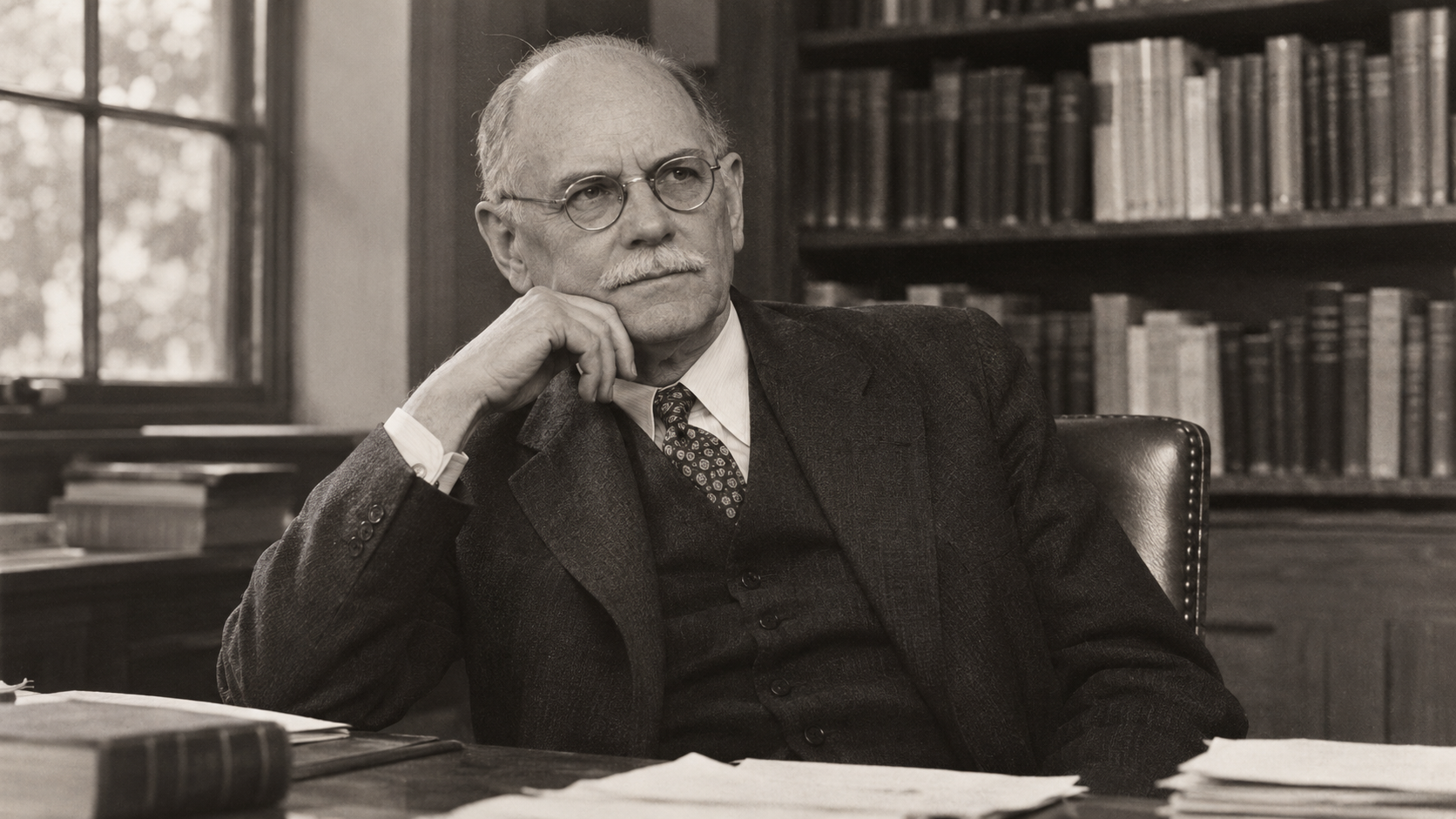
Frank H. Knight wrote this sentence in Risk, Uncertainty, and Profit, published in 1921. The book grew out of his doctoral research and became a foundation for the modern study of entrepreneurship, corporate decision-making, and the difference between calculable risk and true uncertainty. It appears near the end of his analysis of the entrepreneur’s responsibility for decisions whose outcomes cannot be calculated in advance. Knight was asking a precise economic question: if competition tends to push prices toward costs, why can profit persist? His answer was that some business choices take place under conditions too singular and changeable to be reduced to dependable odds. The residual gain—or loss—belongs to whoever accepts responsibility for judgment when contracts cannot settle the result beforehand.
Knight’s crucial distinction is between risk and uncertainty. Risk describes situations in which probabilities can be estimated from repeated events, making losses easier to price, pool, or insure. Uncertainty is different: the relevant future may have no stable pattern, no adequate sample, and no reliable probability distribution. Once a task becomes predictable and a person’s contribution can be valued routinely, Knight argued, its return begins to look more like a wage, rent, or interest than pure profit. His quote therefore does not say that all danger is profitable. It says that profit is tied to decisions where prediction itself has hard limits.
There is an important caution inside Knight’s argument. In any single case, he observed, it may be impossible to separate superior judgment from good luck. A founder can be right for the wrong reason, while a carefully reasoned decision can still fail. Repeated evidence may eventually reveal skill, but genuine uncertainty prevents certainty at the moment of choice. Leaders should not use the quote to glorify reckless bets, ignore data, or treat instinct as proof. The point is to recognize where available evidence ends, make assumptions visible, and accept accountability for what follows.
That lesson remains useful in markets shaped by artificial intelligence, supply-chain shocks, new regulation, changing consumer behavior, and technologies without long operating histories. Forecasts and metrics are valuable for repeatable problems, but they can create false confidence when the environment is genuinely new. Strong operators answer uncertainty with scenario planning, small reversible experiments, resilient balance sheets, diverse perspectives, and clear signals for changing course. Knight’s line reminds businesses that opportunity often exists where the future is not fully priced—but durable advantage comes from meeting that uncertainty with disciplined judgment, not bravado.
Knight published the line on page 311 of his 1921 book Risk, Uncertainty, and Profit, in a discussion of decisions that cannot be insured, capitalized, or salaried.
He was explaining why profit can remain after competitive markets have priced routine labor, capital, and measurable risk.
For Knight, risk can be estimated from repeated events, while true uncertainty has no dependable probability distribution.
The quote is not a license for reckless bets: in a single case, superior judgment may be impossible to separate from good luck.
New technologies, regulatory shifts, supply disruptions, and changing customer behavior repeatedly confront companies with futures that historical data cannot fully price.
Scenario planning, reversible experiments, financial resilience, and explicit assumptions help leaders meet uncertainty with discipline rather than false precision.
Explore more "Quotes of The Day"
Discover more notable quotes from influential voices across politics, science, business, technology, sports, and culture. Each quote offers insight into how ideas, beliefs, and decisions shape the world around us.