

On This Day in Tech: September 13, 1956
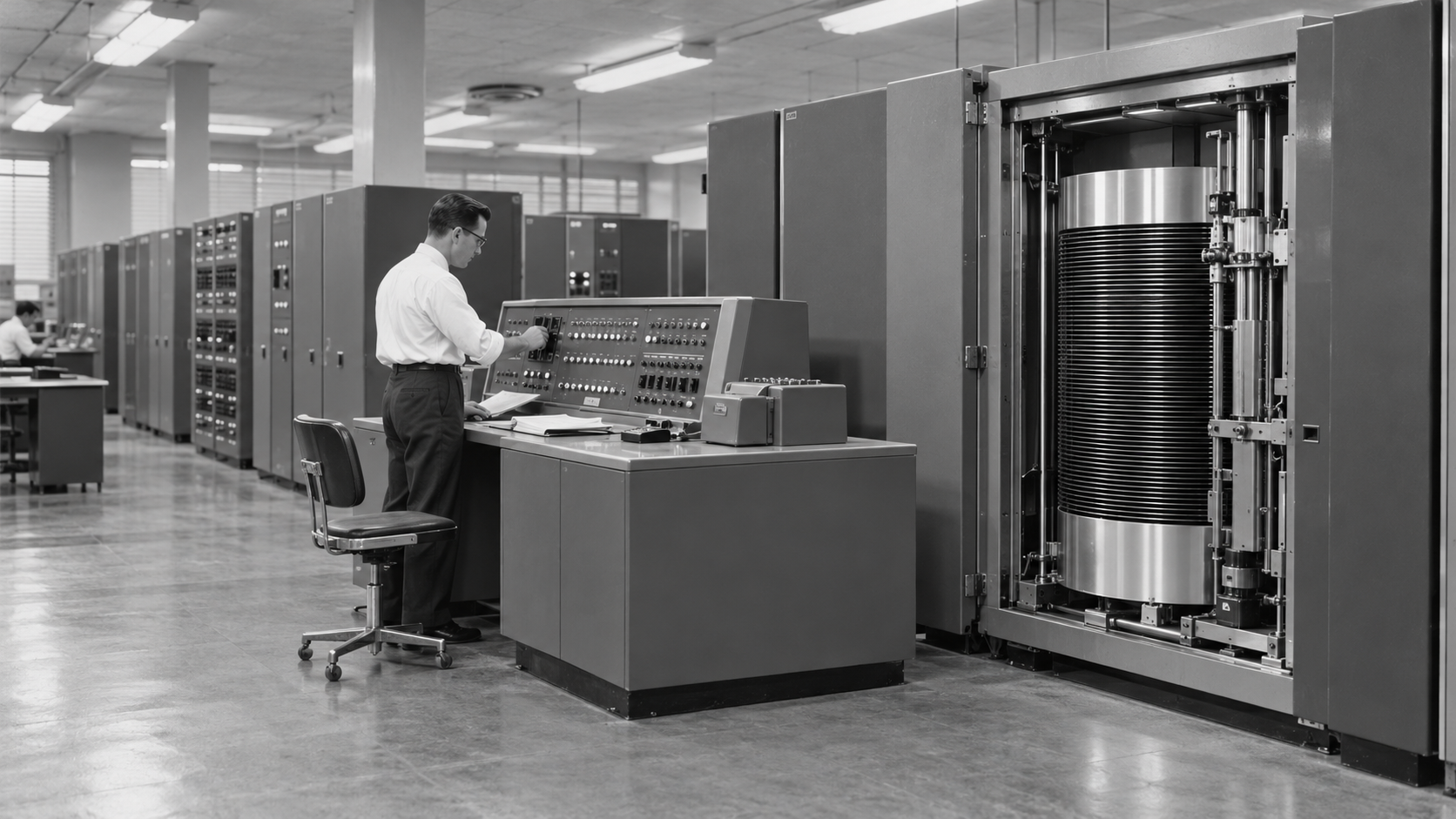
On September 13, 1956, IBM introduced the 305 RAMAC, a business computer whose 350 Disk Storage Unit brought random-access magnetic-disk storage into commercial computing. Before systems like RAMAC, organizations commonly worked through punched cards or sequential media. Finding one record could require moving through many records first; RAMAC made direct retrieval possible.
The disk unit used a stack of large rotating platters and a mechanically controlled arm. It stored about five million characters—roughly five megabytes by modern shorthand—inside equipment about the size of two refrigerators. That capacity now seems tiny, but the ability to retrieve and update business information in seconds was the breakthrough.
RAMAC changed how organizations could imagine inventory, reservations, accounting, and other data-heavy work. IBM says early customers included United Airlines, Pfizer, 3M, and New York University. The machine also demonstrated a durable principle: faster access to information can create entirely new workflows, not merely accelerate old ones.
Modern solid-state drives look nothing like RAMAC, yet they inherit its central promise—stored information that can be reached directly and quickly. The 1956 introduction therefore marks an important step toward databases, online transactions, cloud services, and the expectation that digital records should be available almost instantly.
IBM engineers in San Jose pursued a practical alternative to punched-card and sequential storage. The result combined the 305 processing system with the 350 Disk Storage Unit.
IBM describes RAMAC as the first computer to use a random-access disk drive. Its name was associated with “Random Access Method of Accounting and Control.”
Direct access reduced the time needed to locate and alter records from hours or days to seconds. Businesses could begin treating stored data as an active operational resource.
The machine was large, expensive, and limited by today’s standards. Its importance came from the new access model, not from raw capacity.
Magnetic disks became a foundation of enterprise and personal computing, while later technologies sharply improved density, speed, reliability, and cost.
Source: IBM history of RAMAC. The system’s legacy is visible wherever software expects direct, rapid access to stored records.
Explore more of "On This Day ..."
Discover more events from the same date across news, politics, technology, sports, and other fields. Each link highlights significant moments that shaped history on different fronts.